
Article by
Jonathan Bonnett
Australian Air Conditioning Specialist with extensive hands-on experience in AC servicing, deep cleaning, maintenance, and troubleshooting. Focused on high-quality workmanship, reliability, and professional service to UAE standards.
What if that sharp, medicinal odor coming from your vents isn’t just a nuisance, but a diagnostic signal of a critical mechanical failure? Most property owners face the same frustration: cleaning companies that spray floral perfumes to mask a problem that feels increasingly toxic. If you’re concerned about refrigerant leaks or the health risks of VOC exposure, you need a solution based on science, not scents. Effective AC chemical smell removal requires a forensic approach to identify the exact source of the contaminant.
We understand the anxiety that comes with inhaling unknown gases in your own space. This guide provides the clinical protocols necessary to diagnose the root cause and achieve permanent remediation. You’ll learn about the 2026 transition to low-GWP refrigerants like R-454B, the mechanics of VOC accumulation, and the specific on-site inspection steps required for a definitive resolution. We’re replacing mystery with technical certainty to restore your indoor air quality once and for all.
Key Takeaways
- Identify the specific scent profile. Sweet or chloroform-like odors often indicate mechanical failures like refrigerant leaks rather than biological growth.
- Understand the “chemical sponge” effect. Porous internal insulation traps Volatile Organic Compounds (VOCs), requiring deep clinical extraction rather than superficial wiping.
- Differentiate between masking and remediation. Avoid temporary fixes like fragrances or ozone generators that fail to address the technical root cause of the odor.
- Implement a professional diagnostic protocol for permanent AC chemical smell removal. A multi-stage on-site inspection is necessary to distinguish between environmental pollutants and mechanical leaks.
- Apply German-style cleaning standards for clinical air quality. Precise, source-focused treatment phases ensure the total elimination of synthetic contaminants from your ventilation system.
Identifying the Chemical Profile: What Your AC is Telling You
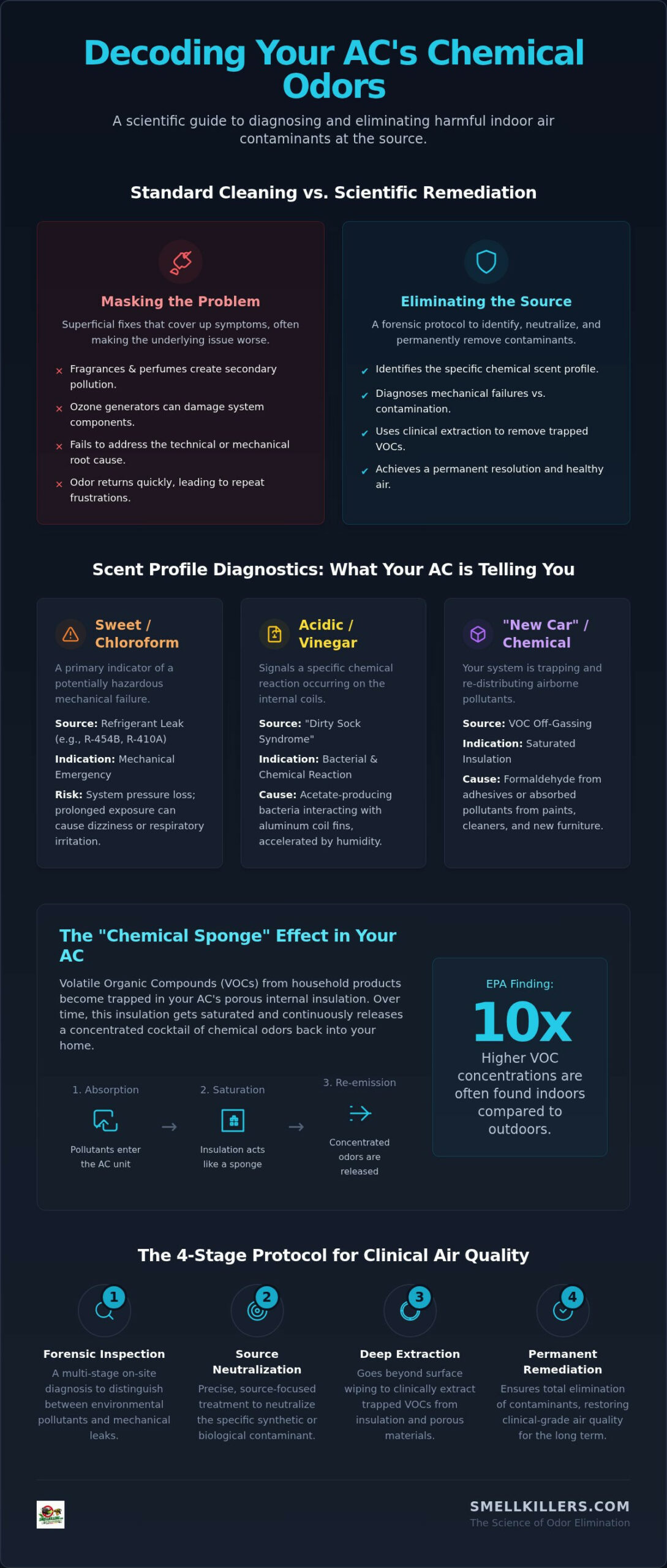
Effective AC chemical smell removal begins with a precise sensory diagnosis. Biological odors, usually described as musty or earthy, indicate mold or fungal growth. Chemical odors are different. They are synthetic, sharp, or cloying. These signals point to mechanical failures or the accumulation of Volatile Organic Compounds (VOCs). Property owners often mistake these technical warnings for simple dirt. They are actually chemical reactions occurring within your ventilation infrastructure.
The ‘Sweet’ Warning: Refrigerant and Freon Leaks
A sweet, chloroform-like scent is the primary indicator of a refrigerant leak. As of January 1, 2026, new residential systems are prohibited from using high-Global Warming Potential refrigerants like R-410A. If you have a newer unit, it likely uses R-454B or R-32. While these are more efficient, a leak still produces a distinct chemical profile that smells oddly sugary. This is a mechanical emergency. Escaping coolant gases create a state of pressure loss that cleaning cannot resolve. Prolonged exposure can lead to dizziness or respiratory irritation.
Acidic and Vinegar Odours: Coil Contamination
Sharp, vinegar-like notes signal a specific chemical interaction on your evaporator coils. This occurs when acetate-producing bacteria interact with the aluminum fins, a condition often called Dirty Sock Syndrome. High humidity levels in the unit accelerate this oxidation. Standard rinsing fails to neutralize these acidic compounds. You need a clinical intervention to break the bond between the bacteria and the metal surface. Without neutralizing the pH of the coil environment, the odor will return within days of a standard cleaning. For property owners dealing with recurring biological contamination alongside chemical odours, understanding the full scope of ac coil cleaning protocols for eliminating biological odours is essential to achieving a permanent resolution.
If your vents emit a “new car” smell, your system is likely distributing formaldehyde off-gassing from adhesives or porous internal insulation. The EPA reports that indoor VOC concentrations are often ten times higher than outdoor levels. Your AC’s internal insulation can act as a chemical sponge, absorbing household pollutants and recirculating them throughout the property. Identifying these specific profiles allows for a targeted treatment plan rather than a superficial fix. Permanent AC chemical smell removal requires addressing the specific synthetic source identified during the initial diagnostic phase.
The Science of AC Chemical Contamination and VOCs
Volatile Organic Compounds (VOCs) are human-made chemicals used in the manufacture of paints, pharmaceuticals, and refrigerants. These substances possess high vapor pressure at room temperature, causing them to off-gas into the air you breathe. According to the EPA on VOCs and Indoor Air Quality, concentrations of these pollutants are often up to ten times higher indoors than outdoors. This is a critical factor for property owners because people spend approximately 90% of their time indoors. In the extreme UAE climate, high thermal loads and stagnant air cycles accelerate the saturation of HVAC components with synthetic molecules, creating a permanent reservoir for chemical discharge.
Your AC unit contains porous internal insulation designed for thermal regulation and sound dampening. Over time, this material acts as a “chemical sponge.” It absorbs airborne pollutants from household cleaning products, new furniture, and floor finishes. Once saturated, the insulation begins to re-emit these concentrated smells back into the living space. This cycle makes standard AC chemical smell removal attempts ineffective if they only address the surface level of the unit. Property owners seeking effective AC cleaning for odour removal in the UAE must understand that superficial chemical flushes cannot break this cycle of re-contamination.
Secondary Contamination from Cheap Cleaning Agents
A common cause of persistent odors is the residue left behind by standard maintenance companies. Many services utilize high-pH chemical cleaners that are aggressive but difficult to rinse away completely. These caustic residues adhere to the evaporator coils and drainage trays. When the system operates, the heat from the motor and the chemical reactions on the coil surface produce new, synthetic odors. This phenomenon is a primary reason why a “clean” AC can still smell like a laboratory. Understanding these Aircon Chemical Cleaning Side Effects is essential for anyone seeking a long-term resolution. For a precise analysis of your property’s air profile, consider an on-site inspection to map the exact origin of these contaminants.
Building Materials and Off-Gassing
Modern building designs prioritize airtight seals to maximize energy efficiency. While this reduces cooling costs, it traps synthetic molecules inside the structure. Fire-retardant coatings on ductwork and specialized sealants used during installation are frequent sources of off-gassing. These materials release chemicals like formaldehyde or organophosphates into the ventilation stream. The AC system then recirculates and concentrates these molecules. Identifying the difference between a mechanical leak and building material off-gassing requires specialized diagnostic equipment. Standard cleaning cannot remove odors embedded in the structural sealants of your ductwork; it requires a forensic approach to source neutralization.
- Fire-retardant coatings: Release sharp, acrid scents when exposed to high temperatures.
- Duct sealants: Produce “new building” smells that persist for years in poorly ventilated spaces.
- Airtight designs: Prevent the natural dilution of VOCs, leading to toxic accumulation.
Why Standard Cleaning Fails to Remove Chemical Odours
Standard maintenance companies often rely on a “spray and pray” methodology. They focus on visible dust and debris while ignoring the molecular film that binds chemical odours to internal components. This superficial approach fails because synthetic contaminants, such as refrigerant oils or VOCs, adhere to the deep recesses of the evaporator coils. Most technicians only treat the front-facing surfaces. The back of the coil remains a primary reservoir for pollutants, allowing the smell to return as soon as the system reaches its operating temperature. Effective AC chemical smell removal requires a transition from basic cleaning to clinical remediation.
Ignoring these deeper contaminants doesn’t just result in bad smells. It can lead to significant physiological symptoms for occupants. Understanding the Dirty AC Health Risks is vital for property owners who prioritize safety. When a system isn’t properly decontaminated, it continues to circulate irritants that can bypass standard filtration. Achieving clinical air quality requires adhering to rigorous industry benchmarks, such as ASHRAE Standard 62.1, which defines the ventilation requirements for acceptable indoor air quality.
The Danger of Masking Agents
Many cleaning services use heavy perfumes or ozone generators to hide persistent odours. This is the “Masking Myth.” Fragrances don’t remove chemicals; they simply add more synthetic molecules to the air. These perfumes can interact with existing pollutants to create complex secondary irritants. A clinically clean AC system should have zero scent. If your technician leaves behind a “fresh” floral smell, they’ve likely introduced new VOCs into your environment. We prioritize the total extraction of odours rather than temporary camouflage.
German-Style Precision vs. Superficial Rinsing
Our German-style cleaning standard prioritizes thoroughness over speed. Standard rinsing often uses high-pressure water that can damage delicate aluminum fins without actually removing chemical residues. We utilize specialized, pH-neutral agents designed to break the molecular bond between the contaminant and the metal surface. This process ensures the integrity of your coils while achieving a level of hygiene that superficial services cannot match.
- Diagnostic Accuracy: We identify the specific chemical note before choosing a treatment agent.
- Full Component Access: We treat the entire depth of the coil, including the inaccessible “back” sections.
- Non-Toxic Protocols: We avoid caustic cleaners that contribute to secondary off-gassing.
- Permanent Resolution: Our goal is the complete removal of the odour source, not a recurring monthly service.
This methodical approach eliminates the bio-chemical film that standard maintenance leaves behind. By focusing on the source rather than the symptom, we provide a definitive solution for chemical sensitivity in indoor environments. For a comprehensive breakdown of why most local services fall short, our technical guide to AC cleaning for odour removal in the UAE explains the specific bacterial strains and mechanical failures that standard maintenance routinely ignores.
The Diagnostic Protocol for Persistent AC Smells
Methodical detection is the cornerstone of AC chemical smell removal. We don’t guess. We follow a strict four-step diagnostic protocol to isolate the synthetic source. First, we conduct on-site odour mapping. This SMELLKILLERS approach identifies the concentration gradients of the scent throughout the property. Second, we perform a differential diagnosis. We distinguish between mechanical failures, such as a refrigerant leak, and environmental pollutants. Third, our technicians inspect the condensate system and internal insulation. We look for chemical absorption in porous materials that act as secondary reservoirs. Fourth, we execute airflow and pressure testing. This identifies if the AC is pulling gases from the drain system through a dry p-trap or faulty seal. An exhaustive on-site inspection remains the only technically sound method to guarantee a permanent resolution.
Tracking the Origin: Beyond the Vent
Finding the origin requires looking beyond the visible unit. We use specialized technology to detect inaudible gas leaks and hidden chemical sources that standard tools miss. Our team inspects the plenum and duct transitions where chemical residues often accumulate. This forensic level of detail is covered in our Property Odour Assessment. By examining the entire ventilation path, we ensure no hidden pocket of contamination is ignored. We focus on the infrastructure, not just the appliance.
Environmental Assessment
The smell might not originate within the AC unit itself. We evaluate external air intakes for industrial exhaust, traffic pollutants, or nearby construction chemicals. Modern buildings often suffer from “negative pressure.” This physical state can pull chemical odours from wall cavities or plumbing vents directly into the AC airstream. If your unit is incorrectly connected to the property drainage, it may act as a vacuum for sewage or chemical gases. We verify the integrity of every connection to prevent this cross-contamination.
- External Intakes: Check for proximity to industrial vents or waste areas.
- Negative Pressure: Identify if the building is “sucking” air from contaminated cavities.
- Drainage Integrity: Ensure p-traps are functional and preventing gas backflow.
- Sealant Degradation: Inspect for old adhesives off-gassing within the ductwork.
Identifying these variables is essential for a definitive diagnosis. Without this technical overview, any cleaning attempt is merely a temporary fix. To secure your property’s air quality and find the root cause, book a professional on-site inspection today.
Professional Remediation: Restoring Clinical Air Quality
Transitioning from diagnosis to treatment requires a disciplined, multi-stage protocol. We don’t simply clean; we decontaminate. Our AC chemical smell removal process begins by isolating the identified source and applying targeted neutralizers that break down synthetic molecules at the molecular level. This is followed by a clinical extraction phase where contaminants are physically removed from the system infrastructure. We prioritize the restoration of a “zero-scent” baseline. A successful intervention ensures that the air exiting your vents is indistinguishable from fresh, outdoor air, free from both the original pollutant and any secondary cleaning residues.
German-style precision is our gold standard for chemical sensitivity. Standard maintenance often leaves behind a bio-chemical film that continues to off-gas. We utilize specialized, non-toxic agents that are pH-neutral and environmentally responsible. These protocols are designed specifically for property owners who cannot tolerate the harsh solvents used by conventional services. By focusing on deep-tissue decontamination of the HVAC system, we provide a long-term resolution that protects your indoor air quality and your health.
Targeted Treatment Protocols
Neutralizing acidic coil odours is a delicate technical task. We use precision application tools to treat every fin without compromising the structural integrity of the aluminum. If the internal insulation has been identified as a “chemical sponge” during our diagnostic phase, we execute a surgical removal and replacement of the contaminated material. This prevents the recurring discharge of trapped VOCs. For a deeper look at our technical methodology, read our Aircon Odour Elimination guide. We ensure every component, from the blower fan to the plenum, meets our clinical standards before the system is reactivated. When biological contamination is also present alongside chemical odours, our technical guide to ac coil cleaning and biological odour elimination outlines the precise multi-stage decontamination steps required to restore verifiable indoor air hygiene.
Next Steps: Booking Your On-Site Inspection
Immediate action is necessary when you detect a chemical scent. These odours often signal escaping refrigerant or the accumulation of toxic VOCs that can impact respiratory health. Our SMELLKILLERS guarantee is simple: we find the source before we begin any treatment. This transparency ensures you aren’t paying for superficial fixes that fail to address the root cause. To prepare for your assessment, we recommend documenting the specific times of day the smell is most prevalent and identifying any household activities that seem to trigger the scent.
- Execute a professional inspection: Stop the guesswork and identify the technical origin of the scent.
- Decontaminate the system: Remove the chemical source using German-style precision cleaning.
- Verify the results: Ensure the air quality has returned to a clinical, scent-free baseline.
- Maintain the environment: Follow our post-treatment guidelines to prevent future VOC saturation.
Don’t settle for temporary masking agents that only hide the danger. Secure your property and restore your peace of mind by booking a professional on-site inspection today. We replace mystery with scientific certainty to ensure your air is safe, clean, and permanently odor-free.
Restoring Your Indoor Air Integrity
Chemical odours in your ventilation system are diagnostic signals. They indicate mechanical failures or deep-seated VOC saturation that standard maintenance cannot reach. Relying on perfumes or superficial sprays merely masks a potentially toxic environment. Permanent AC chemical smell removal requires a clinical transition from surface cleaning to forensic remediation. We replace mystery with scientific certainty to protect your property and your health.
Our approach prioritizes diagnostic accuracy. We identify the exact synthetic source before applying specialized German-style cleaning protocols. This methodology addresses the unique HVAC challenges found in the UAE, where high heat cycles often trap pollutants within porous internal insulation. Restoring a zero-scent baseline is the only way to ensure your indoor air is truly safe. You don’t have to tolerate recurring synthetic scents or the frustration of failed cleanings.
Eliminate the mystery. Resolve the frustration. Book Your Professional On-Site Odour Inspection Now. We’re ready to provide the technical expertise and long-term resolution your property requires. Let’s restore your peace of mind together.
Frequently Asked Questions
Is a chemical smell from the AC dangerous to breathe?
Yes, persistent chemical odors often indicate elevated VOC levels or active refrigerant leaks. The EPA reports that indoor pollutant concentrations can be up to ten times higher than outdoor levels, and people spend about 90% of their time indoors. Prolonged exposure can lead to respiratory irritation, dizziness, or headaches. You need an immediate diagnostic assessment to identify the specific synthetic source and prevent long-term health risks.
Why does my air conditioner smell like nail polish remover?
This scent typically indicates a refrigerant leak or the off-gassing of specific adhesives within the ductwork. As of 2026, newer systems using mildly flammable refrigerants like R-32 or R-454B require specialized safety features and leak sensors. A nail polish odor is a mechanical warning sign that your system’s pressure integrity has been compromised. This issue requires technical detection and repair rather than a standard cleaning service.
Can a refrigerant leak be fixed with a standard AC cleaning?
No, cleaning cannot repair a mechanical breach in the cooling coils or lines. Standard maintenance addresses dust and biological growth but ignores the pressure loss associated with a leak. If you suspect a refrigerant issue, you need specialized detection technology to locate the exact origin of the breach. Attempting to clean away a chemical leak is ineffective and delays the necessary mechanical intervention.
How long does it take to professionally remove a chemical smell from an AC?
A complete technical intervention usually takes between three and eight hours depending on the property size and contamination level. This timeframe includes the mandatory on-site inspection, diagnostic odor mapping, and the multi-stage German-style cleaning process. We prioritize diagnostic accuracy over speed to ensure the treatment is targeted. Our methodical approach ensures the odor is removed permanently rather than just temporarily masked.
Will an air purifier get rid of the AC chemical smell?
No, an air purifier only addresses airborne particles and cannot remove the source located inside your AC unit. While high-efficiency MERV 13 filters can trap 98% of airborne particles, they don’t stop the “chemical sponge” effect within your unit’s insulation. Permanent AC chemical smell removal requires source neutralization at the molecular level. An air purifier is a supportive tool but isn’t a substitute for professional remediation.
Why did the smell come back after I had my AC cleaned by another company?
Standard cleaning often fails to achieve permanent AC chemical smell removal because it ignores the molecular film on the back of the coils. Most companies use superficial sprays and perfumes that only mask the symptom for a few days. If the internal insulation or the deep recesses of the evaporator aren’t decontaminated, the chemical reservoir remains. High-pH agents used by standard services can also leave residues that react with heat.
What is the ‘German-style’ aircon cleaning mentioned by specialists?
This refers to a high-precision cleaning standard that prioritizes component integrity and clinical thoroughness. It involves using pH-neutral, non-toxic agents and specialized multi-stage extraction protocols. Unlike standard rinsing, this method removes the molecular film responsible for persistent chemical odors without damaging delicate aluminum fins. It’s a source-focused treatment designed for property owners who require a higher standard of indoor air quality and technical precision.
Can I use vinegar to clean my AC and remove chemical odours?
No, vinegar is an acetic acid that can accelerate the oxidation and corrosion of aluminum coils. While it may neutralize some biological scents, it fails to address complex VOCs or synthetic residues. Using the wrong household chemicals can worsen the situation by reacting with existing contaminants within the system infrastructure. Professional remediation requires specialized, non-corrosive agents that effectively break down synthetic molecules without damaging the HVAC hardware.