
Article by
Jonathan Bonnett
Australian Air Conditioning Specialist with extensive hands-on experience in AC servicing, deep cleaning, maintenance, and troubleshooting. Focused on high-quality workmanship, reliability, and professional service to UAE standards.
That AED 500 “deep clean” you recently booked might be the exact reason your home still smells like vinegar or damp socks. Most property owners in the UAE assume a standard wash is enough to fix a foul-smelling system, yet the stench often returns before the receipt even hits the bin. You’re likely tired of wasting money on superficial services that treat aircon odour elimination as a janitorial task rather than a technical investigation. We understand the frustration of breathing in air that feels compromised despite your efforts to maintain a healthy environment.
This misconception often extends to vehicle maintenance as well, where a simple rinse fails to address deep-seated grime; for comprehensive care, Wipe Crew offers professional mobile detailing that delivers showroom results at your doorstep.
This guide moves beyond the surface to explain why typical cleaning fails to address deep-seated microbial growth and complex drainage issues. You’ll learn how professional diagnostic protocols identify the precise origin of the smell, whether it’s a mechanical failure or a hidden biological contaminant. We’ll outline the path to achieving clinical-grade indoor air quality through German-style standards and source-focused remediation. It’s time to stop masking the problem with temporary scents and start eliminating the root cause for good.
Key Takeaways
- Understand why standard maintenance fails to reach deep-seated microbial growth within the HVAC infrastructure.
- Learn to decode specific odour profiles, such as bacterial biofilms versus sewage backflow, to target the correct root cause.
- Move beyond temporary masking agents and ozone generators toward a scientific protocol for permanent aircon odour elimination.
- Discover the technical advantages of German-style cleaning for restoring clinical-grade indoor air quality in the UAE climate.
Understanding Aircon Odour: Why Surface Cleaning Often Fails
Effective aircon odour elimination is not a janitorial task; it is a technical remediation process. Most property owners in the UAE rely on standard “wash and brush” maintenance, yet these services rarely penetrate the internal infrastructure where foul smells originate. A typical technician might spray the filters or vacuum the vents, but this only addresses the visible symptoms. True remediation requires a diagnostic approach that identifies the specific biological or mechanical source of the smell. Without this investigative step, any cleaning remains a temporary fix.
The UAE environment presents unique challenges for HVAC systems. High humidity levels combined with fine desert dust create a perfect incubator for microbial growth. When these elements enter your system, they form a sticky biofilm on internal components. This is why a unit can look clean on the outside while circulating contaminated air throughout the property. Clinical cleanliness differs from “perceptible freshness” because it focuses on the total removal of pathogens rather than the presence of a masking fragrance. Standard services simply cannot achieve this level of decontamination.
The Anatomy of a Recurring Smell
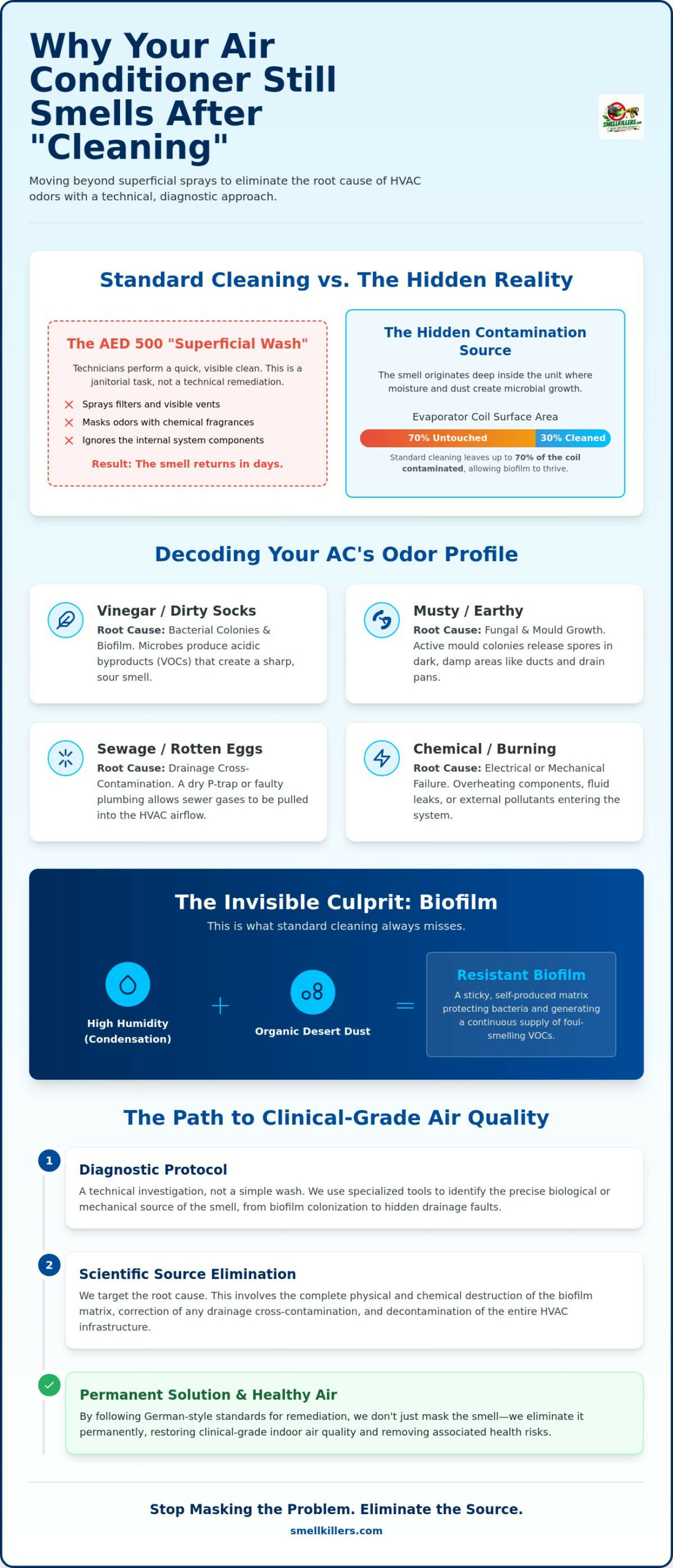
Biofilm develops when moisture from condensation meets organic dust particles. This mixture adheres to the evaporator coil, which is the heart of the system. Understanding how air conditioning systems work reveals that this coil is constantly damp, making it a primary site for bacterial colonization. Even if you wash your filters weekly, the air must still pass through this contaminated coil before entering your room. Standard cleaning often leaves 70% of the coil’s surface area untouched, allowing the smell to return within days. True aircon odour elimination ensures every square centimetre of this component is treated.
The Health Implications of HVAC Odours
Persistent smells are more than an inconvenience; they are indicators of poor indoor air quality. These odours are often linked to Sick Building Syndrome (SBS), where occupants experience headaches, fatigue, or throat irritation. Unmaintained units in the UAE frequently harbour pathogens such as Legionella or various mould species. These contaminants circulate through the vents, potentially triggering chronic respiratory issues or allergic reactions. The impact is measurable and significant.
- Bacterial Biofilms: These colonies produce volatile organic compounds (VOCs) that cause the “dirty sock” smell.
- Mould Spores: These can remain dormant in dry ducts and reactivate immediately when humidity levels rise.
- Cross-Contamination: Faulty drainage connections can introduce sewer gases directly into the airflow.
Addressing these risks requires a shift from superficial maintenance to professional diagnostic protocols. It is the difference between a temporary relief and a permanent resolution for your indoor environment.
Common AC Odour Profiles and Their Root Causes
Identifying the specific scent emitted by your vents is the first stage of a professional diagnostic protocol. Each odour profile corresponds to a distinct mechanical or biological failure. Successful aircon odour elimination depends on matching the symptom to its root cause with scientific precision. In the UAE’s high-demand cooling environments, these smells are rarely isolated incidents; they are indicators of systemic contamination. If you notice a smell coming from AC vent outlets, each distinct odour profile points to a specific mechanical or biological failure that requires targeted investigation.
- Vinegar or Dirty Socks: This scent indicates the presence of bacterial colonies and mature biofilm. These organisms produce acetic acid as a metabolic byproduct.
- Sewage or Rotten Eggs: This profile signals cross-contamination from the building’s drainage or sewage infrastructure. If your AC smells like sewage, you are likely dealing with a mechanical failure in your property’s pressure barriers rather than a simple cleaning issue.
- Musty or Earthy: These odours point to active fungal and mould growth within the dark, damp recesses of the unit.
- Chemical or Burning: Such scents suggest overheating electrical components or the infiltration of external pollutants through fresh air intakes.
Biological Biofilms: The Invisible Culprit
Biofilm is a complex, multi-cellular community of microorganisms embedded in a self-produced protective matrix. It is exceptionally resistant to standard household detergents and superficial sprays. Inside a dark, humid AC unit, bacteria multiply rapidly and form a thick, gelatinous layer on the evaporator fins. This matrix protects the colony from basic cleaning agents. It acts as a continuous reservoir for Volatile Organic Compounds (VOCs). Effective aircon odour elimination requires the physical and chemical disruption of this protective layer. Without removing the matrix, the bacteria will simply repopulate the surface within hours of a standard service.
Cross-Contamination from Building Vents
The “Siphon Effect” occurs when pressure imbalances pull sewer gases into the ventilation system. If a P-trap is dry or the condensate line is improperly vented, the AC fan creates negative pressure. This suction draws air directly from the sewage lines into the room. The resulting smell often appears only when the AC is running, which leads many property owners to incorrectly assume the unit itself is dirty. Given the serious health risks of mold exposure and bacterial inhalation, these scents require a professional property odour assessment to identify the mechanical breach. Resolving this issue involves correcting the drainage path rather than just performing a surface wash. Identify the profile. Match the cause. Treat the source.
Masking Agents vs. Scientific Source Elimination
Relying on aerosol sprays or ozone generators to fix a foul-smelling AC is a strategic error. These methods don’t achieve true aircon odour elimination; they merely delay the inevitable return of the stench. Fragrances work by overwhelming your olfactory senses with synthetic chemicals. While the room might smell like a “fresh breeze” for a few hours, the bacterial colonies and biofilms continue to thrive behind the vents. In some cases, these masking agents actually provide a food source for certain microbes, accelerating the problem. If you can smell a contaminant, the physical source is still present in your system.
The chemistry of odour dictates that molecular neutralisation requires physical removal. You cannot chemically “delete” a thick layer of organic sludge. Professional remediation focuses on extraction first and treatment second. This approach ensures that the air returning to your living space is not just “perfumed” but fundamentally clean. We prioritize long-term resolution over the temporary satisfaction of a scented spray. If the source remains, the risk to your health remains.
The “Fresh Scent” Trap
A “clean” smell can often be a warning sign of poor maintenance. Many low-cost service providers in the UAE use heavy perfumes to hide the fact that they haven’t actually cleaned the internal components. This creates a false sense of security. Adding more chemicals to the air via “encapsulating” sprays often degrades indoor air quality further. According to The Inside Story: A Guide to Indoor Air Quality, biological contaminants require physical removal to stop being a health hazard. The ultimate goal is neutral, odourless air that doesn’t trigger chemical sensitivities or respiratory distress.
Source Detection: The Investigation Phase
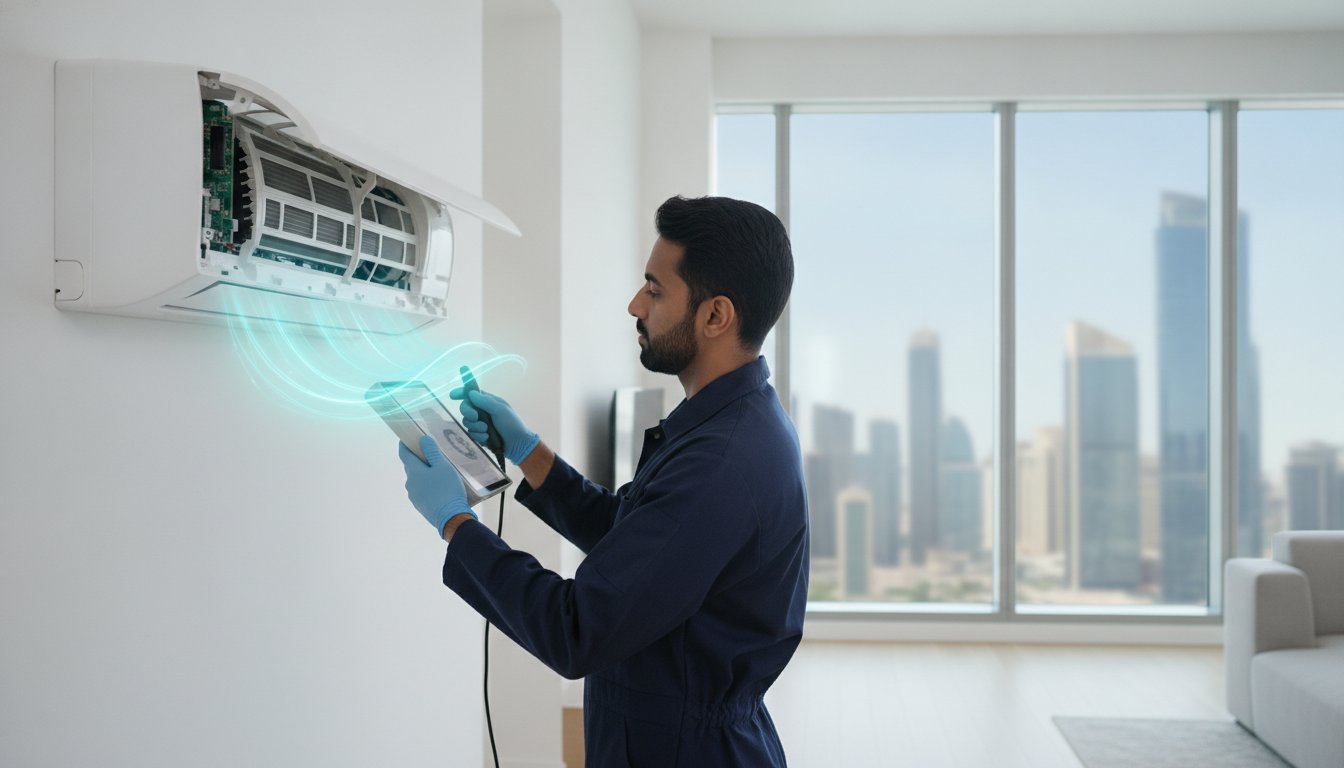
We treat every case as a technical investigation. Source detection is the critical first step because HVAC systems are full of blind spots. An on-site inspection is non-negotiable for permanent results. Standard cleaning services often miss the internal insulation or the rear sections of the evaporator coils where moisture accumulates. We use specialized technology to track gas signatures and biological origins back to their exact location. Identifying these hidden pockets of contamination is the only way to ensure the smell doesn’t return. We don’t just wash the unit; we diagnose the environment to find exactly where the failure occurred. Property managers dealing with recurring smells across multiple units will find that a structured commercial property smell inspection provides the systematic, clinical-grade detection framework needed to permanently resolve building-wide odour failures.
The Diagnostic Protocol for Persistent HVAC Smells
Permanent aircon odour elimination is impossible without a structured investigative framework. We replace subjective “sniff tests” with a five-step diagnostic protocol. This methodical approach identifies mechanical failures and biological reservoirs that standard maintenance teams overlook. Our process follows a strict linear logic to ensure no component is left unexamined.
- Visual and technical assessment of the indoor unit (FCU): We inspect the internal insulation, blower wheel, and rear coil sections for hidden microbial activity.
- Testing the condensate drain line: We check for stagnant water, blockages, or backflow issues that facilitate bacterial growth.
- Inspecting the AC-plumbing interface: We verify the integrity of connections to the building’s waste system to prevent gas infiltration.
- Airflow analysis: We measure pressure differentials to detect if the unit is actively pulling odours from wall cavities or sewage lines.
- Final reporting: We provide a technical summary of findings followed by a targeted treatment plan.
Following this protocol allows us to move from mystery to scientific certainty. We don’t guess where the smell is coming from; we prove it through technical data. This is the essential first step toward a breathable, clinical-grade indoor environment.
On-Site Inspection: Replacing Guesswork with Data
A general cleaner looks for dust. A specialist looks for the origin. We use thermal imaging to identify cold spots where condensation accumulates behind walls or within the unit’s chassis. Moisture meters detect dampness in internal insulation, which often acts as a permanent sponge for foul scents. We evaluate the entire property environment because the AC unit is often just the delivery mechanism for a smell originating elsewhere. To resolve your issues permanently, book a professional on-site inspection today.
Treating the Drain and Sewage Connection
The condensate drain is frequently the forgotten source of persistent smells. In many UAE properties, the AC drain connects directly to the sewage system without a functional P-trap or air gap. This allows gases to bypass the drainage system and enter the airflow. We focus on correcting these plumbing errors to ensure permanent separation of the air and sewage systems. This technical correction is the only way to stop the “siphon effect” from recontaminating your home. True aircon odour elimination requires more than just a clean coil; it requires a sealed and functional drainage path. When an AC smells like sewage due to a failed pressure barrier, correcting the drainage connection is the only permanent fix. We identify the breach. We correct the connection. We eliminate the smell.
Professional German-Style Aircon Cleaning: The Permanent Solution
Standard maintenance in the UAE often relies on high-pressure water and generic detergents that can damage delicate HVAC components. Professional German-style cleaning represents a shift toward technical precision and clinical thoroughness. This methodology prioritizes the integrity of the system while ensuring total aircon odour elimination. We don’t just rinse the surfaces; we perform a deep-tissue remediation of the entire unit. This process requires specialized tools and a methodical approach that leaves no room for shortcuts.
The evaporator coils are the primary focus of this high-standard treatment. These aluminium fins are easily bent or flattened by improper cleaning, which restricts airflow and increases energy consumption. We use precision extraction methods to remove deeply embedded biofilms without compromising the mechanical structure of the coil. Once the coils are restored, we turn our attention to the blower fan and internal housing. These components often harbour the highest concentration of pathogens. Disinfecting them to clinical standards ensures that the air circulated through your property is fundamentally pure and free from microbial triggers.
Investing in this level of service provides a measurable long-term ROI. A system free from biological obstruction operates with significantly higher efficiency. In the UAE’s extreme heat, this translates directly into lower monthly DEWA or Empower bills. Beyond the financial savings, you benefit from increased system longevity and, most importantly, breathable indoor air quality. It’s the transition from a state of constant discomfort to a state of permanent resolution.
The SMELLKILLERS.COM Standard
Our commitment is built on the refusal to accept superficial results. We focus entirely on finding the origin of every odour, drawing on our specialized building maintenance expertise to look beyond the AC unit itself. While competitors might offer fragrances that “encapsulate” smells, we recognize these as a failure of service. If a treatment relies on a scent to prove it’s working, it hasn’t actually solved the problem. We provide a technical solution that results in neutral, odourless air. This transparency ensures you know exactly why the smell existed and how we’ve removed it.
Next Steps for Your Property
The path to clinical-grade air begins with a technical evaluation. You can easily book an on-site odour assessment to identify the specific profile and source of your HVAC issues. During the treatment process, our specialists follow the diagnostic protocols outlined in this guide to ensure every hidden pocket of contamination is addressed. We provide a clear timeline and a detailed report of the remediation steps taken. Don’t let persistent smells compromise your health or your comfort any longer. Book your professional odour inspection today and experience the difference of a truly scientific approach to aircon odour elimination. Identify the source. Treat the cause. Breathe the results.
Restore Clinical-Grade Air Quality Today
Standard maintenance is a recurring expense that rarely solves the underlying problem. You’ve learned that persistent smells are indicators of deep-seated biofilms or mechanical breaches in your drainage system. Resolving these issues requires a transition from superficial washing to scientific remediation. By choosing a diagnostic approach, you ensure that every intervention targets the root cause rather than just the perceptible symptom. We don’t believe in temporary fixes or masking agents that only degrade your indoor environment further.
Our technical diagnostic experts provide national UAE coverage, bringing German-style precision cleaning to every property we assess. We replace the uncertainty of foul smells with the clarity of technical data. Achieving permanent aircon odour elimination is not a matter of luck; it is the result of a methodical, source-focused protocol. This investigative standard is what separates a routine service from a permanent solution. You can finally stop breathing in hidden contaminants and start enjoying a clinical-grade indoor environment that supports your long-term health.
Identify the source of your AC smell: Book an Inspection. You deserve a home where the air is as clean as it looks.
Frequently Asked Questions
Why does my AC smell like vinegar when I turn it on?
The vinegar scent is a result of acetic acid produced by bacterial colonies and mature biofilms on your evaporator coils. These microorganisms thrive in the humid UAE environment, converting dust and moisture into pungent metabolic byproducts. Effective aircon odour elimination requires the physical disruption of this gelatinous matrix. Standard surface sprays cannot penetrate the biofilm, which is why the smell persists even after basic maintenance.
Can a dirty air conditioner make you sick?
Yes, contaminated HVAC systems are primary drivers of Sick Building Syndrome (SBS). Units that harbour mould spores, Legionella, or high concentrations of VOCs can trigger headaches, fatigue, and chronic respiratory distress. When the fan runs, it aerosolizes these pathogens, forcing occupants to inhale concentrated biological contaminants. Maintaining clinical-grade indoor air quality is essential for preventing long-term health complications and allergic reactions.
How often should I have a professional aircon odour treatment?
Odour treatment is a conditional remediation process rather than a scheduled task. You should book a professional assessment immediately if you detect persistent vinegar, musty, or sewage scents. While industry standards like NADCA 2026 suggest duct cleaning every three to five years, clinical decontamination of the FCU should occur whenever a biological or mechanical breach is identified through diagnostic testing. To understand the full scope of a professional residential evaluation, you can learn more about the inspection process.
Will a standard AC duct cleaning remove sewage smells?
No, duct cleaning only removes physical debris and will not resolve a sewage smell. These odours usually originate from a dry P-trap, a blocked condensate line, or a direct cross-connection between the AC and the building’s waste system. A technical diagnostic protocol is required to identify the mechanical failure. You must correct the plumbing breach to achieve permanent aircon odour elimination in these cases.
Why does the bad smell come back a few days after cleaning?
The smell returns because the cleaning agent only addressed the surface layer of the contamination. Biofilms are highly resistant structures that protect the underlying bacterial colony from standard detergents. If the “origin” of the growth isn’t physically extracted, the bacteria will repopulate the damp surfaces within 48 to 72 hours. Permanent results require source-removal techniques that strip the entire biological matrix from the internal components.
Are the chemicals used in odour elimination safe for children and pets?
We utilize professional German-style standards that prioritize non-toxic, eco-friendly treatment solutions. These protocols focus on mechanical extraction and biodegradable disinfectants rather than harsh, aerosolized masking agents. This approach ensures the environment remains safe for sensitive occupants, including children and pets. Our goal is to achieve neutral, odourless air without introducing new chemical pollutants into your home or office.
Can you find the source of a smell if it is not coming from the AC?
Yes, a comprehensive property odour assessment evaluates the entire building infrastructure. We investigate floor drains, sewage vents, wall cavities, and structural gaps to track gas signatures back to their origin. Often, the AC unit acts as a delivery mechanism for smells produced elsewhere in the plumbing or ventilation system. Identifying these external sources is a core part of our diagnostic investigative process.
How long does a professional odour detection inspection take?
A standard technical inspection typically requires 45 to 90 minutes to complete. This duration varies based on the size of the property and the complexity of the HVAC configuration. During this time, we perform airflow analysis, moisture mapping, and a visual assessment of all critical components. This investment in time replaces guesswork with scientific data, providing a clear roadmap for permanent remediation.