Article by
Jonathan Bonnett
Australian Air Conditioning Specialist with extensive hands-on experience in AC servicing, deep cleaning, maintenance, and troubleshooting. Focused on high-quality workmanship, reliability, and professional service to UAE standards.
If your commercial property still smells like sulfur or vinegar after three rounds of professional cleaning, you aren’t dealing with a hygiene problem. You’re facing a technical failure. Most facility managers in the UAE mistake persistent smells for a lack of maintenance when, in reality, the issue is often a structural or biological breach. It’s exhausting to field tenant complaints while general contractors offer nothing but temporary masking agents that fade in hours. You need more than a fragrance; you need a diagnosis.
When standard maintenance fails, advanced commercial AC odour removal protocols must shift toward clinical property odour assessment. This article outlines the technical 2026 standards required to permanently eliminate recurring odours across the UAE. We’ll move past superficial fixes to explore the intersection of ventilation mechanics and drainage systems. You’ll learn how to identify the exact source of the contamination, implement a targeted treatment plan, and restore a healthy indoor environment for your occupants through scientific certainty.
Key Takeaways
- Identify the biological root causes, such as biofilm and bacterial colonies, that render standard superficial cleaning ineffective in high-occupancy environments.
- Execute a professional on-site inspection to establish a clinical diagnostic baseline before attempting commercial AC odour removal Dubai.
- Implement German-style aircon cleaning standards that prioritize systematic disassembly for deep component access and long-term resolution.
- Resolve the HVAC-drainage nexus by identifying how faulty plumbing vents or dry P-traps introduce sewage gases into your ventilation system.
- Protect your asset’s ROI by linking precise technical remediation to improved indoor air quality and sustained employee productivity.
The Pathology of Commercial AC Odours: Why Standard Cleaning Fails
Superficial cleaning fails because it treats the symptom, not the source. In high-occupancy commercial environments, ventilation systems operate under constant load. Standard maintenance often involves wiping diffusers or vacuuming filters; however, the primary source of malodour resides deeper within the mechanical infrastructure. For effective commercial AC odour removal Dubai, technicians must address the biological reality of the evaporator core. Masking these smells with heavy fragrances provides only temporary relief. True remediation requires a clinical approach to source elimination.
The UAE climate acts as a catalyst for microbial growth. High ambient humidity leads to excessive condensate production within large-scale units. When this moisture meets the organic dust trapped in industrial cooling coils, it creates an ideal environment for bacterial colonies. This isn’t a simple hygiene issue; it’s a mechanical and biological failure that requires technical intervention.
Biological Contaminants and Biofilm Formation
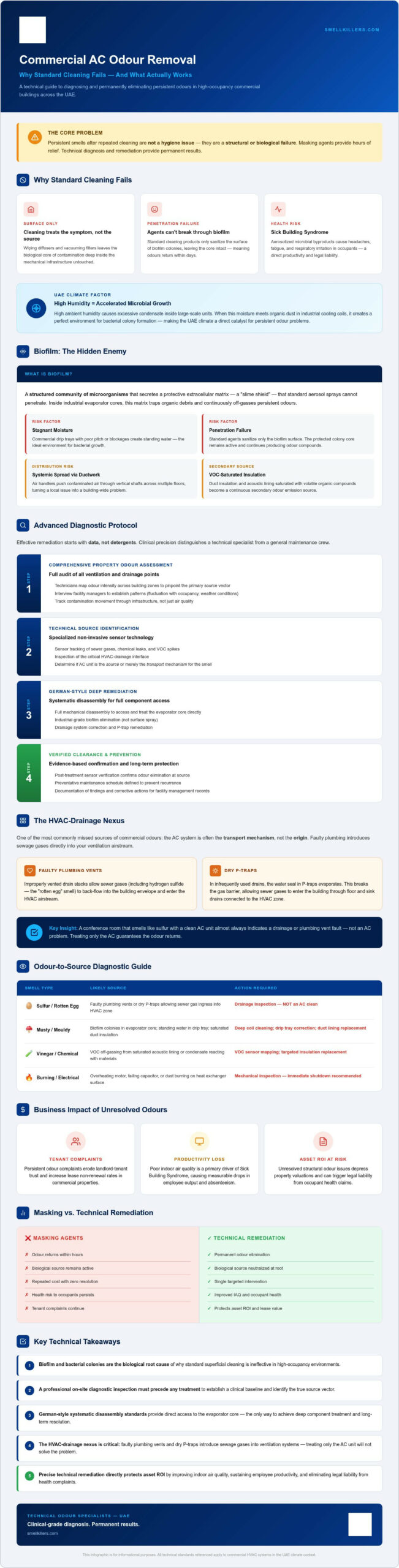
Biofilm is a structured community of microorganisms. These colonies secrete a protective extracellular matrix that shields them from standard aerosol sprays. Within industrial evaporator cores, this “slime” traps organic debris and off-gasses persistent odours. Identify the specific risks associated with these contaminants:
- Stagnant Moisture: Commercial drip trays often suffer from poor pitch or blockages, leading to standing water where bacteria thrive.
- Penetration Failure: Standard cleaning agents cannot penetrate deep-seated biofilm layers. They only sanitize the surface, leaving the core of the colony intact.
- Health Implications: Poor indoor air quality in office settings is a primary driver of Sick Building Syndrome. Occupants may experience headaches, fatigue, or respiratory irritation when exposed to aerosolized microbial byproducts.
Mechanical Vectors for Odour Distribution
Odours are rarely localized. Air handlers act as distribution hubs, pushing contaminated air through vertical shafts and horizontal ductwork across multiple floors. If the internal insulation or acoustic lining becomes saturated with volatile organic compounds (VOCs), the entire system becomes a secondary source of the smell. Localized odours in a single conference room often point to a systemic failure in the central air handling unit. Professional commercial AC odour removal Dubai protocols must account for these mechanical vectors. Without addressing the systemic distribution of contaminants, any localized cleaning effort will result in a rapid return of the original malodour.
Advanced Diagnostic Protocols for Commercial AC Odour Removal in Dubai
Effective commercial AC odour removal Dubai begins with data, not detergents. Most general cleaning services skip the diagnostic phase, leading to recurring issues and wasted maintenance budgets. We utilize an investigative approach that treats the building as a single integrated organism. This methodology replaces guesswork with scientific certainty. Our on-site inspections are available nationally across the UAE to ensure that every intervention is evidence-based and permanent.
The diagnostic process is designed to find the “patient zero” of the malodour. Without this step, cleaning is merely a cosmetic exercise. By identifying the root cause, we ensure that the source is neutralized before any remediation begins. This clinical precision is what distinguishes a technical specialist from a general maintenance crew.
Step 1: Comprehensive Property Odour Assessment
The process starts with a full audit of all building ventilation and drainage points. Technicians map odour intensity across different zones to pinpoint the primary source vector. We don’t just sniff the air; we track the movement of contaminants through the infrastructure. By interviewing facility managers, we establish patterns of occurrence, such as whether the smell fluctuates with occupancy levels or external weather conditions. This data-driven baseline allows us to focus our efforts where they are most needed.
Step 2: Technical Source Identification
Detection requires specialized, non-invasive technology. We use sensors to track sewer gases, chemical leaks, or volatile organic compound (VOC) spikes. A critical part of this stage is inspecting the HVAC-drainage interface. We determine if the AC unit is the actual source of the smell or simply the transport mechanism moving air from a faulty drain pipe or a dry P-trap. If you suspect a systemic issue, a professional property odour assessment is the most efficient way to stop the cycle of temporary fixes.
Step 3: Clinical Treatment Planning
Once we confirm the origin, we develop a targeted remediation plan based on the specific contaminant identified. This isn’t a one-size-fits-all service. We specify whether the situation requires German-style deep cleaning for biofilm removal or technical structural repairs to the ventilation vents. Every client receives a transparent breakdown of the necessary interventions. This plan prioritizes long-term resolution and environmental responsibility, ensuring the odour does not return once the treatment is complete.
German-Style Remediation: Professional Aircon Cleaning Standards
German-style remediation is not a marketing term; it’s a technical engineering standard. While standard services focus on speed and high-volume turnover, our approach to commercial AC odour removal Dubai prioritizes mechanical integrity and biological neutralization. This methodology replaces the “spray and wipe” habit of general contractors with a systematic, phased restoration process. We don’t just clean surfaces. We restore the entire internal environment of the air handling unit to its original, sterile state.
The foundation of this standard is systematic disassembly. Most cleaning companies in the UAE market attempt to treat odours by injecting foam through the external vents or merely vacuuming the filters. This is insufficient for commercial systems. We dismantle the unit to gain direct access to the evaporator core, the blower wheel, and the internal drainage channels. By exposing these components, we ensure that no bacterial colonies remain hidden in the recesses of the machine. This level of depth is the only way to achieve a permanent end to persistent smells.
We utilize eco-friendly, high-performance agents specifically engineered for industrial HVAC applications. These solutions dissolve biofilm without the use of harsh, corrosive chemicals that can damage delicate aluminum fins or leave toxic residues. This ensures that the air pushed into your office space is not only odourless but also chemically safe for your employees and tenants.
Precision Component Disinfection
Our cleaning protocols target the specific areas where biological debris accumulates. We focus heavily on the commercial-grade evaporator coils, using pressurized treatment to flush out contaminants from between the fins. This is followed by a total decontamination of the hidden drip trays and pans. These areas are notorious for holding stagnant water and sludge, which serve as the primary breeding grounds for vinegar and “dirty sock” smells. By treating every internal surface, we prevent the immediate re-colonization that typically occurs after superficial cleanings.
Long-Term Protection and Prevention
Eliminating the current odour is only half of the solution. To prevent recurrence, we apply professional-grade antimicrobial treatments that provide a lasting protective barrier on treated surfaces. We also calibrate the airflow and check the drainage pitch to reduce future moisture accumulation. German-style cleaning is the integration of mechanical precision and biological safety. This comprehensive approach ensures that your commercial AC odour removal Dubai investment delivers a healthy, neutral-smelling environment that lasts for the long term.
The HVAC-Drainage Nexus: Solving Persistent Sewage Smells
The most frequent diagnostic error in commercial facility management is assuming that every foul smell exiting an AC vent originates within the unit itself. In reality, the ventilation system often acts as a delivery mechanism for sewer gases. When property managers seek commercial AC odour removal Dubai, they are frequently dealing with a breach in the building’s plumbing integrity rather than a dirty filter. Specifically, the ‘rotten egg’ or ‘sulphur’ smell is a clinical indicator of hydrogen sulphide infiltration from the drainage network.
High-rise commercial buildings across the UAE are particularly susceptible to the ‘Siphon Effect.’ This occurs when the movement of waste through vertical stacks creates a vacuum, pulling water out of the P-traps in lower or adjacent units. A dry P-trap loses its ability to block sewer gases, allowing them to enter the indoor environment directly. This is a structural failure, not a hygiene issue.
Cross-Contamination in Ventilation Systems
Condensate lines are the primary bridge. These pipes, designed to carry moisture away from the AC unit, often connect directly to the building’s drainage system. If the connection lacks a proper air gap or a functional trap, the negative air pressure created by the AC blower pulls sewer gas into the air handler. This structural flaw turns a plumbing issue into a systemic ventilation failure. We identify these common structural flaws during our property assessments, ensuring that the AC is recognized as the transport mechanism rather than the source.
Permanent Elimination of Drain Odours
Standard drain cleaners or fragrances cannot resolve this issue. They treat the fluid, not the gas flow. Permanent resolution requires technical solutions such as sealing the drainage-ventilation gap and installing specialized one-way valves or deep-seal traps. If your building suffers from recurring sewage smells, you need a professional drain and sewage smell elimination assessment to identify the exact point of cross-contamination. Our protocols ensure that the HVAC and drainage systems are properly isolated, restoring air quality through mechanical precision. This approach replaces temporary masking with a permanent engineering fix.
Commercial Odour Management and Business Continuity
Investing in professional commercial AC odour removal Dubai is a strategic business decision. It’s about protecting your bottom line. Persistent odours lead to tenant churn and reduced lease rates. If a prospective tenant enters a lobby smelling of sewage, the deal is often lost before the viewing begins. Permanent remediation preserves the market value of your asset by ensuring the infrastructure remains healthy and desirable. It’s an essential step for long-term property management.
Indoor air quality directly impacts cognitive function. Employees in environments with poor ventilation and offensive smells report higher rates of absenteeism and lower focus. By eliminating the source of the odour, you create a workspace that supports productivity rather than hindering it. This ROI is measured in reduced turnover and improved operational efficiency across your entire organization. A neutral-smelling office isn’t a luxury; it’s a requirement for high-performance business operations.
Reducing Liability and Health Risks
Clinical cleaning protocols are essential to address ‘Sick Building Syndrome’ (SBS). When occupants are exposed to aerosolized bacterial byproducts, facility managers face increased liability. Our diagnostic approach ensures compliance with UAE indoor air quality guidelines by removing the biological source of the problem. We provide transparent reporting and technical documentation for every assessment. This allows facility managers to demonstrate a proactive and scientific response to health concerns. It replaces mystery with a documented trail of professional intervention, ensuring all stakeholders feel secure in the building’s safety.
Booking Your Professional Inspection
Our team of PANKOBAU specialists provides national UAE service coverage. We bring German-style precision to every property, regardless of location. During the first 24 hours of an on-site inspection, you can expect a comprehensive audit of your HVAC and drainage systems. We utilize non-invasive sensors to map odour intensity and identify the exact origin of the contamination. This initial phase is critical for developing a treatment plan that works the first time. Stop relying on temporary masking agents that fail to solve the underlying technical issue. Contact SMELLKILLERS.COM for a professional commercial AC odour assessment to secure your building’s environment and ensure long-term business continuity.
Restoring Technical Integrity to Commercial Air Quality
Permanent odour resolution requires a shift from superficial maintenance to clinical diagnostic accuracy. We’ve established that persistent smells aren’t just hygiene failures; they’re often complex mechanical or biological breaches within the HVAC-drainage nexus. By moving past masking agents and adopting German-style precision, facility managers can eliminate the biofilm and cross-contamination that drive tenant complaints. This transition protects both your building’s market value and the health of its occupants through scientific certainty.
Operated by PANKOBAU Building Maintenance LLC, our team brings specialized German-style cleaning protocols to commercial properties across the UAE. We prioritize source detection over temporary fixes, ensuring every intervention is evidence-based and durable. Don’t let recurring malodours compromise your business continuity or employee productivity. It’s time to replace mystery with a methodical, technical solution that restores your indoor environment to a neutral, sterile state.
Take the first step toward a permanent resolution today. Book a Professional On-site Odour Inspection and experience the difference of national UAE expertise in commercial AC odour removal Dubai. Your building’s air quality deserves nothing less than professional precision.
Frequently Asked Questions
Why does my commercial AC smell like sewage even after it was cleaned?
Sewage smells usually indicate a breach in the HVAC-drainage nexus rather than a dirty filter. If the P-trap is dry or the vent stack is faulty, negative pressure pulls hydrogen sulphide into the air handler. Standard cleaning only addresses surface debris; it doesn’t isolate the plumbing system from the ventilation. A technical assessment is required to identify the exact point of cross-contamination and seal the breach.
Are the chemicals used in professional AC odour removal safe for office workers?
Our remediation protocols utilize eco-friendly, high-performance agents specifically engineered for indoor environments. These solutions are biodegradable and non-corrosive. They effectively dissolve biofilm without releasing toxic volatile organic compounds (VOCs). This ensures that the air quality remains safe for office workers immediately after the treatment is complete. We prioritize biological safety alongside mechanical precision to protect your staff.
How long does a commercial property odour assessment take to complete?
A standard commercial property odour assessment usually takes between two and four hours. This duration depends on the total square footage and the complexity of the building’s ventilation network. During this time, technicians conduct a comprehensive audit of all HVAC and drainage interfaces. We provide a diagnostic report immediately following the inspection to outline the necessary remediation steps and find the source.
Can a bad smell from the air conditioner make employees sick?
Persistent malodours are often a symptom of aerosolized microbial contaminants. These biological byproducts can trigger Sick Building Syndrome, leading to employee headaches, lethargy, and respiratory irritation. Effective commercial AC odour removal Dubai protocols don’t just eliminate the smell; they remove the underlying health risks. Restoring air quality is essential for maintaining a safe and productive workplace environment for your entire team.
What is the difference between standard AC cleaning and German-style cleaning?
The primary difference is systematic disassembly. Standard cleaning often relies on superficial vacuuming or pressurized air. German-style cleaning requires dismantling the unit to access the evaporator core and hidden drip trays. This ensures that the deep-seated biofilm, which standard methods miss, is completely neutralized. It moves beyond cosmetic maintenance to provide a total biological restoration of the equipment and long-term results.
Do you provide AC odour removal services for hotels and large malls across the UAE?
We offer national UAE service coverage for all large-scale commercial properties, including hotels, malls, and industrial complexes. Our team is equipped to handle high-capacity air handling units and complex drainage networks. Whether you manage a single office floor or a multi-building campus, we provide the same clinical diagnostic precision to ensure permanent odour elimination across your entire facility portfolio.
Can you identify smells that only appear at certain times of the day?
Intermittent smells often correlate with specific mechanical cycles or occupancy patterns. We use non-invasive sensors to track gas concentrations over time. If a smell only appears during peak hours or when certain drains are used, it points to a specific pressure imbalance or a siphon effect in the plumbing. We specialize in identifying these temporal patterns to find the root cause through scientific analysis.
Is it necessary to replace the AC unit if the smell won’t go away?
Replacement is almost never necessary if the structural integrity of the unit is intact. Most “permanent” smells are caused by deep biological colonization or external gas infiltration. Both issues are solvable through specialized commercial AC odour removal Dubai techniques. We focus on remediating the existing infrastructure, which is significantly more cost-effective than a full system replacement. Don’t replace your equipment before a technical diagnosis.