Article by
Jonathan Bonnett
Australian Air Conditioning Specialist with extensive hands-on experience in AC servicing, deep cleaning, maintenance, and troubleshooting. Focused on high-quality workmanship, reliability, and professional service to UAE standards.
The “fresh” scent following a standard service often masks a more dangerous reality; your HVAC system is being corroded from the inside out. You’ve likely experienced the frustration of recurring sewage smells or respiratory irritation shortly after a professional visit. It’s a valid concern to fear that harsh industrial acids are compromising your expensive unit’s integrity. These common aircon chemical cleaning side effects aren’t just an inconvenience. They’re symptoms of a non-diagnostic approach that prioritizes superficial fixes over technical precision.
This clinical risk assessment for 2026 details exactly why traditional chemical washes fail and how German-style clinical sterilization eliminates stubborn odours without damaging your hardware. You’ll understand the mechanical risks of corrosive residues and how to achieve a truly clean, toxin-free environment in your UAE property. We’re moving beyond temporary masking to provide a methodical, diagnostic solution for long-term air quality. This guide breaks down the transition from aggressive chemical intervention to precise, source-based treatment.
Key Takeaways
- Identify mechanical risks. Standard chemical washes often cause coil corrosion and degrade protective HVAC components.
- Recognize that common aircon chemical cleaning side effects like respiratory irritation result from unrinsed acidic residues and persistent biofilms.
- Transition to German-style clinical sterilization. Use biodegradable enzymes rather than aggressive industrial acids to protect system longevity.
- Prioritize a Property Odour Assessment. Isolate the root cause of smells before committing to any mechanical or chemical intervention.
- Secure long-term indoor air quality. Replace superficial chemical masking with a technical, non-toxic remediation protocol.
Understanding Common Aircon Chemical Cleaning Side Effects
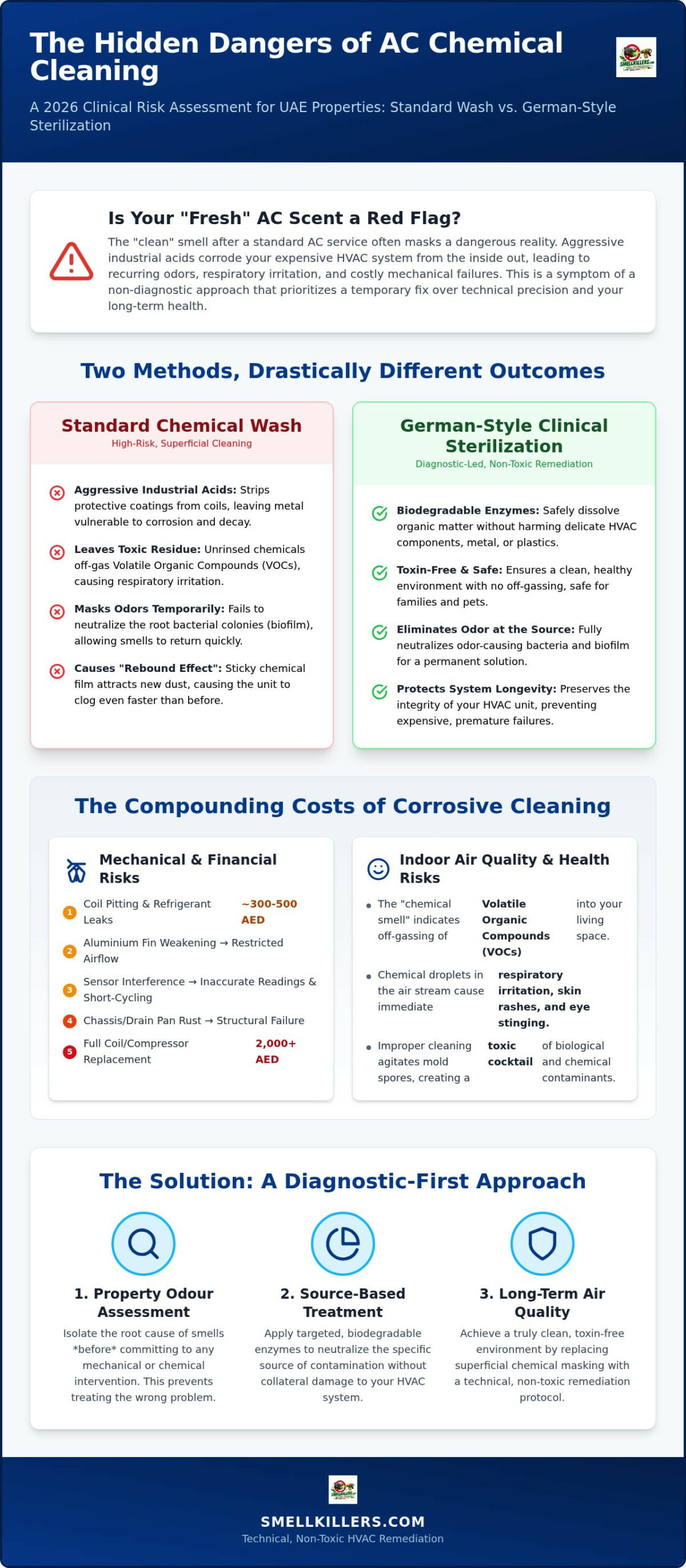
Standard aircon maintenance in the UAE often relies on high-acidity solutions designed for rapid grime removal. While these agents appear effective, they introduce a range of technical and environmental complications. These aircon chemical cleaning side effects manifest as both immediate mechanical failures and long-term indoor air quality degradation. Many service providers utilize aggressive industrial acids that strip the protective hydrophilic coatings from evaporator coils. This leaves the metal vulnerable to environmental stressors and accelerates the decay of the entire HVAC system.
The UAE’s high humidity levels exacerbate these issues. When acidic residues aren’t perfectly neutralized, moisture in the air reacts with the chemicals to create a secondary corrosive layer. This often leads to “coil pitting,” where the cleaning agent literally eats into the copper tubing. The inevitable result is a refrigerant leak. Fixing these leaks typically costs property owners between 300 د.إ and 500 د.إ for a basic recharge, though a full coil replacement is significantly more expensive. Precision in agent selection is the only way to avoid these compounding costs.
Mechanical Risks: Corrosion and Component Failure
Aggressive cleaning agents don’t just target dirt; they attack the structural integrity of the unit. You’ll often see the following mechanical symptoms after a standard chemical wash:
- Aluminium Fin Weakening: Harsh acids cause the delicate fins to become brittle and collapse, restricting airflow.
- Sensor Interference: Chemical residues coat thermistors and electronic sensors, leading to inaccurate temperature readings and system short-cycling.
- Chassis Structural Damage: Improper rinsing allows acidic runoff to pool in the drain pan and AC chassis, causing rust and localized structural failure.
These issues aren’t just maintenance hurdles. They represent a fundamental compromise of the unit’s mechanical lifespan. Replacing a compressor or a severely pitted coil in 2026 can cost upwards of 2,000 د.إ, making the “cheap” chemical wash a high-risk financial gamble.
Health Risks: VOCs and Respiratory Irritation
The distinct “chemical smell” following a service is a diagnostic red flag. It indicates the off-gassing of Volatile Organic Compounds (VOCs) into your living space. According to this Indoor Air Quality Overview, these compounds are primary contributors to poor home health. When industrial cleaning agents aren’t thoroughly flushed, droplets enter the high-velocity air stream. This causes immediate respiratory irritation, skin rashes, and eye stinging for residents. Effective AC chemical smell removal requires a forensic approach to identify the exact source of the contaminant rather than masking it with fragrance-based sprays.
There is a documented link between these industrial residues and specific dirty AC health risks. Instead of achieving a sterile environment, improper chemical applications often agitate existing mould spores without fully neutralizing them. This creates a toxic cocktail of chemical fumes and biological contaminants. A diagnostic-led approach replaces these aggressive acids with biodegradable sterilization enzymes to ensure the air remains safe for UAE families.
The Science of Chemical Interaction: Why ‘Cheap’ Washes Fail
Low-cost chemical washes often rely on a deceptive immediate result. While the unit appears clean, the technical reality is far more problematic. Understanding the technical aircon chemical cleaning side effects requires looking at the molecular interaction between the cleaning agent and the system components. Standard industrial surfactants leave a sticky, microscopic film on the aluminium fins. This phenomenon, known as the “rebound effect,” causes the residue to act as an adhesive for dust and organic matter. Consequently, the unit clogs faster than it did before the service, often within weeks of the initial cleaning.
Standard biocides also struggle with bio-film chemistry. These bacterial colonies produce a protective extracellular matrix that resists most superficial cleaners. A standard wash merely “shaves” the top layer of bacteria, leaving the root colony intact to regenerate. Furthermore, in many UAE properties, harsh chemicals can react with hydrogen sulfide from external sewage intrusions. This creates a volatile cross-contamination event where the cleaning agent itself becomes a source of secondary pollution. Permanent aircon odour elimination is only possible using pH-neutral agents that break down these bonds without introducing new toxins. Property owners who want to understand why standard maintenance repeatedly fails should review this detailed breakdown of AC cleaning for odour removal UAE, which identifies the specific bacterial strains and mechanical failures driving these recurring issues.
The Failure of Superficial Masking
Technicians frequently use fragrance-heavy sprays to signal “cleanliness” to property owners. These artificial scents are a significant red flag; they indicate a lack of diagnostic depth and serve to hide unresolved biological growth. The EPA on VOC Health Effects confirms that such chemical concentrations are significantly higher indoors, contributing to persistent respiratory distress. Non-neutralized acids continue to corrode the metal substrate long after the technician has left the site. This hidden chemical reaction between artificial scents and biological odours often results in a “sickly sweet” smell that indicates active mould metabolism under a chemical veil.
Bio-film Persistence and Chemical Resistance
Bacteria in UAE HVAC systems quickly develop resistance to frequently used low-grade industrial biocides. This resistance leads to the rapid return of the “rotten egg” smell shortly after the unit is turned back on. German-style clinical agents differ by focusing on breaking the molecular bond of the bio-film rather than just poisoning the surface. By utilizing biodegradable sterilization enzymes, these agents neutralize the acidic environment that bacteria thrive in. A technical on-site inspection can determine if your system is currently trapped in this cycle of chemical resistance and structural decay.
Chemical Wash vs. German-Style Clinical Sterilization
Traditional chemical washes are often reactive, aggressive, and technically imprecise. General contractors typically apply a “one-size-fits-all” acidic solution to every component, regardless of the actual contamination levels. This lack of diagnostic accuracy is a primary driver of the aircon chemical cleaning side effects discussed previously. In contrast, German-style clinical sterilization is a diagnostic-led protocol. It replaces corrosive industrial acids with biodegradable sterilization enzymes. These enzymes specifically target biological pathogens without compromising the mechanical integrity of the HVAC system. While a standard wash might provide temporary relief for three months, clinical methods typically maintain system hygiene for up to a year, offering three times the longevity of results.
Safety profiles differ significantly between these two approaches. Standard washes leave behind residues that can be hazardous in residential villas and high-occupancy commercial offices nationwide. The EPA on chemical biocides in air ducts notes that research hasn’t demonstrated the effectiveness of many chemical biocides, particularly regarding potential adverse health effects. Clinical sterilization avoids these risks by ensuring all agents are non-toxic and fully neutralized before the system is reactivated. This makes the protocol safe for sensitive environments, including nurseries and clinics.
Precision Methodology for HVAC Integrity
German standards prohibit the “soak and spray” method favoured by general contractors. This outdated technique often pushes contaminants deeper into the coil assembly. Instead, the clinical protocol follows a strict sequential logic:
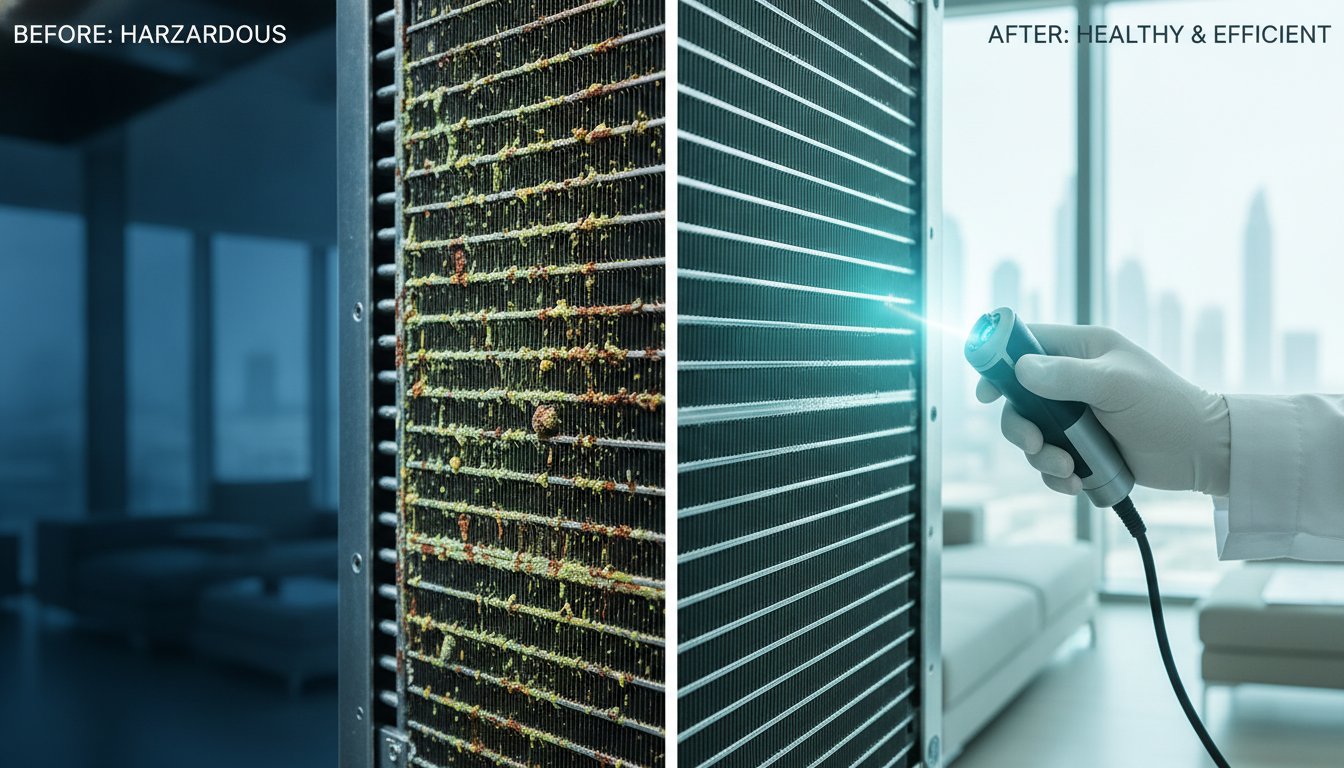
- Endoscopic Verification: Technicians use high-resolution cameras to inspect the internal chassis and drainage trays.
- Source Identification: Treatment is only applied where biological growth or blockages are confirmed.
- Targeted Remediation: Agents are applied with surgical precision to ensure no unnecessary chemical exposure to sensitive electronics or sensors.
This method ensures that the root cause of the odour is treated without the collateral damage typical of standard aircon chemical cleaning side effects.
Long-term Economic Side Effects
The return on investment (ROI) for clinical sterilization is mathematically superior for property owners. While the initial cost of a specialized service may be higher, the long-term savings are substantial. One clinical sterilization session per year effectively replaces the need for four “cheap” chemical washes. This reduction in service frequency minimizes the mechanical wear on the unit. Furthermore, clean, uncorroded coils significantly lower energy consumption. Chemically pitted or clogged fins force the compressor to work harder, increasing monthly utility bills. By preventing premature coil failure, property owners avoid the multi-thousand expense of early system replacement, ensuring the HVAC hardware reaches its full ten-to-fifteen-year lifespan.
Diagnostic-First Approach: Mitigating the Risks of AC Cleaning
Many property owners mistake systemic plumbing failures for HVAC issues. When you apply a chemical wash to a unit that isn’t the origin of the odour, you expose your system to unnecessary aircon chemical cleaning side effects without resolving the discomfort. A technical property odour assessment is the only mandatory first step in professional remediation. This diagnostic phase identifies whether the odour is AC-borne mould or an external sewage gas intrusion caused by failed P-traps or cracked vent pipes in the building infrastructure.
Our investigators track air pressure differentials within the building envelope. During operation, an AC unit can create localized negative pressure. This vacuum draws foul air from wall cavities or floor drains directly into the ventilation stream. If the root cause is external, even the most thorough cleaning will fail. Technical reporting provides the necessary “before and after” diagnostic data to verify that the intervention was both necessary and effective. We replace mystery with scientific certainty through measurable evidence.
Identifying the Root Cause of Odours
Consider a scenario where a resident reports a persistent “dirty sock” smell. A general contractor might immediately recommend an aggressive chemical wash. However, our diagnostic protocols often reveal that the perceived “side effect” is actually a drain leak or a dried-out floor trap. By following strict sewage odour elimination UAE standards, we prevent the redundant use of chemicals. We utilize high-precision VOC sensors to identify the exact chemical signature of the pollutant. This ensures the treatment matches the source, whether it’s biological growth or industrial off-gassing from building materials.
Safe Treatment Protocols
Once the source is confirmed as the HVAC unit, the clinical sterilization process follows a methodical sequence. We begin with a mechanical removal of loose debris. This is followed by the targeted application of pH-neutral sterilization agents. This approach prevents the metallic decay and coil pitting associated with standard aircon chemical cleaning side effects. After the treatment, we verify the system’s pH levels to ensure zero corrosive residue remains on the evaporator fins. Diagnostic accuracy is the best protection against HVAC damage because it eliminates unnecessary chemical exposure. To secure your property’s air quality, schedule a professional on-site inspection today.
SMELLKILLERS (by PANKOBAU Building Maintenance LLC) provides the technical resolution for property owners exhausted by recurring odours and mechanical failures. We replace the standard “cleaner” mindset with a clinical investigator’s approach. This transition from superficial masking to scientific air quality certainty is essential in the UAE’s demanding climate. Standard contractors often ignore the long-term aircon chemical cleaning side effects that damage your investment. We don’t. Our protocol prioritizes the structural integrity of your HVAC system while ensuring the air remains sterile and safe for your family.
Our commitment to non-toxic, eco-friendly sterilization agents replaces the need for harsh industrial biocides. This methodology provides a permanent resolution rather than a temporary fragrance-based cover-up. We provide national coverage for property owners who value technical expertise and mechanical longevity. By using biodegradable enzymes, we achieve clinical-level sterilization without the risks of metal decay or respiratory irritation. Our process follows a strict sequential logic: Diagnose. Treat. Verify. This methodical approach ensures that your HVAC system is restored to its original clinical state without the risk of collateral damage.
The SMELLKILLERS Technical Standard
There’s a direct link between diagnostic accuracy and long-term HVAC health. Our technicians are trained as investigators, not just cleaners. They look beneath the surface to find root causes. They utilize endoscopic cameras and VOC sensors to identify the exact origin of a smell before any treatment begins. This precision prevents the unnecessary application of chemicals that lead to coil pitting. Transparency is maintained through detailed post-inspection field reports. These documents provide a clear, chronological breakdown of the system’s condition and the specific treatments applied. You receive a technical record of your system’s remediation, replacing mystery with data-driven results.
Securing Your Property’s Air Quality
The UAE climate demands clinical-grade maintenance to combat persistent biological growth and high dust loads. Regular technical assessments prevent the accumulation of bio-films and the subsequent need for aggressive, corrosive intervention. If you’re experiencing persistent indoor odours despite regular cleaning, a technical assessment is the only way to find a permanent fix. We guide you from a state of frustration to a state of scientific certainty. Our process is fast-paced, structured, and focused entirely on resolution. Secure your property’s air quality today. Book your on-site inspection for a side-effect-free HVAC system that performs at peak efficiency.
Securing Your HVAC Integrity and Indoor Air Quality
Transitioning from reactive chemical washes to a clinical diagnostic protocol is the only way to safeguard your property. Aggressive industrial acids cause irreversible mechanical decay over time. These aircon chemical cleaning side effects compromise both your equipment’s lifespan and your family’s respiratory health. By prioritizing a “root cause” investigation, you eliminate the cycle of temporary masking and toxic off-gassing. Permanent resolution requires the technical precision of clinical sterilization and biodegradable enzymes rather than superficial sprays. Standard maintenance doesn’t have to be a gamble with your health or your hardware.
SMELLKILLERS, operated by PANKOBAU Building Maintenance LLC, specializes in permanent odour elimination through rigorous clinical diagnostic protocols. We replace mystery with scientific evidence to ensure your HVAC hardware reaches its full fifteen-year lifespan. Our investigators look beneath the surface to identify the exact origin of every pollutant. Book Your Technical On-Site Odour Inspection to restore your home’s air quality today. Technical accuracy is your best defense against recurring smells and mechanical damage. You deserve an indoor environment that is both comfortable and clinically safe.
Frequently Asked Questions
Can aircon chemical cleaning cause respiratory problems?
Improperly executed chemical cleaning can lead to immediate respiratory distress. When technicians fail to thoroughly rinse acidic cleaning agents, microscopic droplets of these chemicals enter the high-velocity air stream during operation. This causes throat irritation, coughing, and sinus inflammation for residents. Standard industrial biocides often contain volatile organic compounds that degrade indoor air quality long after the service is completed, making thorough neutralization essential for home safety.
Will a chemical wash damage the copper coils in my AC unit?
Standard chemical washes utilizing high-acidity solutions will cause structural damage to copper coils over time. These harsh agents strip the protective hydrophilic coating from the evaporator fins, leading to a phenomenon known as coil pitting. This corrosive process eventually creates microscopic holes in the copper tubing, resulting in refrigerant leaks. Preventing these aircon chemical cleaning side effects requires the use of pH-neutral agents that target dirt without attacking the metal substrate.
What is the difference between a standard chemical wash and German-style sterilization?
The primary difference lies in the diagnostic methodology and the agents used. Standard chemical washes are reactive, pressurized treatments that use corrosive acids for rapid grime removal. German-style clinical sterilization is a diagnostic-led protocol that utilizes biodegradable enzymes. These enzymes break the molecular bond of bio-films without damaging the unit’s mechanical integrity. This approach prioritizes long-term system health and air purity over superficial, immediate results.
Is the chemical smell after AC cleaning dangerous for children or pets?
A persistent chemical scent after cleaning indicates active off-gassing of industrial solvents, which poses specific risks to children and pets. These sensitive groups are more susceptible to the effects of Volatile Organic Compounds (VOCs) released by non-neutralized agents. Symptoms include eye stinging, skin rashes, and lethargy. Professional remediation ensures all agents are fully flushed and neutralized to provide a sterile, odourless environment that is safe for all residents.
How often should I perform a deep chemical clean on my AC in the UAE?
Clinical-grade deep cleaning is typically required once every 12 months for standard residential properties in the UAE. However, units in high-occupancy areas or those near construction sites may require more frequent assessment to maintain the 30% efficiency improvement associated with clean coils. Instead of adhering to a rigid schedule, property owners should utilize a diagnostic inspection to determine actual contamination levels. This prevents unnecessary exposure to aircon chemical cleaning side effects caused by excessive chemical intervention.
Why does my AC smell like vinegar after a chemical cleaning?
A vinegar-like odour usually signals a chemical reaction between acidic residues and existing moisture or biological matter. This scent often appears when the cleaning agent hasn’t been neutralized, allowing acetic acid to form on the coils. It can also indicate that the cleaning was superficial, leaving behind anaerobic bacteria that produce sour-smelling byproducts as they regenerate. A technical diagnosis is required to identify if the smell originates from residue or persistent bio-films. For a comprehensive clinical protocol addressing these persistent odours, our guide to AC chemical smell removal and permanent VOC elimination details the forensic steps required for definitive remediation.
Can chemical cleaning fix a sewage smell coming from my vents?
Chemical cleaning cannot resolve a sewage smell if the origin is a plumbing failure. While a dirty AC can harbour mould, rotten egg odours often stem from dried-out P-traps, cracked vent pipes, or failed drainage seals. Applying chemicals to the AC unit in these cases is redundant and technically incorrect. A property odour assessment must be conducted first to differentiate between HVAC-borne pathogens and external sewage gas intrusions from the building infrastructure.
What should I look for in a technical report after an AC cleaning session?
A professional technical report should include high-resolution endoscopic “before and after” imagery of the internal coils and drainage trays. It must also document the verified pH levels after rinsing to ensure no corrosive residue remains on the metal components. Look for specific data regarding VOC sensor readings and a clear identification of the contamination source. This transparency ensures that the treatment provided was necessary, targeted, and mechanically safe for your HVAC system.