
Article by
Jonathan Bonnett
Australian Air Conditioning Specialist with extensive hands-on experience in AC servicing, deep cleaning, maintenance, and troubleshooting. Focused on high-quality workmanship, reliability, and professional service to UAE standards.
Your apartment doesn’t need another deep clean; it needs a technical diagnosis. If you’re constantly fighting persistent sewage smells or a heavy, musty atmosphere, the issue isn’t surface dirt. It’s a structural or mechanical failure. You’ve likely wasted money on expensive air fresheners and repeated cleaning sessions that only mask the symptoms. We understand the frustration of living in a space that feels compromised. An expert apartment odour assessment UAE shifts the focus from superficial scrubbing to scientific investigation. It uncovers the exact origin of the problem that standard services simply cannot reach.
You deserve to breathe clean air without the constant worry of hidden mould or bacterial growth. This guide explains how a professional diagnostic approach identifies root causes like P-trap failures, AC biofilm accumulation, or cross-contamination in ventilation shafts. We’ll break down the specific steps involved in a technical inspection and how identifying the source leads to a permanent resolution. Learn how to stop the cycle of temporary fixes and restore your indoor air quality through clinical precision and German-standard expertise.
Key Takeaways
- Modern UAE apartments are designed to be airtight, which often traps pollutants and VOCs. Standard cleaning cannot reach these structural pockets where odours originate.
- A professional apartment odour assessment UAE identifies the specific source of a smell. This prevents you from wasting money on ineffective surface treatments.
- Stop relying on ozone machines or fragrances to mask persistent issues. These temporary fixes don’t address the underlying biological or mechanical failures.
- Technical inspections use a methodical process to map odour timelines. This allows specialists to locate hidden triggers in ventilation systems and wet areas.
- Long-term resolution requires German-style cleaning standards and mechanical repairs. These methods ensure total removal of bacteria and restoration of drainage integrity.
The State of Poor Indoor Air Quality in Modern UAE Apartments
Poor indoor air quality (IAQ) in UAE high-rises is a technical measurement of airborne contaminants within a sealed living environment. It isn’t merely about unpleasant smells. It’s about the concentration of gases, particulates, and microbial agents that cannot escape. Modern construction in cities like Dubai and Abu Dhabi prioritizes thermal insulation and energy efficiency. While this keeps the heat out, it creates an airtight envelope. This seal prevents the natural dispersal of pollutants. Volatile organic compounds (VOCs) from furniture, paints, and cleaning agents become trapped. Without a professional apartment odour assessment UAE, these invisible toxins circulate through your living space indefinitely.
Persistent odours serve as a diagnostic signal. They indicate underlying mechanical building faults that surface cleaning cannot resolve. A smell is often the first symptom of a failed architectural or mechanical component. Standard ventilation systems in many UAE towers are designed for temperature control rather than high-volume air exchange. They often fail to mitigate localized odour sources because they lack the necessary filtration or pressure balance to extract heavy gas molecules. Common failure points include:
- Pressure Imbalances: Negative pressure in the apartment pulls sewer gases from the building’s main stack through floor drains.
- Ductwork Integrity: Leaks in the supply or return air ducts allow unconditioned, contaminated air from wall cavities into the living area.
- Cross-Contamination: Shared ventilation shafts can transport odours from kitchens or bathrooms in neighbouring units.
The Health Impact of Contaminated Indoor Air
Degraded IAQ is a physiological risk. Residents frequently report chronic headaches, respiratory irritation, and persistent fatigue. These symptoms often stem from bio-aerosols. These are microscopic airborne particles containing bacteria or mould spores. When an AC system is poorly maintained, it becomes a delivery mechanism for these pathogens. We see many clients who request an apartment odour assessment UAE because they’ve noticed their health improves the moment they leave their home. This “Sick Building Syndrome” is a direct result of biological growth hidden within the infrastructure.
Trends in UAE Residential Odour Challenges
The UAE’s extreme climate creates a unique set of challenges. High ambient humidity combined with year-round AC usage provides the ideal environment for microbial activity. One prevalent issue is “dirty sock syndrome.” This occurs when bacteria colonize the damp evaporator coils of an AC unit, releasing a pungent, earthy smell every time the system cycles. Additionally, the complex plumbing stacks in modern high-rises are prone to gas infiltration if the P-traps aren’t regularly primed or if the air vents on the roof are blocked. These aren’t cleanliness issues; they’re technical failures that require a specialist’s diagnosis.
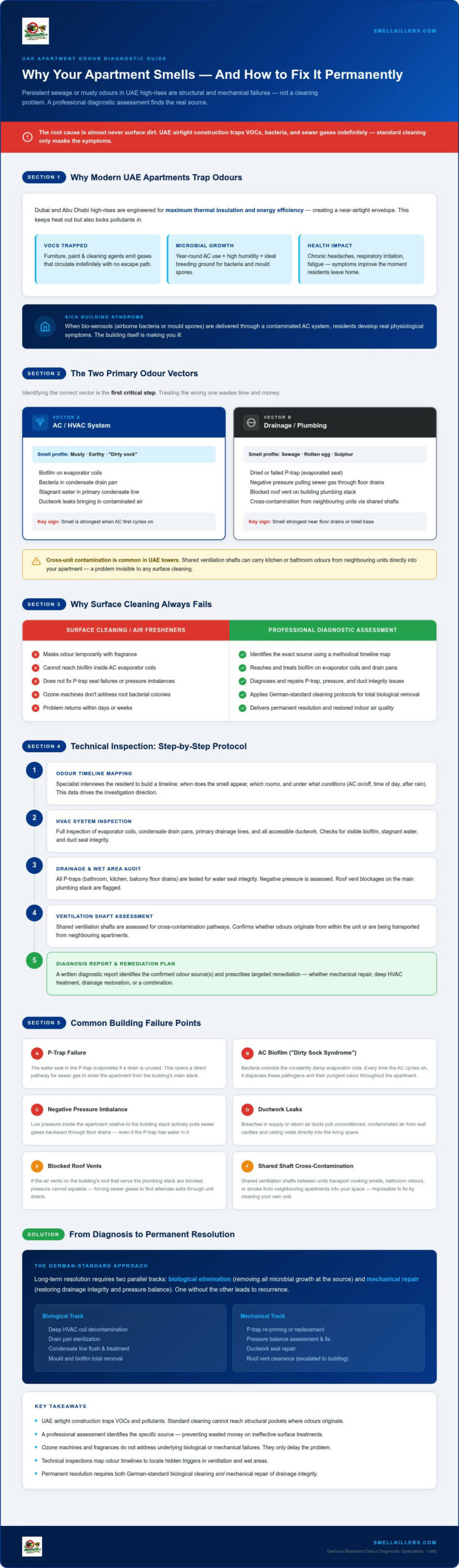
Identifying Common Odour Vectors: AC Systems vs. Drainage Faults
To resolve persistent smells, you must first classify the vector. A professional apartment odour assessment UAE differentiates between biological activity in the mechanical cooling system and gaseous infiltration from the plumbing infrastructure. These are distinct technical failures. Treating one when the other is the cause results in wasted expenditure and continued discomfort. Most property owners mistake one for the other, leading to repeated, ineffective cleaning cycles.
The “musty” spectrum usually indicates microbial growth. Biofilm and mould colonize the evaporator coils where moisture is constant. Conversely, the “sewage” spectrum signals a breach in the building’s airtight drainage seal. This often happens when pressure imbalances within the high-rise stack pull sewer gas through floor drains. Identifying the correct vector is the primary objective of any diagnostic inspection.
AC-Specific Odour Sources
Biological buildup occurs deep within the unit, specifically in the drain pan and the primary condensate line. Stagnant water in these areas becomes a breeding ground for bacteria. Effective aircon odour elimination requires cleaning the internal coils and the blower fan, not just the mesh filters. If you notice a sharp, vinegar-like smell, it’s often a sign of specific chemical reactions between bacterial metabolites and the metal surfaces of the cooling system. This requires a clinical treatment approach rather than a simple fragrance spray. For a comprehensive breakdown of the diagnostic protocols used to permanently resolve these issues, our guide to professional AC odour removal Dubai properties explains the full technical methodology from detection to remediation.
Drainage and Sewage Gas Infiltration
The UAE’s extreme heat and low humidity cause P-traps to dry out rapidly. These traps are designed to hold a water seal that blocks sewer gases. When the water evaporates, the seal breaks. Identifying a recurring sewage smell home often reveals a venting issue or a failed mechanical seal in a floor drain. Bathroom drain smell UAE issues are among the most common entry points for methane and hydrogen sulphide, which enter the living space when the building’s ventilation system creates negative pressure.
Cross-contamination adds another layer of complexity. The AC system can act as a distribution network. It pulls odours originating in a bathroom or kitchen and circulates them through every room in the apartment. This makes the source feel “everywhere,” making it impossible for a layperson to locate the origin without technical equipment. If you’re struggling to pinpoint the source, an on-site diagnostic inspection is the only way to replace guesswork with scientific certainty.
Why Surface Cleaning Fails: Masking vs. Diagnostic Assessment
Surface cleaning is a cosmetic intervention. It treats the air you breathe but ignores the physical origin of the contaminant. If your home has a persistent smell, scrubbing floors or wiping walls will not provide relief. An apartment odour assessment UAE is required to move beyond superficial aesthetics. Most residents attempt to “clean” their way out of a mechanical problem. This approach is fundamentally flawed. It treats a structural or biological failure as a hygiene issue. It’s a technical error that leads to wasted time and money.
The “Ozone Myth” is a common trap in the local market. Many services offer ozone generators as a catch-all solution. Ozone is a reactive gas that neutralizes odour molecules currently in the air. However, it does not penetrate the source. If there’s a sewage leak behind a wall or a biofilm colony in an AC drain pan, the smell will return within hours of the treatment. Relying on temporary gas treatments is a cycle of failure. It provides a false sense of resolution while the underlying cause remains active.
The Failure of Traditional Air Fresheners
Masking agents are chemical compounds designed to overwhelm your olfactory senses. They don’t remove the problem; they hide it. These fragrances often trigger air quality sensors because they are high in Volatile Organic Compounds (VOCs). Spraying these chemicals indoors can lead to severe sensitivities, especially in the airtight environments common in UAE apartments. The “rebound effect” occurs when the fragrance dissipates. The original odour often feels more intense because the underlying source has continued to grow or leak during the masking period. You aren’t improving the air; you’re simply adding more pollutants to it.
The Logic of Source-Based Elimination
Total resolution depends on finding the “root” rather than the “route.” An odour expert UAE uses technical protocols to trace the path of a smell back to its mechanical origin. This diagnostic focus is the hallmark of the “German-style” approach. It prioritizes precision over the application of chemicals. We identify the specific fault, whether it’s a failed P-trap or a contaminated evaporator coil, before any treatment begins.
Consider the cost-benefit ratio of these different approaches:
- Superficial Cleaning: Low initial cost, high frequency, zero long-term resolution.
- Diagnostic Assessment: One-time investment, identifies the physical fault, leads to a permanent fix.
Stop investing in temporary fixes that fail to deliver. A technical apartment odour assessment UAE provides the data needed to implement a mechanical or biological treatment that actually works. It replaces guesswork with scientific certainty.
Technical Protocols: What to Expect During an Apartment Odour Assessment
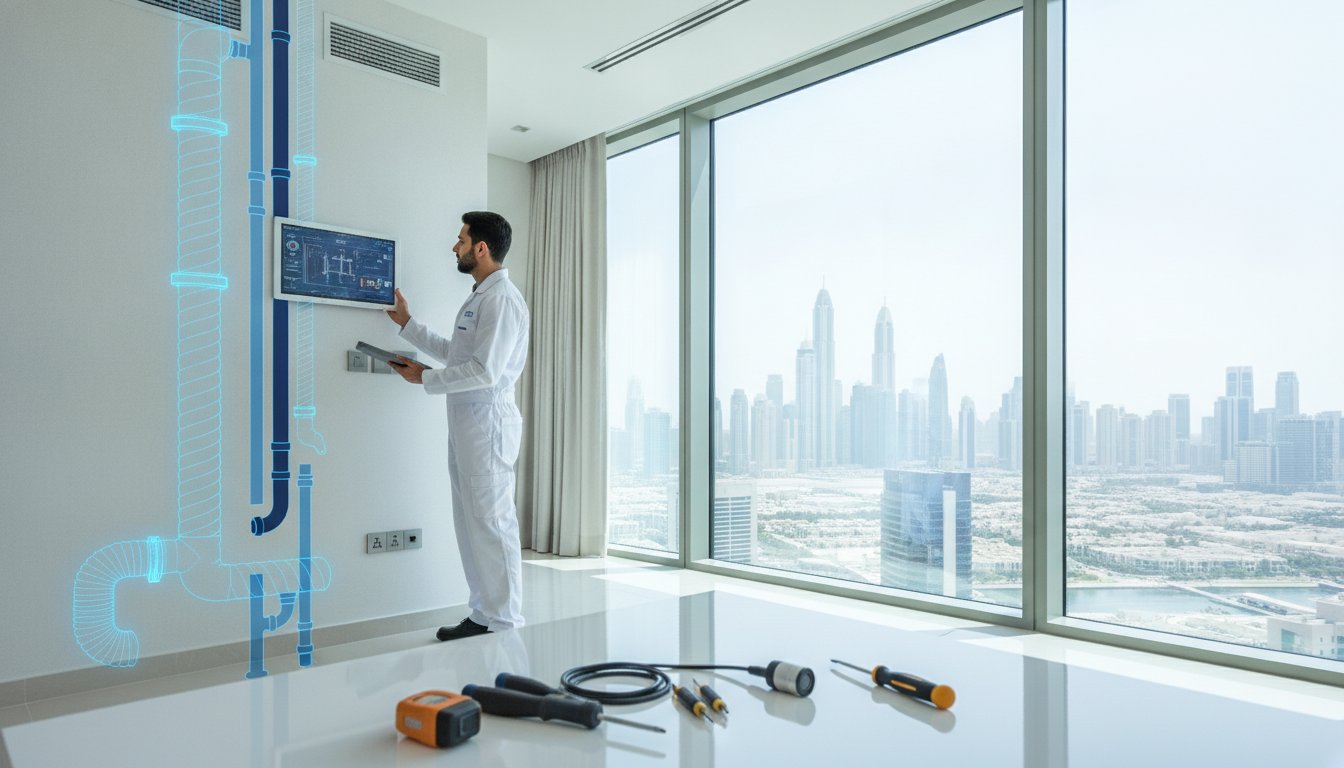
A technical apartment odour assessment UAE is a multi-phase investigation. It is not a casual walk-through. We begin with a detailed client interview to map the “odour timeline.” This process identifies environmental triggers such as specific times of day, humidity fluctuations, or AC operation cycles. This data allows our specialists to narrow down the mechanical origin before deploying sensors. Mapping the symptoms is the first step toward scientific certainty.
Next, we conduct a rigorous visual inspection of all “wet areas.” This includes kitchens, bathrooms, and laundry rooms. We look for compromised seals, dried P-traps, and improper plumbing vents. Simultaneously, we evaluate the HVAC system. This involves checking duct integrity and coil conditions to find hidden biological colonies. The investigation concludes with pressure testing and gas detection. We use calibrated sensors to find invisible leaks in the drainage system that pull sewer gas into the home. Once the investigation is complete, you receive a final diagnostic report. This is your technical roadmap for permanent elimination.
Advanced Diagnostic Tools Used by Specialists
Precision requires high-tech intervention. We utilize thermal imaging to detect hidden moisture pockets behind walls and insulation failures that lead to mould growth. Gas sniffers are essential. These devices are calibrated specifically for hydrogen sulphide and methane detection, identifying gas concentrations at parts-per-million levels. For internal ductwork and pipe interiors, we deploy borescope cameras. These allow us to see structural failures or blockages that are otherwise inaccessible. We don’t guess; we verify.
The Role of the On-site Inspection
Remote advice is insufficient for complex building odours. Every apartment has a unique pressure profile. We often identify “ghost smells” caused by air pressure differentials between units. These smells are pulled from neighbouring apartments or shared shafts through tiny gaps in the building envelope. Documenting these findings is the only way to determine how to get rid of AC smell permanently. Without an on-site presence, a technician cannot verify the interaction between your ventilation and the building’s main stack. If you are tired of temporary fixes, book a professional apartment odour assessment UAE to secure a definitive diagnosis of your property’s air quality.
Permanent Remediation: Moving from Diagnosis to Treatment
Technical diagnosis is only the first stage of resolution. Once the apartment odour assessment UAE identifies the specific origin of a smell, the transition to remediation must be clinical and precise. Surface cleaning is not remediation. Permanent elimination involves a two-pronged approach: biological eradication within the HVAC system and mechanical restoration of the plumbing infrastructure. We don’t just clean; we restore the technical integrity of your living environment.
Mechanical failures require mechanical solutions. If an inspection reveals a failed seal or a compromised P-trap, we replace the physical components. We restore trap integrity to ensure the water seal remains permanent. This prevents sewer gas from bypassing the building’s safety measures. Understanding the mechanics of a bathroom drain smell UAE issue, including the critical role of the 75mm water seal, is essential to ensuring these repairs deliver lasting results. Post-treatment verification is essential. We re-test the air quality to confirm the source is gone. We don’t consider a project complete until the data proves the air is clean.
German-Style Aircon Cleaning Explained
Standard AC cleaning often stops at the mesh filters. This is a failure of process. German-style standards target the evaporator coil, the fan blower, and the entire internal housing. We focus on total biological removal. Our technicians use eco-friendly, non-toxic agents that eliminate biofilm without increasing VOC levels in your home. It’s a deep-tissue decontamination. This methodology ensures that the source of the “musty” smell is physically extracted from the system, not just masked with a temporary chemical rinse.
Long-term IAQ Management for Apartment Owners
Maintaining high indoor air quality requires a preventative mindset. Don’t wait for an odour to return before taking action. Implement a maintenance schedule that prioritizes the mechanical health of your property. Simple daily habits prevent the buildup of stagnant air. Open windows for brief periods during cooler hours to flush the apartment. Pour water into floor drains weekly to keep P-traps primed and functional. These small steps protect the results of your initial apartment odour assessment UAE.
For residents in mixed-use developments or high-density towers, shared ventilation shafts remain a risk. When odours originate from common areas, you may need to schedule a commercial property smell inspection to address building-wide issues. Secure your property’s air quality today. Eliminate the mystery of persistent smells. Replace frustration with scientific certainty by partnering with a technical specialist who understands the physics of odour.
Restore Your Home’s Technical Integrity
Persistent smells are diagnostic signals of mechanical or biological failure. You’ve learned that surface cleaning and chemical masking agents only hide the symptoms of deeper structural issues. Whether the origin is a colonized AC evaporator coil or a failed drainage seal, identifying the root cause is the only path to permanent relief. A professional apartment odour assessment UAE replaces the cycle of frustration with scientific data and clinical certainty. It moves your home from a state of discomfort to a state of resolution.
We provide national coverage across the UAE, delivering clinical diagnostic reports that map every technical fault in your property. Our specialists utilize specialized German-style cleaning protocols to ensure total biological removal and long-term air quality. Don’t settle for temporary fixes that compromise your health. Take control of your indoor environment today. You deserve a home that is both fresh and safe.
Book Your Technical Odour Assessment with SMELLKILLERS.COM
Frequently Asked Questions
Why does my apartment smell like sewage even when I clean regularly?
Sewage odours are typically caused by mechanical failures in the plumbing or ventilation infrastructure, not lack of hygiene. Cleaning cannot fix dry P-traps, failed mechanical seals, or pressure imbalances in the building’s drainage stack. These faults allow sewer gases like methane and hydrogen sulphide to bypass your apartment’s airtight seals and enter your living space through floor drains.
Can poor indoor air quality in an apartment cause health problems?
Degraded air quality triggers documented physiological symptoms. Airborne pathogens, mould spores, and high concentrations of Volatile Organic Compounds (VOCs) often lead to chronic headaches, fatigue, and respiratory irritation. This condition is frequently referred to as Sick Building Syndrome. It occurs when pollutants are trapped within the modern, airtight construction common in UAE high-rises.
How long does a professional apartment odour assessment take?
A comprehensive apartment odour assessment UAE typically requires between 60 to 90 minutes for a standard unit. This duration allows specialists to conduct a methodical visual inspection, map environmental triggers, and deploy gas detection sensors. Larger properties or complex cases involving shared ventilation shafts may require additional time for a thorough technical analysis of the ductwork.
What is the difference between standard AC cleaning and an odour assessment?
Standard cleaning is a superficial service that focuses on mesh filters and visible surfaces. An odour assessment is a forensic diagnostic investigation. It utilizes technical equipment to locate the physical origin of a smell. We identify whether the issue is hidden biological growth deep within the AC coils or a gaseous leak in the drainage system.
Is the odour assessment non-invasive for my apartment walls and floors?
The assessment is entirely non-invasive. We utilize high-tech diagnostic tools such as thermal imaging cameras and calibrated gas sniffers to see behind walls and inside pipes. There is no requirement for structural demolition or removal of materials to identify the source of a smell. Our methods prioritize diagnostic accuracy without causing damage to your property.
Will an odour assessment identify mould that is hidden behind walls?
Thermal imaging identifies hidden moisture pockets where mould thrives behind drywall or under flooring. We detect temperature differentials that signal active leaks, insulation failures, or condensation issues. This technical approach allows us to locate biological threats and structural dampness without the need to physically open the wall cavities or remove building materials.
Can you identify the source of a smell if it only happens at certain times of day?
Intermittent smells are identified by mapping the “odour timeline.” We analyze how the odour correlates with AC operation, building pressure differentials, or external humidity levels. This methodical approach allows us to pinpoint the mechanical trigger and the specific source even if the smell is not actively present during the time of the physical inspection.
What is the ‘German-style’ aircon cleaning mentioned by specialists?
German-style cleaning is a deep decontamination standard for HVAC systems. It moves beyond the filters to treat the evaporator coils, fan blowers, and the entire internal housing. This methodology ensures total biological removal using eco-friendly, non-toxic agents. It is designed to physically extract biofilm and bacteria, preventing the return of persistent musty odours in your apartment odour assessment UAE.