
Article by
Jonathan Bonnett
Australian Air Conditioning Specialist with extensive hands-on experience in AC servicing, deep cleaning, maintenance, and troubleshooting. Focused on high-quality workmanship, reliability, and professional service to UAE standards.
Most “deep cleaning” services in the UAE are purely cosmetic, masking bacterial growth with synthetic fragrances rather than removing the source. You’ve likely spent hundreds of dirhams on superficial chemical flushes only to have that persistent vinegar or sewage smell return within forty-eight hours. It’s a frustrating cycle of wasted expenditure. You expect a healthy home environment, but standard AC cleaning for odour removal UAE often ignores the underlying mechanical and biological causes. This technical guide identifies why standard maintenance fails to resolve these recurring issues. We’ll explain the scientific necessity of German-style cleaning protocols and how a diagnostic approach eliminates HVAC odours at their origin. You’ll learn to distinguish between temporary masking and permanent resolution. We’ll cover the specific bacterial strains common in local systems and the precise steps required to restore clinical air quality. Stop settling for temporary fixes. It’s time to understand the mechanics of your indoor air and solve the problem at its root.
Key Takeaways
- Identify why standard filter changes fail to address the microbial biofilm developing deep within your evaporator coils.
- Distinguish between biological “Dirty Sock Syndrome” and structural plumbing failures like dry p-traps that allow sewage gases to enter the ventilation.
- Evaluate the clinical advantages of German-style AC cleaning for odour removal UAE over traditional, often corrosive, chemical flushes.
- Learn the specific diagnostic markers that indicate a need for professional on-site odour assessment rather than routine maintenance.
- Understand the technical protocols required for long-term remediation of indoor air quality issues without relying on temporary masking fragrances.
Why Standard AC Cleaning Fails to Remove Persistent Odours
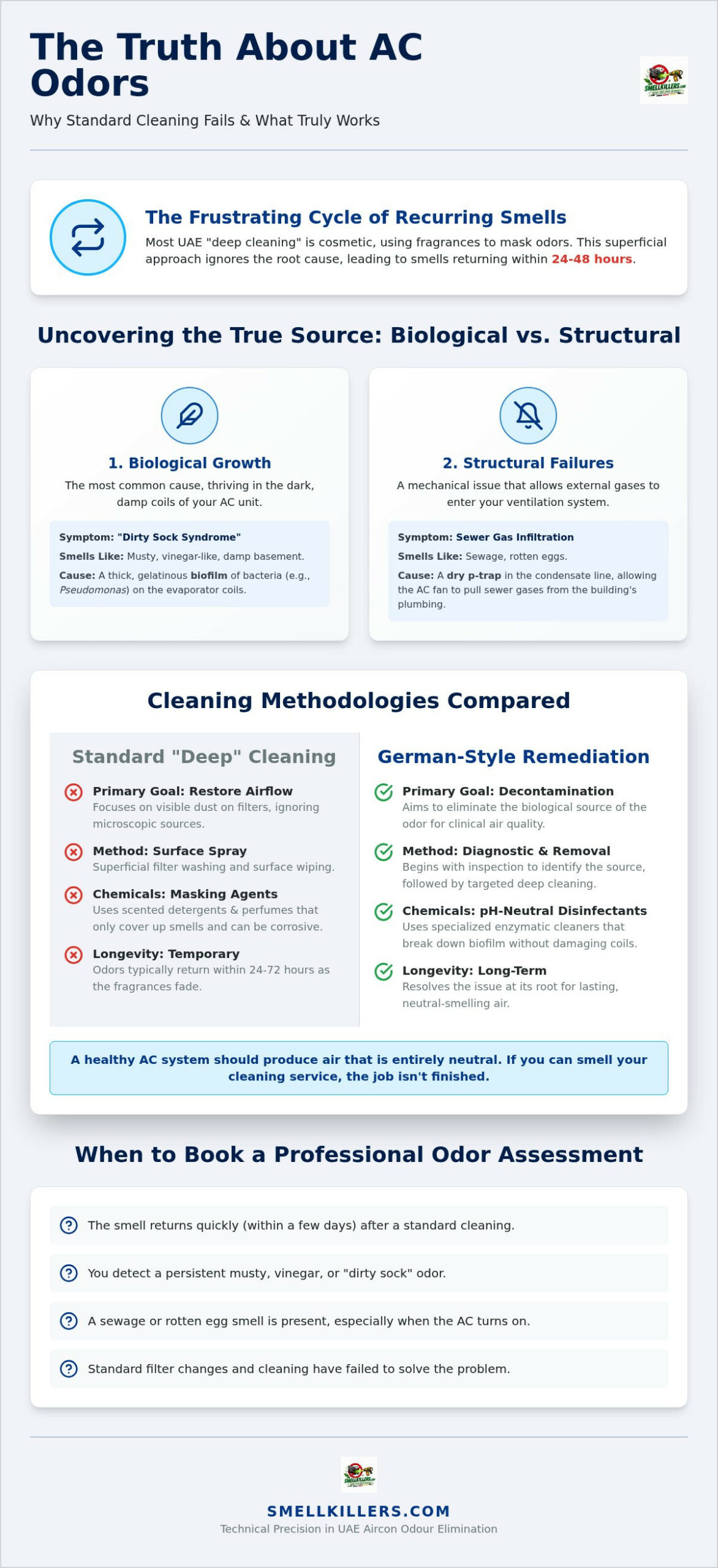
Standard maintenance is designed for mechanical longevity, not air purity. Most technicians focus on removing dust from filters to improve airflow efficiency. While this helps the compressor run without overworking, it ignores the microbial reality of HVAC systems. Odours are biological signals. They indicate the presence of active colonies. Cleaning the filter does nothing to address the biofilm adhering to the evaporator coil fins or the stagnant water in the condensate tray. Standard protocols prioritize what is visible. They ignore what is microscopic.
The primary issue is the “Fragrance Trap.” Many general cleaning services in the UAE use scented aerosol sprays or heavy perfumes. These chemicals provide a temporary sensory distraction. They do not neutralize the bacteria. Within 24 to 48 hours, the scent evaporates, and the original smell returns. This failure occurs because the technician didn’t identify the biological sources of HVAC smells hidden within the internal insulation or the drainage line. True AC cleaning for odour removal UAE requires moving beyond surface aesthetics to clinical decontamination.
The Limitation of General Maintenance
Visual cleanliness is deceptive. A filter can look spotless while the evaporator coil behind it is coated in a thick, gelatinous biofilm. This layer protects bacteria from standard detergents. General maintenance packages often skip the deep-seated coil disinfection required to stop recurring smells. Without specialized enzymatic or high-pressure German-style protocols, these colonies remain active. They continue to release Volatile Organic Compounds (VOCs) into your living space every time the fan engages. If the condensate drain line is partially blocked, it creates a reservoir for anaerobic bacteria, causing a persistent sewage smell that a simple filter wash cannot fix. Understanding the full clinical process of ac coil cleaning for biological odour elimination reveals why surface-level approaches consistently fail to deliver lasting results.
Masking vs. Remediation: A Technical Comparison
Effective remediation requires a diagnostic mindset. You must determine if the smell is biological, such as fungal growth, or structural, such as sewage gas entering through a dry p-trap. Standard chemical flushes often use corrosive acids that damage coil coatings. These agents might kill some surface bacteria but fail to reach the root of the problem. A technical approach focuses on source elimination rather than scent application.
| Feature | Standard Cleaning | Specialized Odour Treatment |
|---|---|---|
| Primary Goal | Restore Airflow | Biological Decontamination |
| Method | Filter wash; surface spray | Diagnostic inspection; source removal |
| Chemicals | Scented detergents; masking agents | Enzymatic cleaners; pH-neutral disinfectants |
| Longevity | Temporary (24 to 72 hours) | Long-term resolution |
Low-quality cleaning agents pose health risks in enclosed Dubai apartments. When these chemicals react with existing mould, they can create secondary irritants. True remediation eliminates the need for any fragrance. A healthy AC system should produce air that is entirely neutral. If you can smell your cleaning service, the job isn’t finished.
Identifying the Biological and Structural Sources of HVAC Smells
Identifying the source is the critical first step in remediation. Odours typically fall into two categories: biological growth or structural infiltration. Understanding the chemistry of these smells prevents wasted expenditure on incorrect treatments. Musty or vinegar-like scents often indicate “Dirty Sock Syndrome.” This occurs when bacterial colonies, including Pseudomonas and Bacillus, thrive on the evaporator coils. They produce a thick biofilm. This matrix protects the microorganisms from standard cleaning agents. High humidity in the UAE accelerates this process. The dark, damp environment of the internal unit acts as an incubator. Effective AC cleaning for odour removal UAE must penetrate this biofilm to reach the metal surface.
Sewage or rotten egg smells suggest a structural failure. This is not a cleaning issue but a mechanical one. If a p-trap in the condensate line dries out, the AC fan pulls sewer gases directly from the building’s plumbing. This cross-contamination bypasses filters entirely. A professional on-site inspection by SMELLKILLERS.COM is required to distinguish between these two root causes. Without this diagnostic step, you’re merely treating a symptom while the source remains active.
Biological Contaminants in the UAE Climate
Extreme humidity levels in the UAE provide the moisture required for rapid fungal escalation. Stagnant water in the drain tray becomes a breeding ground for pathogens. When the system engages, it aerosolizes these contaminants. This directly impacts respiratory health. Review the dirty AC health risks to understand the clinical implications of poor HVAC hygiene. Biofilm chemistry is complex. It requires specialized enzymatic disruption to fully eradicate the colony and prevent immediate regrowth.
Structural Odour Vectors: Drains and Vents
Air pressure physics dictate odour movement. The HVAC system creates negative pressure. If the drainage connection is improper, the unit acts as a vacuum for the building’s vent pipes. This explains why smells often intensify when the compressor starts. A professional inspection must determine if the odour is generated by the unit or transported through it. Cleaning the unit without addressing the plumbing connection will result in immediate recurrence. Technical AC cleaning for odour removal UAE involves more than just washing parts; it requires verifying the integrity of the entire drainage circuit.
Comparing Cleaning Methodologies: Chemical Flush vs. German-Style Deep Cleaning
Standard industry practices in the UAE often rely on speed rather than efficacy. Most providers offer a “chemical flush” as a premium solution. This involves spraying aggressive acidic or alkaline foaming agents onto the evaporator coils. While these chemicals react quickly with surface dirt, they rarely reach the core of the biological biofilm. In contrast, technical AC cleaning for odour removal UAE utilizes a clinical German-style protocol. This methodology prioritizes diagnostic accuracy and mechanical sanitization over chemical saturation. The goal is the total eradication of the odour source, not just a surface-level wash.
The equipment used defines the result. Standard cleaning typically involves a low-pressure garden hose or a basic spray bottle. These tools lack the force required to penetrate the dense fins of modern high-efficiency AC units. Professional remediation requires specialized diagnostic tools. We utilize endoscopes to inspect the dark recesses of the air handler and high-pressure steam generators. Steam at high temperatures provides a physical kill rate for bacteria that chemicals cannot match. It reaches into the crevices of the insulation where odours often linger. A comprehensive technical guide to ac coil cleaning and biological odour removal details precisely how these steam and enzymatic protocols achieve results that standard chemical flushes cannot.
The Hidden Dangers of AC Chemical Cleaning
Aggressive chemical cleaning agents leave behind microscopic residues. These surfactants are often hygroscopic, meaning they attract moisture. In the high-humidity environment of Dubai or Abu Dhabi, this residue creates a sticky surface that accelerates new bacterial colonization. Over time, these corrosive substances degrade the delicate aluminium fins of your heat exchanger, reducing cooling efficiency. Review the aircon chemical cleaning side effects to understand the long-term structural risks. Many residents find that the strong “clean” scent of these chemicals is itself a VOC irritant. You are simply swapping a biological odour for a synthetic one.
The Precision of German-Style Remediation
German-style remediation is a systematic, sequential process. It moves from diagnosis to treatment with mathematical precision. The SMELLKILLERS.COM technical cleaning protocol follows a strict hierarchy of actions. We start by isolating the internal components to prevent cross-contamination. We then apply pH-neutral, enzymatic cleaners that break down the protein structure of biofilms. This is followed by high-temperature steam sanitization. This process ensures the unit is biologically inert. Precision matters in commercial property odour remediation. A single recurring smell in a retail or office space can impact business operations. We focus on source elimination. This ensures the result is a neutral, healthy environment that requires no masking fragrances to feel clean.
Diagnostic Checklist: When to Book a Professional Odour Assessment
Standard maintenance is a scheduled preventative measure. A diagnostic assessment is a targeted investigative process. You must recognize when the former is insufficient. If a typical AC cleaning for odour removal UAE has been performed and the smell returns within 48 hours, the source is likely structural or deep-seated biological growth. You are dealing with a root-cause issue that surface washing cannot reach. Delaying a professional assessment allows microbial colonies to expand further into the internal insulation and ductwork.
Watch for these specific indicators that demand technical intervention:
- The odour is strongest immediately after the fan engages or the compressor starts.
- The scent resembles fermented vinegar, rotten eggs, or raw sewage.
- Occupants report recurring headaches, sinus congestion, or respiratory irritation while indoors.
- Visible black spots or gelatinous “sludge” appear in the condensate drain tray or on the blower wheel.
- The smell persists even when the AC unit is in “fan only” mode.
Evaluating Your Current Indoor Air Quality
Identify the origin by comparing the air at the supply and return vents. If the smell is localized at the supply vent, the contamination is inside the AC unit itself. If the smell is present at the return vent, the source is likely within the room or the building’s structural voids. Document the timing of the occurrence. Note if the smell is constant or intermittent. Intermittent smells often point to external environmental factors or specific plumbing usage. Constant smells suggest a permanent biological colony within the HVAC insulation. This data is vital for a clinical diagnosis. A diagnostic inspection differs from a maintenance call because it utilizes specialized tools like endoscopes and moisture meters to find hidden moisture pockets.
Commercial vs. Residential Warning Signs
High-rise apartments and office buildings in the UAE face unique pressure differentials. These forces pull sewer gases through dry p-traps or faulty vent pipes. In the Dubai real estate market, persistent odours can devalue a property or lead to high tenant turnover. For multi-unit properties, a technical property odour assessment is necessary to map the building’s airflow and drainage connections. This prevents the spread of contaminants between floors. The cost of a diagnostic assessment is significantly lower than the cumulative waste of multiple ineffective cleanings. If your system shows these symptoms, book an on-site inspection to resolve the issue permanently.
SMELLKILLERS: Technical Precision in UAE Aircon Odour Elimination
SMELLKILLERS.COM represents a shift from general maintenance to clinical remediation. We apply rigorous German-style protocols to ensure that every intervention is permanent. Standard providers often rush into a chemical flush that damages equipment. We do the opposite. We prioritize on-site inspection to map the biological and structural landscape of your property. This ensures that our AC cleaning for odour removal UAE is targeted and effective. We don’t believe in temporary solutions. Our team eliminates the root cause of the smell, whether it is a thriving bacterial colony or a mechanical failure in the drainage system.
Our commitment to air quality is absolute. We never use masking agents or synthetic fragrances to hide underlying issues. If a system is professionally sanitized, it should produce neutral, scent-free air. We focus entirely on the transition from a state of discomfort to a state of scientific resolution. By identifying the specific microbial or structural origin, we provide property owners with the certainty that the issue won’t return in forty-eight hours.
Our Technical Diagnostic Protocol
We utilize specialized sensors and visual tools to find hidden odour sources. This includes high-resolution endoscopes and moisture detectors. These tools allow us to see behind the evaporator coils and into the condensate trays where biofilm accumulates. Our partnership with PANKOBAU Building Maintenance LLC provides the structural expertise required for complex building investigations. This is essential for high-rise apartments in Dubai where air pressure issues pull sewage gases into the living space. We do not clean until we have diagnosed the origin of the contaminant. This source-first philosophy prevents wasted expenditure and ensures clinical air quality.
Ensuring Long-Term HVAC Hygiene
Resolution is the first step; prevention is the second. After treatment, we provide post-remediation guidelines to maintain a neutral environment. This includes managing humidity levels and ensuring p-traps remain functional. For complex properties, regular odour expert UAE consultations are recommended to monitor indoor air quality. We restore your environment to its natural state without the use of harmful chemicals. Take the first step toward permanent resolution. Book a Professional On-site Odour Inspection Today.
Restore Clinical Air Quality to Your Property
Persistent HVAC smells are not a maintenance issue; they are a diagnostic challenge. Standard cleaning fails because it addresses visible dust while leaving microbial biofilms and structural plumbing faults intact. Permanent resolution requires a shift from superficial masking to technical source detection. By identifying whether your odour is biological, such as fungal growth on coils, or structural, like sewer gas infiltration, you stop the cycle of wasted expenditure on recurring chemical flushes. German-style protocols provide the methodical precision needed for total decontamination.
Choosing a specialized AC cleaning for odour removal UAE ensures your indoor environment is healthy and scent-free. We utilize expert diagnostic technology and precision cleaning to eliminate root causes without relying on synthetic fragrances. It’s time to replace the mystery of recurring smells with scientific certainty. You don’t have to tolerate poor air quality or temporary fixes. Take the final step toward a neutral, healthy home or office. Book a Technical Odour Assessment and German-Style Cleaning today to experience the difference of a clinical, source-first approach. Your journey to permanent odour elimination starts with a single diagnostic inspection.
Frequently Asked Questions
Why does my AC smell like sewage even after it was cleaned?
Sewage smells usually indicate a structural plumbing failure rather than a dirty filter. If the p-trap in your condensate line dries out or the vent pipe is blocked, the AC fan pulls sewer gases into your home. Standard maintenance doesn’t address these drainage connections. You need a technical inspection to verify the mechanical integrity of the entire waste-water circuit and prevent gas infiltration.
Is the smell coming from my AC harmful to my health?
Persistent odours are biological indicators of active mould or bacterial colonies. These microorganisms release spores and volatile organic compounds (VOCs) that trigger respiratory distress, headaches, and sinus irritation. Dubai Municipality sets strict indoor air quality standards because these contaminants directly impact long term health. Ignoring a foul scent means you are breathing in aerosolized pathogens that require clinical remediation to eliminate.
What is the difference between AC duct cleaning and odour removal?
Duct cleaning is a maintenance process that removes physical debris like dust and sand from the ventilation channels. Odour removal is a diagnostic treatment targeting the biological source of a smell, such as biofilm on evaporator coils or structural gas leaks. While duct cleaning improves airflow, it doesn’t necessarily kill the bacteria causing a scent. True AC cleaning for odour removal UAE requires specialized disinfection protocols.
Can a dirty AC cause a vinegar-like smell indoors?
A vinegar-like scent is a primary symptom of “Dirty Sock Syndrome,” caused by bacterial fermentation on damp evaporator coils. Microorganisms like Pseudomonas thrive in the dark, humid environment of the internal unit, creating a thick biofilm. This chemical reaction occurs when the system transitions between cooling cycles. Simple washing won’t work. You need enzymatic cleaners and high temperature steam to physically disrupt and kill the colony.
How long does a professional German-style AC cleaning take?
A technical German-style cleaning typically requires 2 to 4 hours per unit. This timeframe allows for a comprehensive diagnostic phase, component isolation, and deep-coil sanitization. We prioritize accuracy and source elimination over speed. The exact duration depends on the severity of the biological contamination and the complexity of the drainage system. We ensure the unit is biologically inert before completing the treatment.
Why do I need an on-site inspection before cleaning?
Inspection replaces guesswork with scientific certainty. We must identify the origin of the odour, whether it is biological growth inside the unit or a structural issue in the building’s plumbing. Cleaning a unit when the smell is coming from a dry drain trap is a waste of expenditure. A diagnostic inspection ensures we apply the correct technical protocol to resolve your specific air quality issue permanently.
Will air fresheners help eliminate AC odours permanently?
Air fresheners are temporary masking agents that do not address the root cause. They introduce synthetic fragrances and additional chemicals into your breathing zone while the underlying bacteria or mould continues to grow. This approach is purely cosmetic and often irritates the respiratory system further. Permanent resolution requires the physical removal of the contaminant. Once the source is eliminated, your indoor air will be naturally neutral.
Are the chemicals used in AC cleaning safe for children and pets?
We utilize pH-neutral, enzymatic cleaning agents and high-temperature steam rather than corrosive acids. These methods are non-toxic and biodegradable, ensuring your indoor environment remains safe for vulnerable occupants. Standard chemical flushes often leave behind irritating residues that can trigger allergies. Our German-style protocols focus on mechanical and biological sanitization. This provides a clean environment without the risks associated with low-quality industrial detergents.