
Article by
Jonathan Bonnett
Australian Air Conditioning Specialist with extensive hands-on experience in AC servicing, deep cleaning, maintenance, and troubleshooting. Focused on high-quality workmanship, reliability, and professional service to UAE standards.
Scrubbing your surfaces and bleaching your drains won’t stop a smell that’s rooted in your building’s infrastructure. Most owners mistake a persistent odour for a cleanliness issue when it’s actually a mechanical failure. You’ve likely spent significant money on superficial cleaning only for that sewage or AC musk to return. A professional property odour assessment is the only way to replace this frustration with technical precision.
This guide details the clinical diagnostic protocols used by specialists to identify and eliminate indoor smells at their source. You’ll learn how to move beyond temporary fixes to achieve scientific certainty about your air quality. We’ll preview the investigation process, from advanced gas detection to structural inspections. Identify the source; restore the air. This methodical approach ensures a permanent resolution and protects your property value.
Key Takeaways
- Understand why standard cleaning fails and how a technical property odour assessment identifies the structural origin of persistent smells.
- Learn the clinical diagnostic protocol used to map symptoms and inspect HVAC and plumbing infrastructure using thermal technology.
- Identify the difference between biological AC growth and mechanical drain gas failures to ensure the correct treatment is applied.
- Discover why chemical masking agents and DIY fixes often cause more harm than good to your indoor air quality.
- Explore the engineering-led remediation methods, including German-style aircon cleaning, that provide a permanent end to indoor odours.
Understanding the Technical Property Odour Assessment
A professional property odour assessment is a clinical diagnostic process. It’s not a subjective sensory check or a simple “sniff test.” While general maintenance focuses on surface hygiene, a technical assessment prioritises source identification. This involves a forensic analysis of the building’s mechanical and structural integrity. Specialists use advanced technology, such as an Olfactometer, to quantify intensity and detect specific chemical or biological markers. Identify the origin. Measure the concentration. Resolve the failure.
This process is essential for maintaining Indoor Air Quality (IAQ) standards. Without a precise diagnosis, property managers often waste resources on recurring cleaning services that fail to address the root cause. A technical report provides the scientific certainty required for long-term remediation. It moves beyond “masking” and into engineering-led solutions. It replaces mystery with data.
The Impact of Persistent Odours on Property Value
Recurring smells are more than a nuisance; they’re a financial liability. In the UAE market, indoor air quality is a primary driver of asset marketability. Persistent sewage or AC odours directly correlate with poor tenant retention and failed lease renewals. If a property smells, it’s perceived as poorly maintained or structurally compromised. Unresolved sewage gas leaks also carry significant legal and health implications. These gases, such as hydrogen sulphide, can be toxic in high concentrations. A documented assessment protects owners by proving due diligence and providing a clear roadmap for repair.
When to Move Beyond General Cleaning
General cleaning has a ceiling. If a smell returns within 24 to 48 hours of a deep clean, you’re dealing with the “rebound effect.” This suggests the odour isn’t on the surfaces; it’s within the infrastructure. You must distinguish between environmental symptoms and mechanical failures. Use this checklist to identify structural issues:
- Structural Infiltration: Odours entering through wall cavities, floor voids, or unsealed penetrations.
- Mechanical Failure: Faulty A/C drainage, dried-out P-traps, or cracked vent stacks.
- Biological Growth: Mould or bacteria colonising internal HVAC components or damp insulation.
If the smell is consistent regardless of cleaning frequency, it’s structural. You need a diagnostic investigation to find the origin. Stop guessing. Start measuring. Professional intervention is required when the problem is mechanical rather than environmental. Understanding how to identify the source of bad smell in buildings using systematic diagnostic protocols is the critical first step toward a permanent resolution.
The Diagnostic Protocol: How Specialists Track Odours
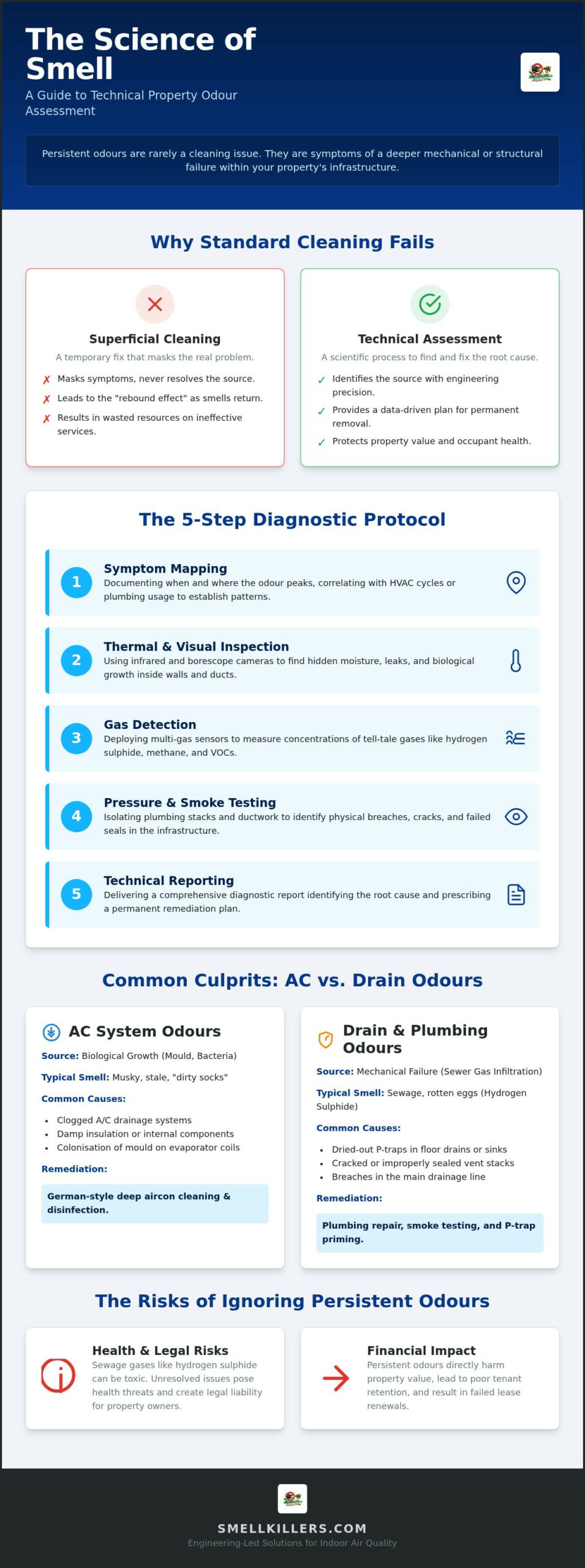
A professional property odour assessment follows a rigorous five-step diagnostic protocol. It moves from historical data collection to mechanical verification. This systematic approach ensures that no structural or environmental factor is overlooked. Specialists don’t rely on subjective “sniffing.” They rely on data. The protocol includes:
- Step 1: Symptom Mapping. We document when the odour peaks. Does it coincide with high-usage plumbing hours or specific HVAC cycles?
- Step 2: Thermal and Visual Inspection. We use infrared technology to find hidden moisture or heat signatures from biological clusters.
- Step 3: Gas Detection. We deploy sensors to measure concentrations of methane, hydrogen sulphide, and volatile organic compounds (VOCs).
- Step 4: Pressure and Smoke Testing. We isolate plumbing stacks and ductwork to identify physical breaches in the infrastructure.
- Step 5: Technical Reporting. We provide a diagnostic document that identifies the root cause and prescribes a permanent remediation plan.
If you suspect a mechanical failure in your building, an on-site inspection provides the technical clarity needed to stop the issue at its source.
Advanced Detection Technology
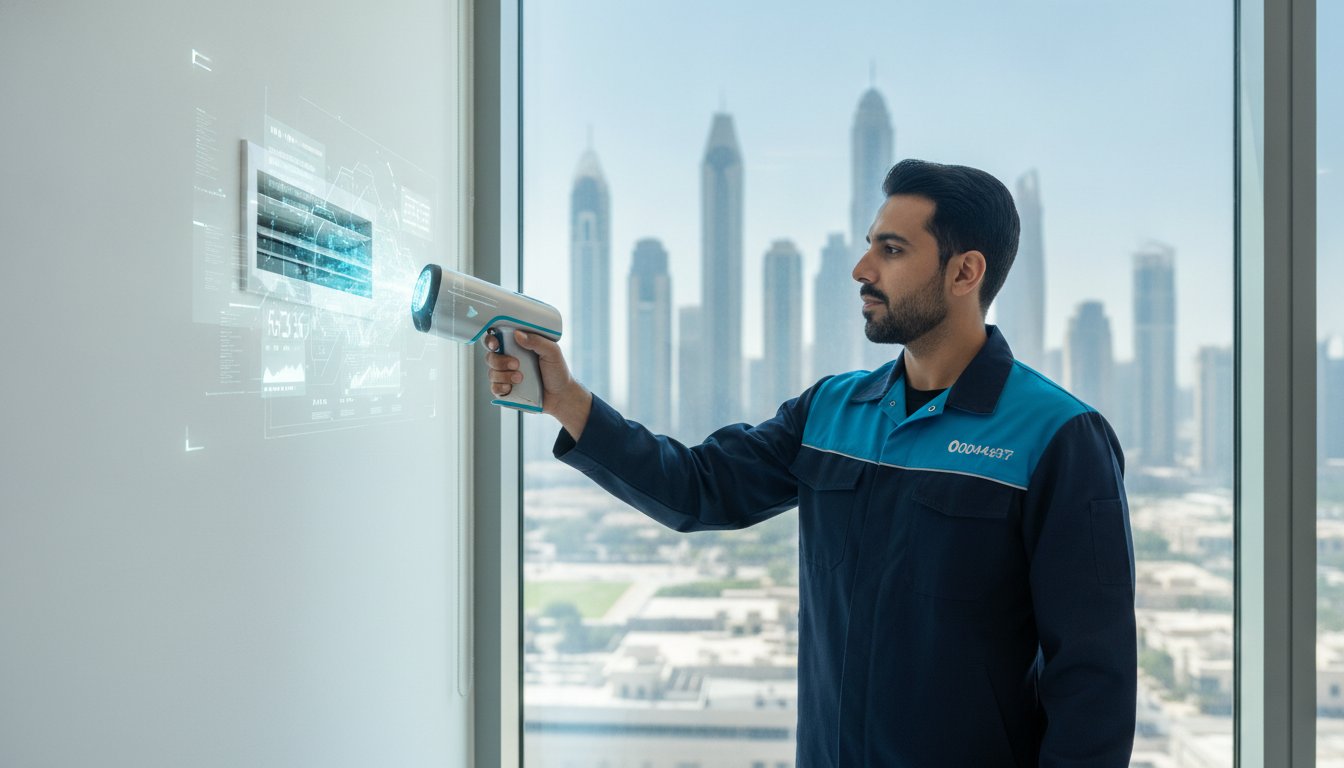
Specialists use multi-gas detectors to identify specific chemical signatures. These devices find methane and hydrogen sulphide, which are common indicators of sewage gas infiltration. We compare these readings against established safety benchmarks, such as those found in A Guide to Indoor Air Quality, to evaluate health risks. Thermal imaging cameras detect moisture trapped behind walls, revealing biological growth that isn’t visible to the naked eye. Borescope cameras allow for internal ductwork and pipe analysis. We see what is happening inside your walls without destructive testing.
Source vs. Symptom: The Investigation Mindset
The core of a property odour assessment is the “investigation mindset.” Specialists ignore the smell itself to find the physical origin. We focus on airflow patterns and pressure differentials. A smell in the living room might originate from a faulty P-trap in a distant bathroom. Gas migrates through wall cavities and ventilation stacks. We evaluate the integrity of every mechanical seal. We track how air moves through the property. Find the leak. Fix the seal. The smell disappears. This methodical approach replaces guesswork with engineering certainty.
AC vs. Drain Smells: Comparative Diagnostic Frameworks
Diagnostic accuracy depends on categorising the odour profile. Biological sources produce musty, vinegar-like, or “sour” scents. Mechanical failures in plumbing systems release hydrogen sulphide, methane, and ammonia. A property odour assessment must first isolate these chemical signatures to determine which infrastructure requires investigation. According to the CDC Guide to Indoor Air Quality, identifying these specific chemical contaminants is a foundational step in mitigating health risks within the built environment. Identify the profile. Map the system. Resolve the source.
Modern high-rise buildings face unique risks from ventilation cross-contamination. HVAC systems can inadvertently distribute plumbing odours through shared ductwork or unsealed utility shafts. The “stack effect” in tall buildings creates pressure differentials that pull sewer gas from faulty drains into the air intake of the A/C units. This results in a plumbing issue masquerading as an AC problem. Villa properties face different vectors, often involving ground-level septic connections or irrigation leaks that infiltrate the building envelope through wall cavities. A technical guide on locating the source of bad smell in buildings provides the precise inspection steps needed to differentiate between these infrastructure failures.
HVAC Odour Vectors
Air conditioning systems are prime environments for biological colonisation. Biofilm accumulates on cooling coils when condensation fails to drain efficiently. This microbial growth releases Volatile Organic Compounds (VOCs) into the supply air. Stagnant water in condensate pans acts as a primary bacteria source, often leading to a persistent “dirty sock” smell. These issues require more than a surface wipe; they demand technical remediation. For a deeper look at mechanical HVAC solutions, refer to our guide on Aircon Odour Elimination.
Plumbing and Sewage Gas Vectors
Mechanical drain smells are usually structural. Dried P-traps are the most common culprit in guest rooms or laundry areas. When the water seal evaporates, sewer gases enter the living space unimpeded. Faulty Air Admittance Valves (AAVs) also play a critical role. These valves can fail in the open position, allowing gas to bypass the ventilation stack. In villas, these vectors are often complicated by specific structural settling that cracks internal vent pipes. The UAE’s high ambient temperatures further accelerate microbial activity, making sewage odour elimination UAE properties require a matter of engineering precision rather than routine maintenance. Property owners can find specific troubleshooting steps in our Villa Smell Problem: A Technical Guide. Stop the gas at the breach. Don’t just clean the floor.
Why DIY Fixes and General Cleaning Fail
Most property owners react to unpleasant smells by increasing the frequency of general cleaning. This is a tactical error. A property odour assessment often reveals that these efforts are not just ineffective; they’re counterproductive. Surface cleaning addresses environmental hygiene but ignores the structural mechanics of gas infiltration. Fragrances do not neutralise gas molecules. They simply add a secondary layer of aromatic compounds to the air, creating a “perfumed sewage” effect that fails to resolve the underlying failure.
Standard AC maintenance is equally limited. Many service providers perform a basic filter wash and coil spray that leaves up to 70% of the bacteria and biofilm behind. These biological clusters reside deep within the cooling fins and internal drainage lines. Without a German-style clinical deep cleaning, the organic matter remains, and the smell returns within days. Beyond ineffectiveness, understanding the aircon chemical cleaning side effects that result from harsh industrial agents is critical, as corrosive residues can damage your unit’s internal components while failing to eliminate the biological source. Professional remediation requires a shift from superficial aesthetics to technical source elimination.
If your property continues to smell despite daily cleaning, you need a technical investigation. Book a property odour assessment to identify the mechanical source of the issue.
The Myth of the “Clean” Smell
There is a critical distinction between a sanitized environment and a perfumed one. Many consumer-grade air fresheners contribute to poor indoor air quality by releasing high levels of Volatile Organic Compounds (VOCs). These chemicals can irritate the respiratory system without removing a single molecule of the original odour. Residents often fall victim to sensory adaptation. Odour fatigue is a biological process where the brain stops perceiving a constant smell, leading occupants to believe an issue is resolved while the actual contaminant remains present. A professional assessment uses calibrated sensors to bypass human sensory limitations and provide objective data.
Structural Limitations of General Maintenance
General cleaning staff lack the diagnostic tools required for root cause identification. They cannot see behind wall cavities or inside complex HVAC ductwork. A standard mop and bucket cannot address a cracked vent stack or a failing Air Admittance Valve. Surface wiping is an aesthetic service; deep-core remediation is an engineering service. To achieve a permanent solution, you must transition from maintenance to a Residential Odour Inspection UAE. We use borescope cameras and thermal imaging to inspect the infrastructure itself. We find the breach. We seal the system. We restore the air quality with scientific certainty.
Using bleach or harsh chemicals in drains is another common mistake. These substances can damage rubber seals and PVC joints, leading to further leaks. In some cases, bleach reacts with sewer gases to create toxic fumes. Stop the DIY experimentation and rely on clinical protocols.
The Smellkillers Approach: Technical Remediation
Remediation begins where general maintenance ends. The Smellkillers approach integrates technical investigation with PANKOBAU Building Maintenance expertise to execute structural repairs. We don’t just identify the breach; we seal it. Our process transitions from a property odour assessment into a targeted elimination phase that neutralises biological or gas sources at their origin. This methodical intervention ensures that smells don’t return once the technicians leave. We replace uncertainty with engineering-led solutions.
Our remediation strategy follows a strict, linear logic to ensure a permanent resolution. We address the physical infrastructure before treating the air. This sequential approach includes:
- Structural Sealing: We repair cracked vent pipes and unsealed wall penetrations identified during the audit.
- Gas Neutralisation: We deploy clinical-grade treatments to break down hydrogen sulphide and ammonia molecules.
- Biological Eradication: We remove the biofilm and bacteria colonies that general cleaning cannot reach.
- Verification: We perform post-treatment air quality monitoring to confirm the total removal of contaminants.
Clinical Cleaning Standards
Professional German-style aircon cleaning is the cornerstone of our biological remediation. This methodology involves more than a surface flush. We use specialised equipment to penetrate the cooling fins and sanitise the internal drainage lines. We utilise eco-friendly, non-toxic agents to ensure the environment remains safe for residents while being lethal to microbial growth. For a detailed breakdown of our technical interventions, review the Odour Expert UAE: Technical Protocols. Clean the system. Verify the air. Breathe with confidence.
Securing Your Property’s Air Quality
Book an on-site property odour assessment to initiate the diagnostic process. During the initial visit, expect a thorough investigation of your HVAC and plumbing infrastructure using gas detectors and thermal cameras. We provide a transparent report detailing the “how” and “why” of the smell. Once remediation is complete, we implement long-term maintenance strategies to prevent odour recurrence. This includes periodic inspections and air quality verification. Don’t settle for temporary masking. Demand a permanent, scientific resolution. Transition from discomfort to resolution today.
Transition to a Permanent Odour Solution
Persistent indoor odours are structural failures. They require a clinical approach to determine if the origin is a compromised plumbing seal or deep-seated biological growth in your HVAC system. A professional property odour assessment replaces guesswork with objective data. It ensures that every mechanical breach is sealed and every biological cluster is eradicated. Operated by PANKOBAU Building Maintenance LLC, we apply specialised German-style cleaning techniques and expert source detection to restore residential and commercial assets.
Stop wasting resources on temporary masking agents. These products only hide symptoms while the underlying contaminant remains. Identify the source. Execute the repair. Restore your environment. Book Your Technical Property Odour Assessment with Smellkillers to secure your indoor air quality and protect your property value. You don’t have to live with a mystery. You deserve scientific certainty. Take the first step toward a healthier, odour-free property today.
Frequently Asked Questions
What is included in a professional property odour assessment?
A professional property odour assessment includes a comprehensive forensic review of your building’s infrastructure. Technicians deploy multi-gas detectors to measure methane and hydrogen sulphide concentrations. We utilise thermal imaging to locate hidden biological clusters and borescope cameras for internal pipe inspections. The process concludes with a technical report that identifies the mechanical or structural root cause of the smell. We replace sensory guesswork with calibrated data and engineering certainty.
How long does a technical odour inspection take?
A standard technical inspection typically requires 1.5 to 3 hours to complete. This duration allows technicians to map symptom peaks and conduct a thorough review of the HVAC and plumbing systems. Larger villas or commercial properties with complex ventilation networks may require additional time for precise source isolation. We focus on diagnostic accuracy rather than speed to ensure the remediation plan addresses the actual failure point within the property.
Can you find a smell that only appears at certain times of the day?
Yes, intermittent smells are frequently linked to specific mechanical cycles or environmental pressure changes. We use symptom mapping to track when the odour peaks, such as during high-usage plumbing hours or specific HVAC cooling cycles. These transient odours often indicate a failing Air Admittance Valve or a dry P-trap that only allows gas infiltration under certain load conditions. We identify these patterns to locate the structural breach.
Why does my AC smell like sewage even after a filter change?
Filter changes only address surface dust; they don’t stop gas infiltration from the drainage network. If your AC smells like sewage, the system is likely pulling sewer gas through a dry condensate P-trap or a breach in a shared utility shaft. The HVAC blower then redistributes these gases throughout the property. A technical property odour assessment is necessary to identify where the plumbing and ventilation systems are cross-contaminating.
Are the chemicals used in odour treatment safe for pets and children?
We utilise eco-friendly, non-toxic agents that are specifically formulated for indoor air safety. Our remediation protocols avoid the use of harsh bleaches or hazardous ozone generators that can leave irritating residues. These clinical-grade treatments target and neutralise gas molecules and biological biofilm at the source. The process is designed to restore air quality without compromising the health of your family or pets. Safety and efficacy are our primary benchmarks.
Do I need to leave the property during the odour assessment?
No, you don’t need to vacate the premises during the initial diagnostic visit. The assessment process is non-invasive and non-destructive. Technicians use electronic sensors and thermal cameras to inspect the infrastructure without damaging walls or ceilings. You can continue your daily routine while we conduct the investigation. If a specific heavy-duty remediation treatment is required later, we will provide clear instructions on any temporary access restrictions for that phase.
What is the difference between a standard AC clean and a German-style clean?
The difference lies in the depth of sanitation and the removal of biological biofilm. Standard cleaning is often a superficial filter wash and a light coil spray. A German-style clean involves a clinical deep-sanitation of the internal cooling fins, condensate pans, and the entire drainage line. This methodical approach removes the organic matter that standard services leave behind. It ensures a permanent end to the musty smells caused by microbial growth.
Can a property odour assessment detect gas leaks?
Yes, our multi-gas detectors are calibrated to identify methane, hydrogen sulphide, and volatile organic compounds. These sensors detect the presence of sewer gases that have bypassed your plumbing seals. While we don’t perform general HVAC repairs, we pinpoint the exact mechanical failure or structural breach allowing these gases into your living space. Identifying these leaks is a critical step in restoring safety and air quality to your residential or commercial property.