
Article by
Jonathan Bonnett
Australian Air Conditioning Specialist with extensive hands-on experience in AC servicing, deep cleaning, maintenance, and troubleshooting. Focused on high-quality workmanship, reliability, and professional service to UAE standards.
What if the “deep cleaning” you booked last month is the primary reason mold is returning to your vents today? Most property owners in Dubai treat HVAC hygiene as a simple seasonal chore, yet they continue to struggle with persistent vinegar-like smells and recurring respiratory irritation. If you’re tired of wasting money on superficial services that fail to solve the issue, you must look beneath the surface. Learning how to prevent mold in AC UAE requires more than just washing filters; it demands a clinical approach to moisture control and biofilm elimination.
We recognize the frustration of living with compromised air quality in a region where residents spend 90% of their time indoors. You need a permanent solution rather than a temporary mask. This guide provides the scientific protocols and technical maintenance steps required to stop biological growth at the source. We will explain the vital distinction between standard cleaning and professional remediation, ensuring your property meets the mandatory requirements of the UAE Climate Decree 2025. It’s time to replace guesswork with diagnostic accuracy and technical certainty.
Key Takeaways
- Analyze the UAE “dew point” challenge to understand why condensation on evaporator coils triggers persistent biological contamination.
- Master the technical steps for how to prevent mold in AC UAE by dismantling the biological biofilm matrix that shelters microbial colonies.
- Evaluate the critical difference between superficial jet washing and German-style remediation focused on root-cause elimination.
- Optimize indoor air quality by maintaining relative humidity between 40% and 55% and utilizing “Auto” mode to allow internal components to dry.
- Implement professional odour detection and on-site inspections to identify and neutralize deep-seated microbial sources permanently.
Why UAE Air Conditioning Systems Are Prone to Mold Growth
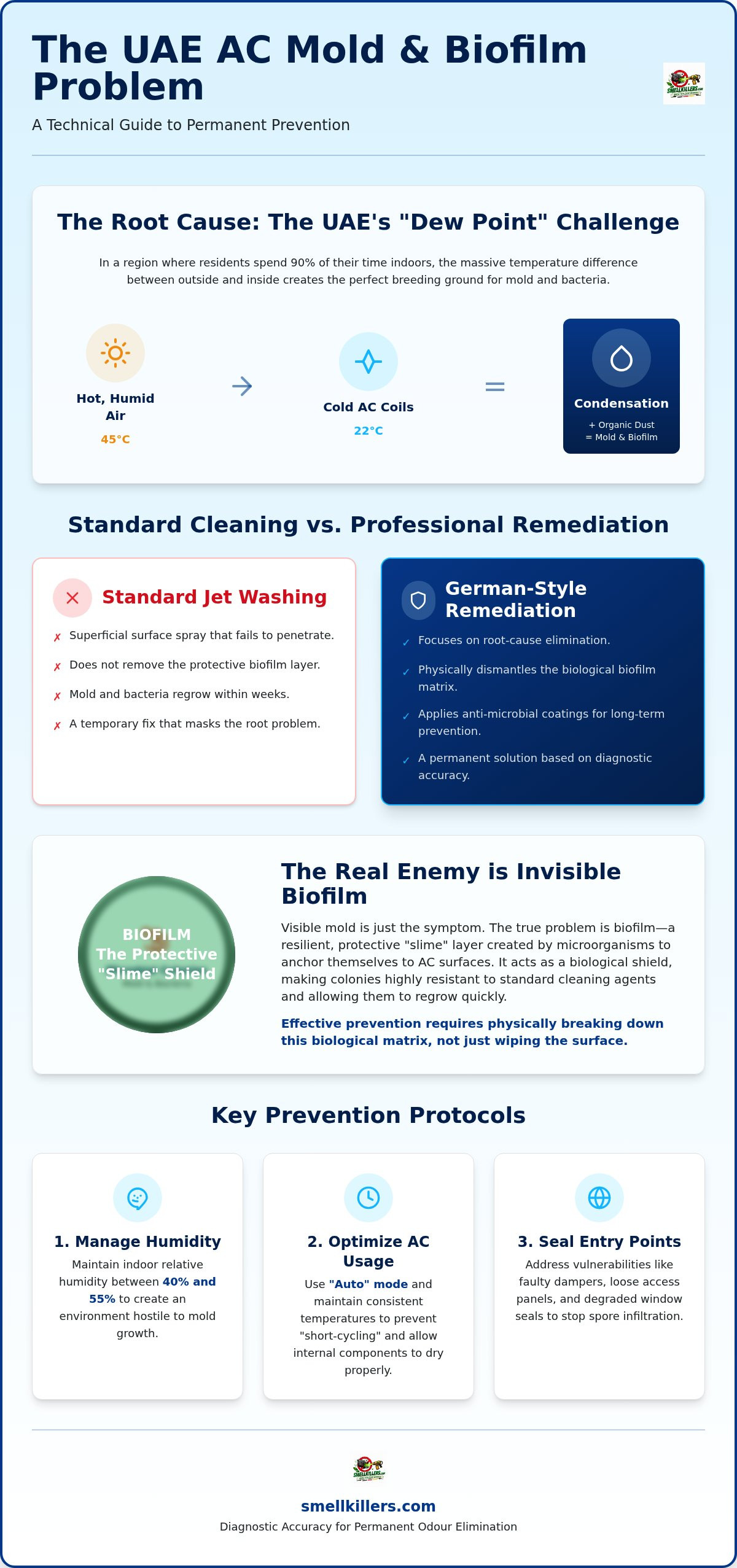
Mold in your HVAC system is not merely a cosmetic issue. It is a biological contamination. This growth occurs when persistent moisture meets organic dust, creating a fertile environment for microbial colonies. In the United Arab Emirates, the primary catalyst is the extreme dew point. When humid outdoor air enters a cooled indoor environment, it reaches its saturation point. This results in heavy condensation on the evaporator coils and internal insulation. Without proper intervention, these wet surfaces become the primary breeding ground for Indoor mold and bacterial biofilm.
Nutrient availability is the second factor in the growth equation. Modern indoor environments are filled with organic matter. Dead skin cells, hair, and microscopic dust particles bypass standard filtration systems. These particles settle on damp internal components, providing the protein and cellulose mold needs to thrive. While visible patches on vents indicate a late-stage infestation, the real danger lies in microscopic spores. These invisible contaminants circulate through your living space long before a musty smell becomes detectable. Understanding how to prevent mold in AC UAE requires a focus on these underlying biological requirements.
The Role of Humidity and Temperature Differentials
The vast gap between 45°C outdoor temperatures and 22°C indoor settings creates a “sweating” effect. This moisture often accumulates in the ceiling void, a space frequently overlooked during routine maintenance. Many UAE villas and apartments feature uninsulated duct plenums that trap humid air. When you fluctuate thermostat settings or turn the system off entirely, you encourage moisture spikes. Consistent temperature management is essential. Rapid cooling cycles lead to “short-cycling,” which leaves the evaporator coil saturated with water rather than allowing it to dry through airflow.
Common Entry Points for Spores and Contaminants
Contamination often begins at the building’s perimeter. Degraded door seals and window gaskets allow humid, spore-laden air to bypass the primary HVAC intake. In high-rise buildings across Dubai and Abu Dhabi, the “stack effect” compounds this issue. Pressure differentials pull unfiltered air through elevator shafts and service gaps. Standard AC filters are designed to capture large dust particles, not microscopic spores. They cannot stop biological infiltration. Diagnosis must focus on the following entry points:
- Plumbing Vents: Improperly sealed drainage lines can introduce sewer gases and moisture.
- Ceiling Access Panels: Loose panels allow unconditioned air from the building structure into the supply air stream.
- External Dampers: Faulty fresh air intakes often pull in excessive humidity during peak summer months.
Identifying these mechanical vulnerabilities is the first step in learning how to prevent mold in AC UAE effectively. Prevention is a technical process of moisture management and source isolation.
Technical Protocols for Preventing Biofilm and Microbial Colonies
Eliminating visible mold is only the first stage of HVAC remediation. The true challenge lies in the removal of biofilm. This is a resilient, protective “slime” layer created by microorganisms to anchor themselves to internal surfaces. It acts as a biological shield, protecting underlying colonies from standard cleaning agents. Effective aircon odour elimination requires a technical protocol that physically breaks down this biological matrix. Without disrupting the biofilm, mold will simply regrow on the same surfaces within weeks.
Understanding how to prevent mold in AC UAE involves more than just cleaning; it requires surface modification. High-quality anti-microbial coatings on evaporator coils provide a long-term defense. These coatings often utilize silver-ion technology to prevent microbes from attaching to the metal fins. By neutralizing the surface, you remove the foundation required for colony formation. This technical approach shifts the focus from reactive cleaning to proactive biological exclusion.
The Science of Biofilm Formation
Biofilm is a collaborative structure. Bacteria and mold spores bond together using extracellular polymeric substances (EPS). This “glue” makes the colony highly resistant to mechanical removal. Standard detergents often slide off this layer without reaching the source. When this matrix becomes saturated with moisture, it emits the characteristic “vinegar” or “sour” smell often reported by UAE residents. This odour is a byproduct of microbial metabolism occurring within the protective slime. Neutralizing this smell requires a deep-penetrating treatment that dissolves the EPS bond.
Managing the Condensate Drainage System
Stagnant water is the primary incubator for HVAC contaminants. The condensate drain pan must maintain a specific slope to ensure immediate water evacuation. Even a minor deviation in the pan’s level leads to standing water, which quickly turns into a microbial breeding ground. According to the EPA guide to mold, controlling moisture is the single most important factor in preventing biological growth indoors. Professional protocols must also verify the integrity of the P-trap. This component prevents sewer gases from entering the air stream, as these gases often contain the nutrients and moisture that feed deep-seated mold colonies.
Regular flushing of the drain lines is a non-negotiable step in how to prevent mold in AC UAE. Blockages in these lines create high-humidity zones within the unit, accelerating the spread of spores. If you detect persistent smells despite regular filter changes, a professional on-site inspection is necessary to diagnose whether your drainage system is functioning as a microbial incubator.
Standard Cleaning vs. Professional German-Style Prevention
Many property owners in Dubai mistake a high-pressure water spray for a comprehensive deep clean. This superficial “jet washing” often fails because it only addresses visible surface dust. Professional German-style prevention is a diagnostic-led remediation process. It prioritizes identifying the root cause of moisture before any treatment begins. Effective AC mold smell removal UAE must involve the entire air path, including the blower motor, the plenum, and internal insulation. Cleaning just the filters is a temporary fix that leaves the primary microbial reservoir untouched.
Chemical selection is equally critical. Standard cleaning services often use harsh, acidic detergents to achieve quick visual results. These substances can corrode the protective coating on evaporator coils. This corrosion etches the metal, creating new microscopic pits where mold and bacteria can grip more effectively. A professional protocol uses pH-neutral, environmentally responsible agents that preserve the integrity of the system while neutralizing biological threats. Understanding how to prevent mold in AC UAE requires this level of technical precision rather than aggressive, unguided washing.
The Diagnostic Advantage: Finding the ‘Why’
Prevention starts with a professional property odour assessment. We don’t just look for mold; we track humidity leaks and pressure imbalances that standard cleaners ignore. Following EPA mold remediation guidance, our protocols focus on the systematic isolation of moisture sources. German-standard protocols ensure biological stability by verifying that the environmental factors which caused the growth are permanently resolved. This diagnostic-first approach is the only way to move from recurring cleaning cycles to long-term prevention.
Why Superficial Fixes Fail
Beware the “Masking Trap.” Many services rely on heavy fragrance sprays to signal cleanliness. These sprays often contain organic compounds that provide a food source for surviving mold spores. Furthermore, improper pressure washing can push contaminants deeper into the porous duct insulation, making them impossible to remove later. A professional service always includes a mandatory “dry-out” phase. This ensures that no residual moisture remains within the unit to trigger immediate regrowth. If you want to know how to prevent mold in AC UAE, you must demand a process that values technical logic over superficial aesthetics.
Practical Steps to Manage Humidity and Air Quality at Home
Daily operational habits are the first line of defense against biological colonization. Managing the internal micro-climate is a technical requirement for any property owner. Maintain indoor relative humidity (RH) levels between 40% and 55%. While Dubai Municipality guidelines suggest keeping RH below 60%, staying within the 40-55% range provides a safety margin against localized condensation. If you want to master how to prevent mold in AC UAE, you must monitor these levels using a digital hygrometer. Consistent humidity control prevents spores from reaching the germination threshold.
Switch your thermostat fan setting to “Auto” rather than “On.” When the fan runs continuously, it re-evaporates moisture from the wet evaporator coil and blows it back into your living space. The “Auto” setting allows the coil to drain and the internal components to dry during the off-cycle. Additionally, verify that all bathroom and kitchen exhaust fans are functioning. These fans must vent moisture externally to prevent humidity spikes that feed microbial growth in the return air ducts. Ensure your door seals and window gaskets are intact. Leaks allow unconditioned, humid air to bypass your system’s filtration, leading to “sweating” on vents and registers.
Sometimes, a smell coming from AC vent is not originating from the unit itself. It is often sewer gas pulled from a dry floor drain P-trap. Ensure you pour water into all floor drains weekly to maintain the water seal. This prevents cross-contamination between your plumbing and ventilation systems.
Thermostat and Mode Optimization
Setting your AC to 18°C is a common mistake that increases mold risk. This creates an extreme temperature differential, cooling the ductwork surfaces below the dew point of the ceiling void. This results in condensation behind your gypsum boards. Keep your thermostat between 22°C and 24°C for biological stability. During transition seasons like October and April, utilize “Dry Mode.” This setting prioritizes dehumidification over cooling, which is essential when outdoor humidity is high but temperatures are moderate. Smart thermostats can assist by maintaining consistent dew points and preventing the rapid fluctuations that trigger moisture accumulation.
Routine Owner Inspections
Perform a monthly visual audit of your AC components. Inspect the “V-bank” where the evaporator coils meet. Look for standing water or greyish sludge. Monitor the condensate drain outlet to ensure a clear, steady flow; a trickle often indicates a partial blockage. Learn to identify the difference between normal dust and biological growth. Dust is typically dry and grey. Mold appears “fuzzy,” “velvety,” or takes the form of black and green spotting on the vent surfaces. If you detect these signs, standard cleaning will not suffice. For a definitive diagnosis of your system’s hygiene, book a professional on-site inspection today.
Professional Odour Detection: The Path to Permanent Prevention
Standard cleaning services treat symptoms. Professional remediation treats the source. At SMELLKILLERS.COM, our on-site inspections utilize forensic methodologies to track the origin of biological and chemical odours. We identify moisture vectors that remain invisible to the naked eye. This diagnostic focus is the only reliable way to understand how to prevent mold in AC UAE over the long term. By mapping the entire air path from intake to exhaust, we ensure that deep-seated microbial colonies are not just suppressed, but eliminated.
Cross-contamination is a frequent cause of HVAC failure. If your AC smells like sewage, the issue often stems from a mechanical breach between the ventilation and plumbing systems. These sewage gases introduce specific nutrients that accelerate mold growth within the ductwork. Resolving these technical overlaps is vital for maintaining HVAC health and preventing recurring infestations. Beyond sewage odours, property owners should also be aware that a sharp AC musty smell removal Dubai protocol is required when sulphur compounds are detected, as these chemical signals often indicate a distinct systemic failure requiring its own clinical diagnostic approach. Our partnership with PANKOBAU Building Maintenance LLC ensures every intervention meets rigorous German technical standards for biological stability.
The SMELLKILLERS.COM Diagnostic Protocol
We employ non-invasive technology to map moisture and odour vectors throughout your property. This process differentiates between mechanical failures, such as leaking refrigerant lines, and biological growth resulting from poor drainage. Our specialists follow a strict sequential logic to ensure accuracy. This includes an on-site environmental assessment, forensic moisture mapping, and root-cause identification. This clinical precision replaces the mystery of bad smells with scientific certainty. We don’t guess; we diagnose.
Securing Your Indoor Air Quality for 2026
Technical prevention is an investment in both health and property value. The UAE Climate Decree 2025 has made indoor air quality (IAQ) a mandatory compliance requirement for many structures. Property owners must prioritize long-term biological stability to meet these evolving regulations. Professional monitoring ensures you meet Dubai Municipality standards, which require Total Volatile Organic Compounds (TVOCs) to remain below 300 µg/m³. Sustainable, non-toxic remediation is the new benchmark for excellence in the Emirates. It protects your family while preserving the delicate balance of your HVAC infrastructure.
Effective management of your home environment is a continuous process. Learning how to prevent mold in AC UAE requires a move from reactive cleaning to proactive technical maintenance. Don’t settle for temporary fixes that merely mask the problem with fragrances. Invest in a permanent solution that addresses the mechanical and biological roots of contamination. Book your professional odour assessment today.
Transitioning to Permanent HVAC Hygiene
Achieving a mold-free environment in the UAE requires a shift from reactive seasonal cleaning to proactive biological management. You now understand that surface-level washing cannot penetrate the resilient biofilm matrix protecting microbial colonies. Effective how to prevent mold in AC UAE protocols depend on maintaining indoor relative humidity between 40% and 55% and utilizing “Auto” modes to ensure internal components remain dry. These technical adjustments, combined with professional diagnostic accuracy, form the only viable path to long-term air quality.
SMELLKILLERS.COM, operated by PANKOBAU Building Maintenance LLC, specializes in German-style clinical cleaning standards that prioritize root cause identification over masking symptoms. We eliminate the sources of contamination rather than simply addressing visible dust. If you’re ready to resolve recurring smells and respiratory irritation permanently, take the final technical step. Book Your Technical Odour Inspection Now. You deserve the certainty of a scientifically managed indoor climate.
Frequently Asked Questions
Is it possible to completely prevent mold in UAE AC systems?
Yes, complete prevention is achievable through precise moisture management and clinical hygiene standards. You must eliminate the environmental conditions that support microbial growth. This involves maintaining the system’s “dry state” and ensuring no organic dust accumulates on internal components. Understanding how to prevent mold in AC UAE requires moving beyond superficial washing toward a strategy of total biological exclusion.
How often should I have my AC professionally cleaned to prevent mold?
Professional deep cleaning should occur every six months to manage the extreme UAE humidity. However, property owners in Dubai must also conduct annual professional IAQ testing according to 2025/2026 standards. These inspections verify that formaldehyde and TVOC levels remain within legal limits. Regular maintenance prevents the formation of thick biofilm layers that are significantly harder and more expensive to remove once established.
Can a UV light in the AC unit stop mold from growing?
UV lights are effective supplemental tools but cannot replace physical cleaning. Ultraviolet Germicidal Irradiation (UVGI) neutralizes spores on the evaporator coil surface where the light directly reaches. It doesn’t penetrate the deep layers of biofilm or address contaminants in the ductwork or blower motor. Relying solely on UV technology without addressing moisture sources won’t provide a permanent solution for HVAC hygiene.
Why does my AC smell musty even after a deep clean?
A musty smell after cleaning indicates that the underlying biological matrix wasn’t fully disrupted. Standard jet washing often leaves the protective biofilm intact, allowing mold colonies to survive and regrow rapidly. The smell may also originate from secondary sources like dry floor drains or cross-contamination from the plumbing system. If the odour has a sharp, chemical quality, a professional sulphur smell from AC diagnostic protocol can help determine whether the source is a refrigerant leak or sewage gas infiltration rather than biological mold growth. A professional diagnostic inspection is necessary to identify the exact origin of these persistent odours.
What is the ideal humidity level for a home in the UAE?
The ideal indoor relative humidity (RH) for UAE homes is between 40% and 55%. While Dubai Municipality recommends keeping levels below 60%, a lower range provides a critical safety buffer against condensation. Maintaining these levels prevents spores from reaching their germination threshold. Use a calibrated hygrometer to monitor your indoor environment; levels above 60% trigger immediate microbial activity on cooled surfaces.
Does ‘Dry Mode’ on my AC help prevent mold growth?
Dry Mode is a highly effective tool for preventing mold during transition seasons like October and April. This setting prioritizes dehumidification over temperature reduction, removing moisture from the air without over-cooling the duct surfaces. By reducing the indoor dew point, you prevent the “sweating” effect that provides the moisture necessary for mold spores to thrive. It’s a key technical step in how to prevent mold in AC UAE.
Are mold spores in the AC dangerous for children or the elderly?
Mold spores represent a significant health risk to vulnerable populations, including children and the elderly. Exposure often leads to chronic respiratory irritation, allergies, and asthma flare-ups. The UAE Climate Decree 2025 recognizes these risks by making indoor air quality a mandatory compliance requirement for public buildings. Ensuring your home meets these clinical standards is essential for protecting the long-term health of all residents.
Should I replace my AC ducts if they have mold inside?
Duct replacement is rarely necessary if the structural integrity remains intact. Most mold infestations in ductwork can be resolved through professional remediation and the application of anti-microbial coatings. Replacement is a last resort reserved for instances where the insulation has suffered irreversible moisture damage or structural collapse. A technical property assessment will determine if the system can be salvaged through root-cause elimination.