

Article by
Jonathan Bonnett
Australian Air Conditioning Specialist with extensive hands-on experience in AC servicing, deep cleaning, maintenance, and troubleshooting. Focused on high-quality workmanship, reliability, and professional service to UAE standards.
Masking a smell is not the same as managing it. If you’re still deploying fragrance sprays to combat tenant complaints, you’re hiding a symptom rather than solving a technical failure. Effective commercial building odour control is a matter of diagnostic accuracy, not heavier perfumes. Most facility managers face a recurring cycle of “sewage” or “musty” odour reports that reappear shortly after a standard cleaning. It’s a frustrating, budget-draining loop that risks regulatory non-compliance and lower air quality scores. You shouldn’t have to guess where a smell originates. Masking agents don’t stop the spread of volatile organic compounds. They just delay the next complaint.
This article helps you master the technical protocols required to identify and eliminate persistent smells at their source. We’ll provide a clear framework to track invisible gas vectors, evaluate HVAC hygiene, and implement permanent solutions that go beyond the surface. We’ll preview the specific diagnostic steps to isolate mechanical failures and plumbing compromises. By the end of this checklist, you’ll have the tools to replace mystery with scientific certainty and ensure your facility meets the rigorous air quality expectations of 2026. This is about moving from temporary treatment to long-term resolution.
Key Takeaways
- Shift from reactive cleaning to systematic commercial building odour control by identifying the “Olfactory Adaptation” trap that compromises tenant satisfaction.
- Detect invisible vectors like negative pressure and dry floor drains that physically pull sewage gases into commercial infrastructure.
- Prioritize molecular source elimination over fragrance masking to prevent the accumulation of harmful volatile organic compounds.
- Utilize a two-phase diagnostic framework to map sensory data and audit HVAC infrastructure for biological or mechanical failures.
- Implement German-style precision cleaning to resolve root-cause issues in aircon units and drainage systems permanently.
Why Building Maintenance Odour is a Critical Operational Liability
Effective commercial building odour control is the systematic management of indoor air pollutants and malodours. It is a technical engineering discipline. It is not a housekeeping task. Many facility managers fall into the “Olfactory Adaptation” trap. This occurs when onsite staff stop noticing persistent smells due to constant exposure. Tenants do not share this desensitization. They experience the building as a critical operational liability. This leads to immediate tenant churn and reduced property value. Employee absenteeism rises as air quality drops. Poor odour management is often the first indicator of deeper mechanical or biological failures.
Sick Building Syndrome (SBS) is directly linked to inadequate ventilation and unresolved contaminant sources. When a building smells, it signals a failure in the indoor environment. Occupants report headaches, fatigue, and respiratory irritation. These symptoms translate to lost productivity and potential legal exposure. You cannot solve these issues with surface cleaning. You must isolate the source. You must diagnose the vector. You must implement a permanent treatment.
The Hidden Costs of “Masking” Strategies
Fragrance sprays and “neutralizers” are operational waste. They do not eliminate gas molecules; they simply overlay them with synthetic scents. This triggers chemical sensitivities. Many air fresheners release volatile organic compounds (VOCs) that worsen indoor air quality. This creates a secondary health risk for occupants. There is also a mechanical cost to ignoring the root cause. For example, Hydrogen Sulfide (H2S) gas from faulty drains is highly corrosive. It attacks the copper in HVAC coils and electronic components. Replacing a corroded A/C system is significantly more expensive than a one-time professional remediation. Stop paying for recurring temporary fixes. Invest in diagnostic accuracy.
Regulatory Compliance and Indoor Air Quality (IAQ)
International standards, such as those provided by ASHRAE, dictate specific ventilation rates for commercial spaces. Compliance is no longer optional. The industry is shifting toward “Well Building” certifications and total air quality transparency. Modern tenants now demand real-time air quality data before signing a lease. Odour reports are becoming standard in commercial lease renewals. If your building fails the “sniff test,” you risk regulatory fines and the loss of high-value corporate accounts. Professional commercial building odour control ensures your facility meets these evolving 2026 standards. It protects your reputation and asset value; for businesses looking to communicate this level of quality to new clients, EmirAds provides the digital marketing strategies needed to drive growth in the UAE.
Identifying Common Odour Vectors in Commercial Infrastructure
Identifying Common Odour Vectors requires an understanding of fluid dynamics and building physics. In modern 2026 facilities, odours rarely remain isolated. They migrate through specific pathways. We categorize these by origin: biological (mould and bacterial colonies), chemical (volatile organic compounds from finishes or cleaning agents), and environmental (sewage gases). High-performance commercial building odour control starts by recognizing that the building itself often acts as a pump. Modern “sealed” buildings, designed for energy efficiency, frequently lack the air exchange necessary to dilute these pollutants. This traps malodours within the envelope. They circulate repeatedly until they are professionally remediated.
The “Negative Pressure” effect is a common culprit in high-rise towers. When exhaust fans in kitchens or restrooms operate without sufficient make-up air, the building creates a vacuum. It physically pulls sewer gases through floor drains and dry P-traps. This is not a cleaning failure; it is a mechanical imbalance. Identifying these vectors is the first step toward a permanent solution. Without correcting the pressure, the smell will return regardless of how often the floors are scrubbed.
HVAC-Related Odours: Beyond the Filters
Your HVAC system is the primary distributor of indoor air pollutants. “Dirty Sock Syndrome” occurs when bacteria grow on the cooling coils, releasing a pungent, earthy smell during seasonal transitions. Biofilm growth in condensate trays is another common failure point. Standing water becomes a breeding ground for microorganisms that enter the air stream. Cross-contamination also occurs when fresh air intakes are situated too close to exhaust vents. The system effectively recycles the very smells it was designed to remove. For persistent HVAC issues, a professional Property Odour Assessment is necessary to isolate the contamination source.
Plumbing and Drainage Failures
Plumbing issues often manifest as “ghost” smells that appear and disappear. Dried P-traps in low-use areas, such as mechanical rooms or vacant suites, allow sewer gases to enter the workspace directly. In high-rise infrastructure, vent stack blockages create a “siphonage” effect. This pulls water out of traps on lower floors and leaves them open to the sewer main. Cracked pipes hidden behind walls or within slabs are the most difficult to diagnose. These require specialized detection equipment to locate the exact point of failure before a small leak becomes a major structural liability. In cases where hidden leaks have caused underlying damage, partnering with a restoration specialist like The Solution ensures that structural integrity is professionally restored. Effective commercial building odour control relies on mapping these failures with clinical precision.
Source Elimination vs. Fragrance Masking: A Cost-Benefit Analysis
Fragrance molecules don’t neutralize malodours. They are physically incapable of it. Most commercial air fresheners use heavy esters to overwhelm human olfactory receptors. Meanwhile, the underlying gas vectors, such as hydrogen sulfide or methane, remain active in the environment. This is not commercial building odour control; it’s sensory deception. True remediation requires a molecular shift. You must remove the organic or chemical source entirely. Masking only creates a “chemical cocktail” effect. This occurs when synthetic fragrances react with sewage gases to produce complex, irritant compounds that can trigger respiratory distress in sensitive occupants.
Comparing standard maintenance with specialized aircon odour elimination reveals a significant gap in technical efficacy. Standard cleaning focuses on visible surfaces. It ignores the sub-surface biofilms and internal duct residues where odours originate. The “German-style” philosophy prioritizes mechanical precision. It utilizes high-pressure, targeted interventions to strip away contaminants. It doesn’t rely on recurring chemical dosing. This approach is more sustainable. It is more effective. It replaces temporary relief with scientific certainty.
The Failure of Standard Cleaning Contracts
General cleaning staff lack the diagnostic tools for deep-source detection. They use mops and surface sprays. They don’t utilize borescope cameras or gas detection sensors. If your provider relies on “stronger” chemicals to solve a smell, they are masking the problem. Clinical-grade deep cleaning is a technical service. It requires an understanding of building physics. It identifies the origin. It treats the root. For professional insights into specialized deep cleaning, international resources like deepcleanservices.nl offer a benchmark for technical standards. You can tell a provider is masking if the “clean” scent disappears within hours, only for the original musty or sewage smell to return. Stop paying for perfumes. Invest in a diagnosis.
Long-Term ROI of Professional Remediation
Professional source elimination offers a measurable return on investment. Corrosive gases like H2S damage copper HVAC coils and electrical contacts over time. Removing these gases extends the functional lifespan of your infrastructure. Clean, unobstructed cooling coils also improve heat exchange efficiency. This reduces compressor load and lowers monthly energy consumption. High-end property management thrives on a “Smell-Free” environment. It justifies higher lease rates. It ensures tenant retention. The same diagnostic principles that protect commercial towers are equally critical in hospitality settings; a hotel odour inspection UAE case study demonstrates how technical source detection directly protects revenue and guest satisfaction scores. Investing in commercial building odour control is a financial strategy. It protects your equipment and secures your revenue; you can learn more about other critical financial considerations like the UAE’s corporate tax law to further safeguard your business.
The Ultimate Commercial Odour Detection Checklist
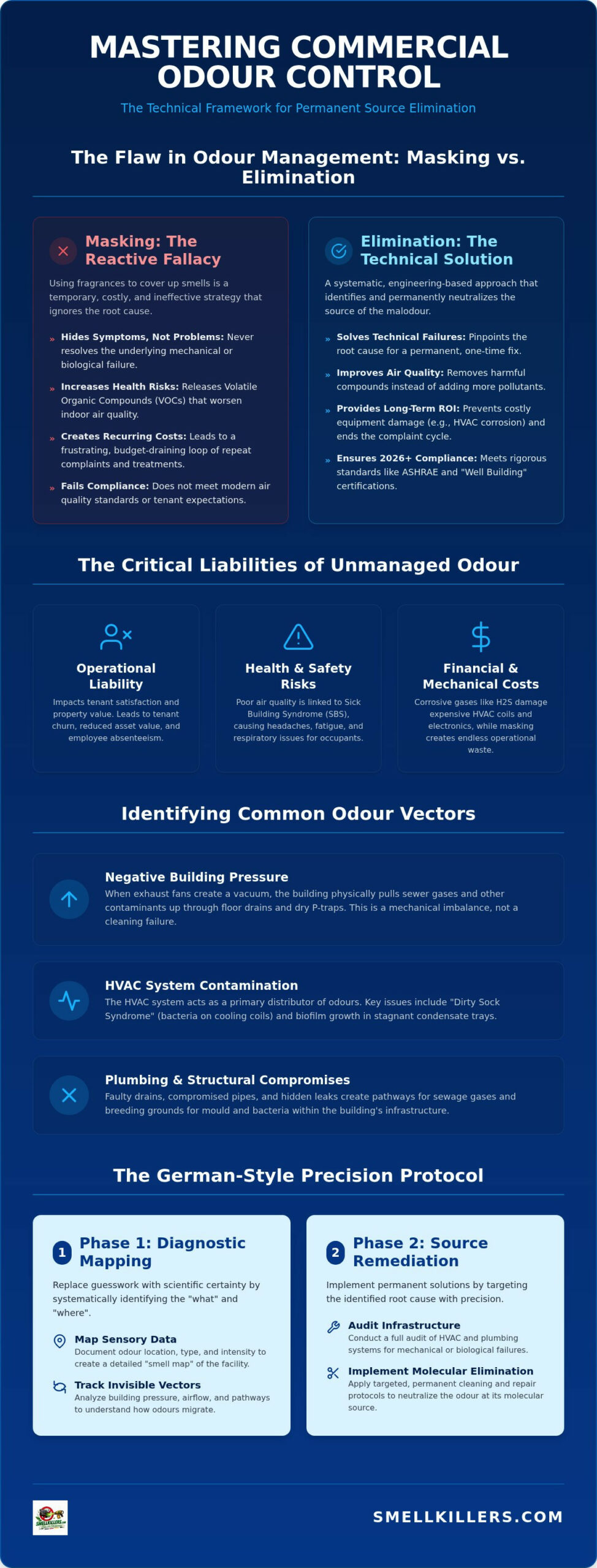
Effective commercial building odour control requires a systematic, phased investigation. Don’t guess. Follow a clinical process to isolate the root cause. This checklist moves from sensory observation to technical audit. It ensures no vector is overlooked. By following these phases, you replace reactive maintenance with diagnostic certainty.
- Phase 1: Sensory Mapping. Document the timing, location, and intensity of the malodour. Note if it correlates with HVAC cycles, occupancy levels, or weather changes.
- Phase 2: HVAC Audit. Inspect primary filters for moisture. Examine cooling coils and condensate lines for biofilm accumulation or standing water.
- Phase 3: Plumbing Audit. Test all P-traps and floor drains. Verify that vent stacks are clear of debris or bird nests that could cause siphonage.
- Phase 4: Structural Audit. Check wall cavities and ceiling voids for mould, dampness, or evidence of pest activity.
Step-by-Step Diagnostic Protocols
Use the “Bag Test” to isolate plumbing issues from air distribution problems. Seal a suspected floor drain with a heavy-duty plastic bag and duct tape. Leave it for 12 hours. If the room smell dissipates but the bag contains a concentrated odour, you’ve identified a drain failure. Perform a visual inspection of A/C coils next. Look for “aluminium rot,” which appears as white, powdery oxidation. This often indicates the presence of corrosive sewage gases reacting with the metal. Finally, check the building pressure balance. If the facility is under high negative pressure, it will pull air from the easiest available path. This is often the sewer line. Correcting this requires adjusting the make-up air units, not adding more fragrance. For a deeper technical breakdown of HVAC-specific causes and remedies, the professional guide to finding a permanent office AC bad smell solution provides the scientific framework needed to move beyond guesswork.
When to Call a Specialist
A self-audit has limits. Call a specialist if the smell persists for more than 48 hours after a deep cleaning. Localized “dead zones” where air remains stagnant also require professional intervention. These areas often hide sub-surface contaminants that standard ventilation cannot reach. Most importantly, act immediately if multiple tenants report symptoms like headaches, nausea, or respiratory irritation. This signals a potential health hazard and regulatory risk. Learn why a commercial property smell inspection is the only way to track inaudible gas leaks and complex biological colonies. For immediate resolution, book an on-site inspection to replace assumptions with diagnostic facts. Professional commercial building odour control stops the complaints by stopping the source.
Professional Remediation Protocols: The German-Style Approach
SMELLKILLERS.COM provides a clinical alternative to traditional facility maintenance. Our methodology is built on diagnostic accuracy. We call it “German-style” precision. This refers to the meticulous stripping of contaminants from infrastructure rather than the application of masking agents. Standard commercial building odour control often fails because it lacks the technical depth to reach the source. We don’t guess. We investigate. Our team operates under Dubai license 1464852, focusing entirely on source detection and permanent elimination.
Resolving persistent “rotten egg” smells in high-traffic commercial towers requires more than a mop. These odours are typically hydrogen sulfide emissions from stagnant drains or faulty HVAC seals. We isolate these gas vectors using specialized equipment. Once identified, we apply mechanical remediation to remove the biological or chemical origin. Integrating this professional oversight, alongside advanced systems from EdNex Automation for broader industrial automation, into your annual maintenance plan prevents the “Olfactory Adaptation” trap. It keeps the asset value high and ensures occupant satisfaction remains consistent year-round.
Our On-Site Inspection Technology
We utilize advanced gas detection and thermal imaging to find hidden leaks. These tools identify moisture plumes and gas concentrations behind walls or inside ductwork. Our “Source-First” guarantee is a hallmark of our service. We don’t start the treatment phase until we find the cause. Every inspection results in a detailed report. This isn’t a simple summary; it’s a technical roadmap for remediation. It provides property managers with the data needed to justify maintenance budgets and ensure long-term building health. To apply this same level of technical oversight to your building’s mechanical systems, you can discover BioKem Oil Services for expert oil analysis and purification. We replace mystery with scientific certainty.
Permanent Solutions for UAE Commercial Properties
The UAE climate creates unique challenges for commercial building odour control. High heat and humidity accelerate bacterial growth in A/C systems and drainage pipes. Standard chemicals can’t fix these deep-seated issues. A specialized odour expert UAE uses targeted protocols to neutralize sewage gases and biological films. This ensures indoor air quality meets 2026 standards. The same investigative rigour applied to commercial towers is equally essential in hospitality; a professional hotel odour inspection UAE reveals how hidden biofilm and ventilation failures are identified and permanently resolved to meet the UAE Climate Decree 2025. After professional treatment, follow this final checklist to maintain a smell-free environment:
- Maintain P-trap water levels in all floor drains weekly.
- Schedule quarterly German-style aircon cleaning for all AHUs.
- Monitor building pressure balance to prevent sewer gas suction.
- Audit exhaust fan performance in restrooms and mechanical rooms.
- Seal all pipe penetrations in wall cavities with appropriate firestop or sealant.
Don’t settle for superficial fixes. Permanent resolution requires tracking invisible gas vectors to their origin. By prioritizing diagnostics over perfumes, you protect your infrastructure and your reputation. Professional remediation is an investment in the longevity of your commercial asset.
Beyond air quality, maintaining the physical condition of your surfaces is vital for long-term value; learn more about SKR Specialists to see how professional respraying can rejuvenate your commercial interiors.
A pristine, odour-free environment is the foundation for hosting successful corporate events; if you are looking to showcase your space through high-end digital media, visit Miami Video Production to learn about broadcast-quality livestreaming for professional venues.
Securing Long-Term Indoor Air Quality
Effective commercial building odour control is a technical engineering discipline, not a janitorial task. You’ve learned that persistent smells are usually symptoms of mechanical imbalances or biological colonies hidden within your infrastructure. Masking these issues with fragrances only delays the inevitable failure of your HVAC coils and the loss of high-value tenants. True resolution requires a shift from superficial cleaning to clinical source detection. By identifying the specific gas vectors and pressure imbalances, you move from a state of frustration to operational certainty.
Our methodology prioritizes diagnostic accuracy over temporary fixes. We provide a No-Masking Guarantee and utilize German-Style Precision Cleaning to eliminate the root cause of every malodour. This methodical approach ensures your facility meets the air quality transparency standards expected in 2026. To help organizations manage and report these technical metrics, Shark Matrix Technologies LLC offers specialized custom software and CMS development services. Don’t let unresolved smells compromise your property value or occupant health. Take the first step toward a permanent solution and restore the professional environment your tenants deserve.
Book a Professional On-Site Odour Inspection Today to replace recurring complaints with scientific results. It’s time to solve the problem at its source.
Frequently Asked Questions
Why does my office A/C smell like vinegar or dirty socks?
Bacterial colonies growing on the cooling coils cause this specific malodour. This condition, often called “Dirty Sock Syndrome,” occurs when microorganisms thrive in the damp environment of the evaporator fins. Seasonal transitions often trigger the release of these smells as temperature and humidity levels shift. You must physically remove the biological film to resolve the issue. Surface sprays won’t reach the internal layers of the coil where the bacteria reside. For a complete technical breakdown of causes and permanent remedies, review the professional office AC bad smell solution diagnostic guide.
Can sewage smells in a building be dangerous to health?
Sewage smells indicate the presence of hydrogen sulfide and methane gases which can be hazardous to health. Prolonged exposure to these gases causes headaches, dizziness, and respiratory irritation. These gases are also highly corrosive to electronic components and copper HVAC coils. Ignoring these odours increases your legal liability and risks non-compliance with indoor air quality standards. You must treat the source to ensure a safe environment for occupants.
How do I tell the difference between a drain smell and an A/C smell?
Identify the origin by observing the smell’s distribution and timing. If the odour is widespread and intensifies when the ventilation fans are active, the HVAC system is likely the source. Localized smells near floor drains or sinks usually indicate plumbing failures like dry P-traps. Perform a “Bag Test” to confirm if a specific drain is leaking gas. Diagnostic accuracy is essential for effective commercial building odour control.
Why does the smell in our lobby only appear at certain times of the day?
Intermittent smells are typically caused by building pressure imbalances or peak usage cycles. When lobby exhaust fans operate without sufficient make-up air, the building creates negative pressure. This vacuum pulls sewer gases through dry floor drains during high-traffic hours. Wind direction and external temperature shifts also affect how gas vectors migrate through the lobby infrastructure. You must balance the ventilation system to stop this mechanical suction effect.
Is it enough to just pour bleach down the drains to stop the smell?
Pouring bleach down a drain is a temporary fix that does not address the underlying mechanical failure. While it may kill surface bacteria, it won’t restore a dry P-trap or clear a blocked vent stack. Bleach can also damage older plumbing infrastructure and react with other chemicals to create toxic fumes. Permanent resolution requires restoring the water seal or repairing the physical breach in the drainage system.
What is German-style aircon cleaning and how is it different?
German-style aircon cleaning focuses on mechanical precision and the total removal of internal contaminants. Standard maintenance often involves only filter cleaning and light surface sprays. This specialized approach utilizes high-pressure, targeted interventions to strip away sub-surface biofilms and oxidation from the cooling coils. This method ensures long-term hygiene and improves heat exchange efficiency. It is a technical remediation process designed for permanent commercial building odour control.
How long does a professional commercial odour inspection take?
A standard professional on-site inspection typically takes between two and four hours per floor or major mechanical zone. The duration depends on the building’s size and the complexity of the HVAC and plumbing infrastructure. Our investigators use gas detection sensors and thermal imaging to map every potential vector during this period. We provide a technical report immediately following the inspection to outline the necessary remediation steps.
Can a persistent smell in a building be a sign of a gas leak?
Persistent smells can indicate a leak of natural gas or a dangerous accumulation of sewer gases. Natural gas has a distinct sulfur odour added by utility companies for detection. Sewage gas also smells of sulfur but originates from plumbing breaches. Both scenarios require immediate investigation to prevent fire hazards or health risks. If you detect a sudden, strong sulfur smell, evacuate the area and contact a technical specialist immediately.