
Article by
Jonathan Bonnett
Australian Air Conditioning Specialist with extensive hands-on experience in AC servicing, deep cleaning, maintenance, and troubleshooting. Focused on high-quality workmanship, reliability, and professional service to UAE standards.
Research from Harvard University indicates that poor indoor air quality costs businesses approximately $100 billion annually in lost productivity. It’s a staggering figure that highlights a common, yet often ignored, workplace failure. You’ve likely authorized multiple filter changes and chemical sprays, yet the persistent scent of damp socks or sewage remains. This cycle of superficial cleaning doesn’t solve the problem; it merely masks a deeper technical failure. Finding a permanent office AC bad smell solution requires moving past guesswork and into precise, scientific investigation.
You deserve a workplace that supports cognitive function rather than hindering it with environmental stressors. We’re here to provide clarity. This guide details the technical root causes of HVAC odours and the professional protocols necessary for permanent elimination. We’ll explore the transition from temporary fixes to a state of total resolution. We will examine biological growth, drainage failures, and the German-style cleaning standards required for a clinical result. It’s time to replace mystery with scientific certainty and restore your building air quality standards for the long term.
Key Takeaways
- Identify specific mechanical and biological failures by recognizing distinct odour profiles, such as musty fungal growth or bacterial colonies on evaporator fins.
- Understand why standard janitorial cleaning and fragrance masking fail to provide a permanent office AC bad smell solution for commercial properties.
- Learn the professional diagnostic protocols required for remediation, including gas detection technology and condensate drainage system integrity testing.
- Recognize the link between airborne volatile organic compounds (VOCs) and “Sick Building Syndrome” to mitigate health liabilities and productivity loss.
- Discover how specialized German-style aircon cleaning and on-site inspections eliminate the root cause of odours rather than offering temporary fixes.
The Impact of Office AC Odours on Productivity and Health
Office AC odours are not merely an aesthetic inconvenience. They are technically classified as airborne volatile organic compounds (VOCs) that indicate a systemic biological or mechanical failure. When a cooling system emits a foul scent, it functions as a delivery mechanism for contaminants. These compounds signal that the ventilation infrastructure is no longer providing clean air but is instead recirculating pollutants. Identifying a permanent office AC bad smell solution is a requirement for maintaining a safe professional environment. Neglecting these signals leads to a measurable decline in indoor air quality, often resulting in Sick Building Syndrome. This condition triggers acute health issues among staff that appear linked directly to time spent within the facility.
Persistent smells disrupt cognitive focus and lower workplace morale. Employees working in environments with poor air quality report higher levels of frustration and decreased task accuracy. Beyond comfort, property owners face significant legal and health liabilities. Mould spores and pathogenic bacteria circulating through a commercial HVAC system can lead to long-term respiratory complications. Ignoring the source of the odour exposes the organization to potential workers’ compensation claims and regulatory scrutiny regarding building maintenance standards.
Biological Contaminants and Employee Wellness
High-velocity office HVAC systems are designed to move large volumes of air quickly. If the internal components are contaminated, the system effectively broadcasts mould spores and bacteria across every workstation. Dirty AC coils and saturated insulation serve as primary breeding grounds. Occupants frequently experience triggered respiratory symptoms, including persistent coughing, sinus congestion, and itchy eyes. Implementing professional aircon odour elimination is the only method to ensure these biological loads are removed from the system. This technical intervention restores health standards by eradicating the colonies at their origin.
The Hidden Cost of Unresolved Workplace Odours
Unresolved odours carry a heavy financial burden that often escapes the balance sheet. Calculate the man-hours lost to environment-related illness and the subtle dip in hourly output caused by discomfort. Superficial cleaning services that use scented sprays provide a false sense of resolution while allowing the underlying issue to worsen. This leads to repeated, wasted expenditures on temporary masking agents. Research confirms that optimized indoor air quality directly correlates to a 10% increase in cognitive performance among office personnel. Investing in a technical office AC bad smell solution prioritizes long-term operational efficiency over short-term, ineffective fixes.
Identifying the 5 Common Office AC Odour Profiles
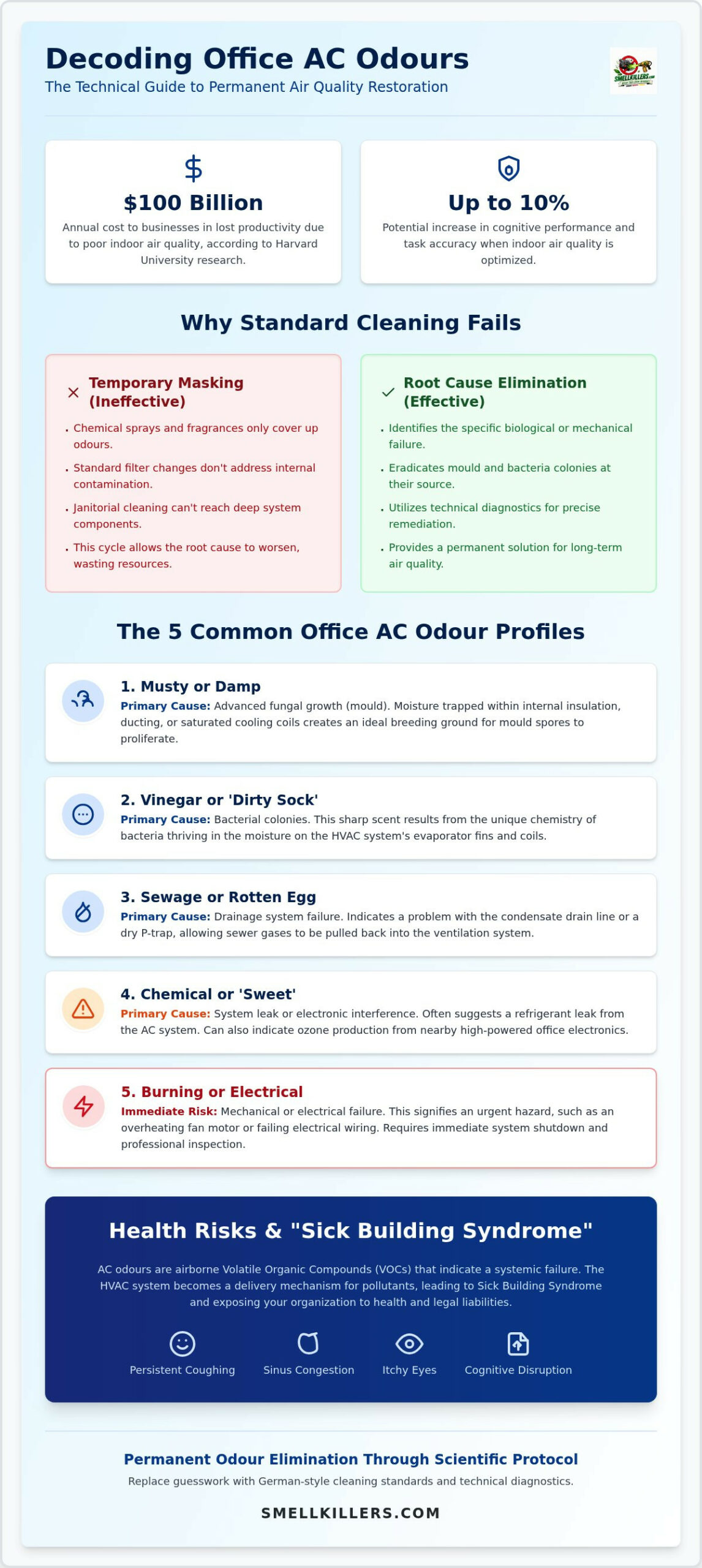
Effective remediation begins with sensory analysis. A precise diagnosis of the scent allows for the identification of the mechanical or biological failure at its source. Understanding Indoor Air Quality in Offices requires recognizing that different contaminants produce unique olfactory signatures. Property managers often waste resources on a generic office AC bad smell solution without first categorizing the symptom. We classify these environmental signals into five distinct profiles:
- Musty or Damp: Signals advanced fungal growth within internal insulation or cooling coils.
- Vinegar or ‘Dirty Sock’: Results from the chemistry of bacterial colonies thriving on evaporator fins.
- Sewage or Rotten Egg: Indicates a failure in the condensate drain or P-trap integration.
- Chemical or ‘Sweet’: Suggests potential refrigerant leaks or ozone production from office electronics.
- Burning or Electrical: Represents immediate mechanical risks within fan motors or electrical wiring that require a system shutdown.
Musty and Vinegar Smells: The Mould Factor
High humidity levels in the UAE create an ideal environment for rapid fungal accumulation within office ducting. When moisture remains trapped, mould spores proliferate on porous surfaces. The sharp vinegar scent is a byproduct of the metabolic processes of bacteria, such as Pseudomonas, which colonize the damp evaporator coils. These odours are not contained within the vents. They eventually embed themselves into office furniture, carpets, and acoustic ceiling tiles. This creates a persistent environmental issue that remains even after the AC is deactivated. If you notice these scents, a technical on-site inspection is the only way to confirm the extent of the contamination.
Sewage and Sulphur Smells: The Drain Connection
A common diagnostic error involves mistaking plumbing failures for AC mechanical issues. Air conditioning units connect to the building drainage system via condensate lines. When a P-trap dries out or is improperly installed, sewer gases bypass the seal and enter the ventilation stream. This is why standard AC cleaning often fails. The smell originates from the building’s plumbing stack, not the unit itself. Facility managers should utilize a commercial building odour control checklist to rule out these structural failures. Identifying the specific office AC bad smell solution in these cases requires looking beyond the filters and into the infrastructure mechanics.
Why Standard Cleaning Protocols Fail to Eliminate Office Smells
Surface cleaning is not a technical solution for atmospheric contamination. Finding a permanent office AC bad smell solution requires moving beyond the scope of general janitorial services. Standard maintenance contracts frequently focus on visible dust removal while ignoring the deep mechanical core where odours originate. When a system emits a foul scent, it indicates that a biological or structural failure has occurred deep within the ventilation infrastructure. Wiping down vents or vacuuming accessible ductwork does nothing to address the root cause.
Fragrance sprays and ozone generators are common but ineffective responses. These methods prioritize temporary masking over actual remediation. Scented aerosols merely add more volatile organic compounds (VOCs) to the air, potentially increasing respiratory irritation for staff. Ozone generators can react with existing office materials to create secondary pollutants. Standard maintenance often neglects the evaporator coil’s deep core, where moisture and darkness allow bacterial biofilms to thrive undisturbed. Improper cleaning techniques, such as using low-pressure rinses without proper biocides, can actually spread contaminants further into the building’s air supply by aerosolizing dormant spores.
The Trap of Superficial Filter and Duct Cleaning
Filters are designed to trap large particulate matter like hair and dust. They are not a barrier against microscopic fungal growth or bacterial off-gassing. Even a brand-new filter will not stop odours if the internal insulation or cooling coils are contaminated. Vacuuming ducts is similarly limited. If the source of the smell is a resilient bacterial biofilm on the heat exchanger, airflow will continue to pick up and distribute the scent. Contrast these superficial efforts with the precision of a technical property odour assessment. This diagnostic approach identifies exactly where the system has failed, ensuring that treatment is applied to the origin rather than the symptoms.
Understanding Cross-Contamination in Commercial Ventilation
Commercial buildings utilize complex air distribution networks. Odours from pantries, restrooms, or neighbouring office suites often migrate through shared ceiling voids and return air plenums. The “stack effect” in high-rise structures further complicates matters by pulling sewer gases upward through dry P-traps and unsealed service shafts. Occupants seeking a Guide to Indoor Air Quality often discover that simple maintenance checklists ignore these complex mechanical interactions. Standard HVAC cleaning fails because it ignores the building’s pressure dynamics and the structural pathways that allow external odours to infiltrate the primary air stream. Resolution requires a specialist who understands the intersection of HVAC mechanics and building plumbing infrastructure.
Technical Remediation: A Professional Protocol for Commercial HVAC
Permanent resolution of atmospheric contamination requires a clinical, five-step protocol. We replace guesswork with scientific certainty to ensure a permanent office AC bad smell solution. Our methodology prioritizes diagnostic accuracy before any chemical treatment is applied. This sequential process moves from the identification of the source to the final verification of air quality standards. We utilize specialized equipment to look beneath the surface of the ventilation infrastructure, identifying failures that standard maintenance teams often overlook.
- Step 1: Conduct an on-site inspection using gas detection technology to map the odour’s exact origin.
- Step 2: Perform diagnostic testing of the condensate drainage system to verify P-trap integrity.
- Step 3: Execute a deep clinical cleaning of the evaporator coils using specialized non-toxic treatments.
- Step 4: Sanitize the air handling unit (AHU) and all internal insulation surfaces to remove dormant spores.
- Step 5: Complete a post-treatment air quality verification to confirm the total elimination of the contaminant source.
On-site Odour Inspection and Gas Tracking
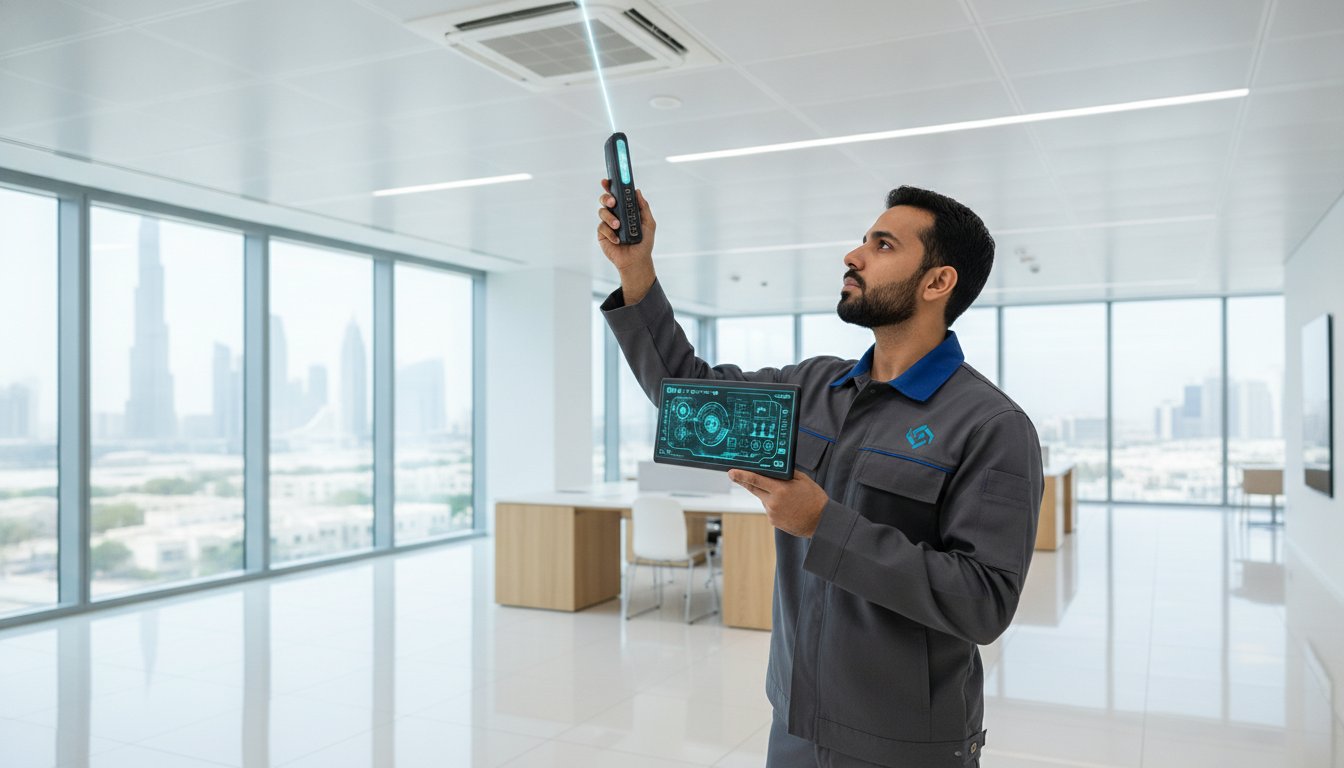
Remediation begins with technical detection. We use specialized sensors to detect hydrogen sulphide and other sewer gases that have infiltrated the office environment. This non-invasive approach allows us to map the movement of contaminants without disrupting daily operations. A commercial property smell inspection provides facility managers with a technical roadmap. It identifies whether the issue is a biological colony within the AC unit or a structural failure in the building’s plumbing stack. We provide documented evidence of the source before proceeding with treatment.
Precision Coil Cleaning and Drainage Treatment
Treatment must be as precise as the diagnosis. Our “German-style” approach ensures that pressure and chemistry are perfectly balanced to remove biofilms without damaging sensitive evaporator fins. We treat the drain line as a critical component of the office AC bad smell solution, not an afterthought. This involves clearing blockages and treating the internal surfaces of the pipes to prevent future bacterial growth. All treatments are eco-friendly and non-toxic. This allows for immediate office re-occupancy without the risk of chemical sensitivities. Secure your workplace environment by scheduling a professional on-site inspection today.
Permanent Odour Elimination with SMELLKILLERS.COM
SMELLKILLERS.COM operates as the leading odour expert UAE for commercial properties. We refuse to participate in the industry cycle of selling recurring cleaning packages that fail to address the origin of the problem. Our commitment is simple. Find the source. Treat the cause. Restore the air. We provide a definitive office AC bad smell solution that restores environmental integrity to your workplace. This technical focus ensures that your maintenance budget is spent on resolution rather than temporary masking agents.
Facility managers require more than just a clean unit. They need data-driven certainty. We support property owners with detailed diagnostic reports that map internal failures and offer long-term prevention strategies. Our investigations look beyond the filters. We examine building infrastructure and plumbing integration to ensure no secondary source is left untreated. This transparency projects an image of technical integrity, replacing the frustration of recurring smells with scientific certainty.
The German-Style Precision Methodology
Our service is defined by the “German-style” precision cleaning methodology. This standard utilizes specialized tools and perfectly balanced chemistry to sanitize the deep core of HVAC systems. We operate under PANKOBAU Building Maintenance LLC, bringing a technical background in building physics to every intervention. This expertise allows us to solve complex atmospheric issues that general cleaning companies cannot identify. Our hotel odour inspection UAE case study demonstrates our ability to detect cross-contamination between guest rooms and centralized drainage stacks. We apply this same level of investigative rigour to sensitive office environments. We ensure a clinical result every time.
Taking the First Step Toward Clean Air
Restore your air quality standards now. The process begins with an on-site inspection. Our technicians arrive at your commercial property equipped with gas tracking technology and diagnostic sensors. During this initial phase, we map the odour profile and identify the exact mechanical or structural failure. You receive a transparent breakdown of the findings and a clear path to resolution. Stop masking the problem with ineffective sprays. Start the cure today by securing a professional office AC bad smell solution. Contact our team to schedule your technical assessment and end workplace odours permanently.
Restore Your Professional Environment Today
Persistent workplace odours are indicators of underlying mechanical or biological failures. Standard maintenance often fails because it ignores the deep evaporator core and building infrastructure. Resolving these issues requires moving beyond superficial masking. Finding a permanent office AC bad smell solution depends on identifying the technical origin of the contaminant. We utilize specialized source detection technology and German-style precision cleaning to ensure a clinical result. Our team provides national UAE coverage for commercial properties, delivering diagnostic reports that replace mystery with scientific certainty.
Don’t settle for temporary masking agents that only hide the symptoms. Protect your staff’s health and restore cognitive performance by addressing the root cause of poor air quality. We provide the expertise needed to transition your facility to a state of total resolution. Take the first step toward a permanent cure. Book a Technical On-site Odour Inspection for Your Office and secure the high-standard air quality your organization deserves.
Frequently Asked Questions
Why does my office AC smell like sewage every afternoon?
This symptom indicates a failure in the building’s plumbing integration or a dry P-trap. Condensate lines often connect directly to the main sewage stack. When the water seal in the trap evaporates, sewer gases are pulled into the air handling unit by the blower fan. Finding the correct office AC bad smell solution in this case requires a technical inspection of the drainage mechanics rather than simple filter maintenance.
Can a bad smell from the office air conditioner make employees sick?
Yes, persistent odours often signal the presence of biological contaminants or volatile organic compounds (VOCs). Mould spores and bacteria thriving on damp coils are aerosolized and distributed through the ventilation. This can trigger respiratory distress, headaches, and sinus congestion, often categorized as Sick Building Syndrome. Eliminating the source is essential for maintaining workplace health standards and avoiding long-term liabilities associated with poor air quality.
How long does a professional office AC odour treatment take?
A standard diagnostic inspection typically concludes within 60 to 90 minutes. The treatment phase varies based on the severity of the contamination and the total number of units involved. Most commercial remediations are completed within a single business day. We prioritize efficiency to ensure minimal disruption to your operations. You receive a detailed diagnostic report immediately following the completion of the on-site assessment.
Will standard AC duct cleaning get rid of a persistent vinegar smell?
No, standard duct cleaning rarely resolves a persistent vinegar scent. This specific odour originates from bacterial colonies, such as Pseudomonas, growing on the evaporator fins or within the internal insulation. Vacuuming the ducts does not remove the biofilm from the mechanical components. Permanent resolution requires deep clinical cleaning of the heat exchanger and the application of specialized, non-toxic biocides directly to the source of the growth.
Is the odour treatment safe for employees to be around during office hours?
We use non-toxic, eco-friendly treatments that are safe for immediate re-occupancy. Our specialized cleaning methodology avoids harsh chemicals that cause secondary respiratory irritation or lingering chemical scents. We prioritize the use of biodegradable sanitizers that effectively eliminate biological growth without leaving harmful residues. This allows your team to continue working in a safe, refreshed environment without the need for facility evacuation or after-hours scheduling.
What is ‘German-style’ aircon cleaning and why is it better for offices?
German-style cleaning is a high-precision methodology characterized by perfectly balanced pressure and specialized chemistry. It focuses on the deep core of the mechanical unit rather than just the surface filters. This approach ensures the total removal of biofilms from the evaporator coils without damaging sensitive fins. It is superior for offices because it provides a clinical level of sanitization that supports higher indoor air quality and productivity standards.
How often should an office property undergo a professional odour assessment?
We recommend a professional property odour assessment at least once every twelve months. Commercial environments experience high occupancy and constant cooling demands, leading to rapid biological accumulation and mechanical wear. Regular assessments allow for the early detection of drainage failures or bacterial growth before they escalate into employee health complaints. Preventive inspections are more cost-effective than reactive remediations following a systemic failure in air quality.
Do you provide AC odour detection services across the entire UAE?
Yes, we provide comprehensive AC odour detection and treatment services across all seven Emirates. Our technical teams are equipped to handle large-scale commercial properties in Dubai, Abu Dhabi, and the Northern Emirates. We offer national coverage to ensure that corporate facilities maintain consistent environmental standards regardless of their specific location. Contact us to schedule a specialized on-site inspection for your national property portfolio to find a permanent office AC bad smell solution.