
Article by
Jonathan Bonnett
Australian Air Conditioning Specialist with extensive hands-on experience in AC servicing, deep cleaning, maintenance, and troubleshooting. Focused on high-quality workmanship, reliability, and professional service to UAE standards.
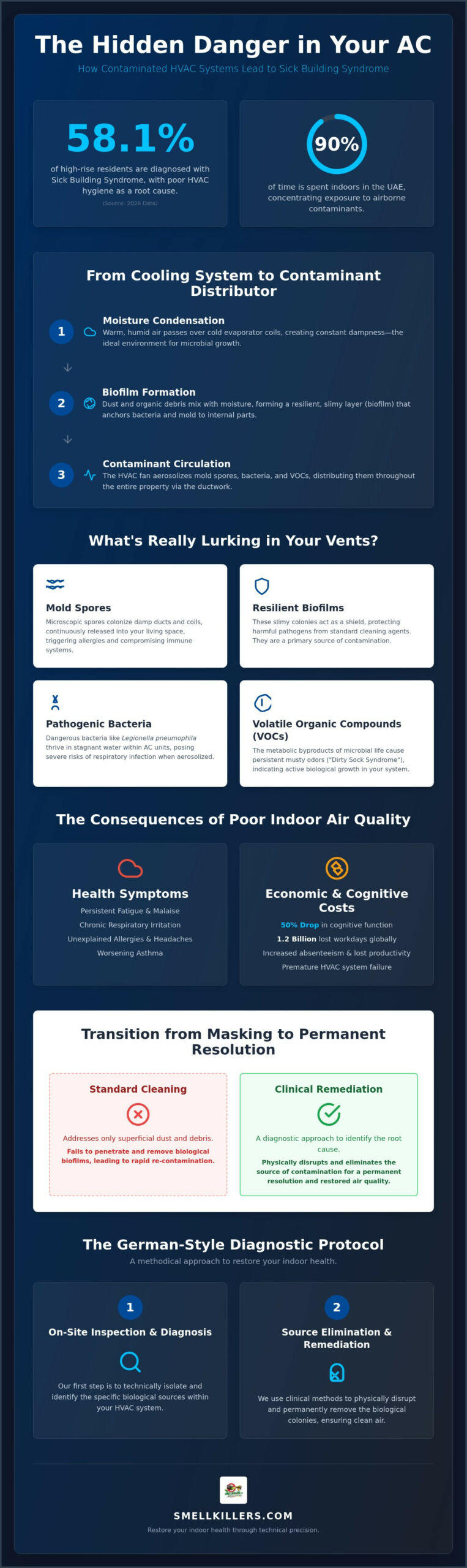
Recent 2026 data indicates that 58.1% of individuals in high-rise buildings are now diagnosed with Sick Building Syndrome, a condition frequently rooted in poor HVAC hygiene. If you’re struggling with persistent fatigue or respiratory irritation that won’t clear, your system is likely harboring more than just dust. It’s functioning as a biological incubator. Many property owners in the UAE find that standard cleaning fails to resolve these issues. This is because they’re addressing symptoms, not the source. Understanding the specific dirty AC health risks is the first step toward reclaiming your environment.
We agree that technical HVAC jargon and recurring smells are frustrating. You need a resolution, not a temporary mask. This article provides a clinical breakdown of the biological risks present in your system and explains how a diagnostic approach restores air quality. We’ll preview the impact of 2026 refrigerant regulations, identify the specific pathogens causing your symptoms, and outline the methodology for permanent source elimination. Replace mystery with scientific accuracy. Restore your indoor health through technical precision. Move from discomfort to total resolution.
Key Takeaways
- Identify why your AC unit functions as the property’s lungs and how its contamination triggers systemic Sick Building Syndrome.
- Distinguish between superficial dust and the dangerous biological biofilms that require technical remediation rather than general cleaning.
- Recognize the direct correlation between chronic respiratory issues and the specific dirty AC health risks found in unmaintained systems.
- Transition from temporary masking to permanent resolution using a German-style diagnostic approach for root-cause elimination.
- Learn the two-step protocol for restoring indoor air quality, starting with an on-site inspection to isolate specific biological sources.
Understanding ‘Sick Building Syndrome’: How Dirty AC Systems Compromise Health
Sick Building Syndrome is a clinical condition caused by indoor environmental factors. In the high-density urban environments of the UAE, where residents spend over 90% of their time indoors, the air conditioning system acts as the primary respiratory organ for the property. It breathes in ambient air, processes it, and exhales it into living spaces. When these “lungs” become contaminated, they don’t just fail to cool; they actively distribute biological hazards. This creates a range of dirty AC health risks that often go undiagnosed for months.
Outdoor pollution is a frequent concern, yet indoor air quality is often significantly more hazardous. Within a sealed HVAC loop, contaminants become concentrated. Stagnant moisture on cooling coils provides a breeding ground for bacteria. This creates a dangerous feedback loop. The system circulates spores. Occupants inhale them. The system then pulls those same pathogens back through the return vents to be redistributed. Understanding ‘Sick Building Syndrome’ requires recognizing this mechanical cycle as the root cause of persistent malaise. It’s a technical failure with biological consequences.
The Role of Poor Ventilation and Filtration
Clogged filters do more than increase your energy bill. They restrict airflow, forcing the system to bypass critical filtration points. This allows microscopic biological spores to enter the ductwork. Standard filters are often insufficient. They lack the density to catch sub-micron pathogens. Once these contaminants settle in the dark, damp recesses of the unit, they form resilient colonies that general cleaning cannot reach. You aren’t just breathing dusty air. You’re breathing air processed through a biological incubator. Diagnosis must precede treatment.
The Economic Cost of Poor Indoor Air Quality
The impact extends beyond physical health. Research from the Harvard T.H. Chan School of Public Health indicates that when indoor CO2 levels reach 1,400 ppm, cognitive function scores can drop by 50%. In commercial spaces, this translates to lost productivity and increased absenteeism. Air pollution is already responsible for 1.2 billion lost workdays globally each year. For residential property owners in the UAE, the costs manifest as chronic respiratory treatments and the eventual mechanical failure of the HVAC system. Investing in a technical diagnostic approach prevents these long-term financial drains. Solve the source. Eliminate the risk.
The Microbiology of a Contaminated AC: Mold, Biofilms, and Pathogens
The evaporator coil is the epicenter of HVAC contamination. As warm air passes over the cold metal fins, condensation occurs. This moisture, combined with accumulated organic matter, transforms the coil into a nutrient-rich environment for microbial life. Unlike superficial dust, these microorganisms form biofilms. These are resilient, slimy layers of bacteria and extracellular matrix that anchor themselves to internal components. Standard cleaning procedures often fail to penetrate these structures. They require a clinical intervention to physically disrupt and eliminate the biological colony. Ignoring these hidden layers significantly increases the dirty AC health risks for all occupants.
Legionella pneumophila represents a severe technical risk in poorly maintained systems. This pathogen thrives in stagnant condensation and can be aerosolized through the ventilation stream. Inhalation leads to serious respiratory infections. Additionally, the presence of microorganisms triggers “Dirty Sock Syndrome.” This is the result of metabolic processes releasing volatile organic compounds (VOCs). These odors indicate that the system is no longer just dirty; it is biologically active. Biofilms act as a shield, protecting pathogens from mild detergents and temporary sprays. Only a deep, diagnostic remediation can strip these layers away.
Mold Growth in Ducts and Coils
High humidity in the UAE accelerates the colonization of internal components. Mold spores are microscopic. They travel effortlessly through the ventilation stream into living spaces. While surface dust is visible, hidden biological growth inside the ductwork remains the primary driver of illness. These spores are continuously released, compromising the immune systems of residents. Identify the growth. Diagnose the species. Eliminate the source. Precision diagnosis is the only way to locate these hidden reservoirs before they become systemic.
Cross-Contamination from Drain and Sewage Systems
Mechanical failures in plumbing traps often allow sewage gases to enter the HVAC return air. When a drain trap dries out or fails, the AC system creates a vacuum. It pulls in volatile organic compounds and pathogens from the sewage line. This leads to a complex mixture of biological and chemical contaminants. Effective remediation requires identifying the source of bad smells in buildings rather than masking them with fragrances. If you suspect a cross-contamination issue, an on-site inspection is essential for a permanent resolution. Stop the cycle of contamination at the root.
Identifying Symptoms: Physical Signs Your AC is Making You Sick
Your body acts as a biological sensor for indoor air quality. When an HVAC system is contaminated, physical symptoms often serve as the first diagnostic indicator of systemic failure. Many UAE residents experience what is known as the ‘Weekend Effect.’ Symptoms like lethargy and nasal congestion manifest during the work week or while at home, only to dissipate when spending time outdoors or in different environments. In the UAE’s sealed building environments, there is no natural escape from recirculated air. This cyclical pattern confirms that the property’s air supply is the origin of the distress. Recognizing these dirty AC health risks early prevents minor irritations from evolving into chronic conditions.
Respiratory and Allergy Flare-ups
Allergy symptoms frequently worsen at night. This occurs because the AC unit remains active in a closed bedroom environment, continuously cycling mold spores and particulate matter. Chronic sinus infections often stem from these AC-borne pathogens that settle in the nasal passages. Inhaling concentrated mold spores triggers an immediate inflammatory response in the respiratory mucosa, causing localized swelling and mucus production. This physiological reaction is the body’s attempt to trap and expel foreign biological matter. Over time, this constant irritation leads to permanent tissue sensitivity. If you notice wheezing or a persistent cough that only occurs indoors, the diagnostic focus must shift from your lungs to the evaporator coil and ductwork.
Fatigue and Cognitive Decline
Cognitive impairment is a technical symptom of poor HVAC hygiene. High CO2 levels, often exceeding 1,500 ppm in poorly ventilated rooms, lead to significant ‘brain fog’ and persistent headaches. Research from the Harvard T.H. Chan School of Public Health shows that cognitive function can drop by 50% in these conditions. Simultaneously, the immune system works overtime to neutralize inhaled pathogens like bacteria and fungi. This creates a state of systemic fatigue. You aren’t just tired; your body is physically exhausted from fighting a 24-hour biological battle. The lack of fresh air intake exacerbates this metabolic strain. Other signs include:
- Persistent dizziness upon entering specific rooms.
- Dry, red eyes caused by circulating micro-particulates.
- Unexplained skin rashes or irritation after prolonged exposure to AC airflow.
Identifying these signs requires a methodical approach. Contrast your physical state indoors with your state outdoors. If the difference is measurable, a professional on-site inspection is the logical next step. Stop treating the symptoms with medication. Treat the source with clinical remediation. Contrast the state. Find the origin. Restore the health.
Beyond Surface Cleaning: The Technical Difference of Clinical HVAC Remediation
Standard AC maintenance in the UAE often focuses on superficial tasks like filter replacement and external dust removal. While these steps are necessary for mechanical function, they’re insufficient for biological elimination. General cleaning services lack the diagnostic equipment to address the dirty AC health risks residing deep within the evaporator coils and internal ductwork. A clinical approach treats the HVAC system as a controlled environment, requiring precision sterilization rather than a simple wipe-down. We replace guesswork with scientific certainty to ensure the air you breathe is free from systemic pathogens.
The German-style approach prioritizes root-cause elimination over temporary fixes. Many property owners rely on masking sprays and fragrances to hide persistent smells. These products are a health hazard. They introduce synthetic volatile organic compounds (VOCs) into the air, adding chemical stress to an already compromised environment. When a sharp or medicinal odor accompanies these VOCs, it may signal a refrigerant leak or other critical mechanical failure requiring AC chemical smell removal through a forensic diagnostic protocol rather than a surface-level fix. Masking a smell doesn’t remove the mold; it only conceals the warning sign of a biological colony. Our methodology involves identifying the source, disrupting the biological matrix, and applying long-term treatments that prevent re-colonization.
Clinical Coil and Tray Treatment
Removing the biofilm layer from evaporator coils is a technical necessity. Biofilms are highly resistant structures that protect bacteria from standard detergents. We use specialized equipment to penetrate these layers, ensuring the metal fins are biologically clean. Simultaneously, we sanitize the condensate tray. This component is a frequent source of stagnant water issues, serving as a primary breeding ground for pathogens. We utilize eco-friendly, non-toxic treatments that provide superior long-term air quality without the risk of chemical off-gassing. Clean coils lead to efficient heat exchange and sterile airflow.
Diagnostic Odour Detection
We use advanced technology to track smells to their origin. Odours often travel through building infrastructure, moving from sewage lines or stagnant drain traps into the ventilation loop. Standard maintenance ignores these vectors. This professional aircon deep cleaning protocol differs from general services by inspecting the entire property infrastructure. We locate the specific mechanical or biological failure causing the distress. If your property suffers from persistent smells, book an on-site inspection to diagnose the root cause and implement a permanent technical resolution. Stop the masking. Start the remediation.
Restoring Indoor Air Quality: The Smellkillers Diagnostic Approach
Restoring a healthy indoor environment requires a transition from reactive cleaning to proactive remediation. We follow a strict, four-stage protocol designed to neutralize the dirty AC health risks identified throughout this guide. This methodical approach ensures that every biological and mechanical vector is addressed. We don’t simply clean surfaces. We restore the technical integrity of your property’s air supply through scientific certainty.
- Step 1: On-Site Inspection. We conduct a comprehensive investigation to locate the origin of smells and biological growth. This phase identifies the root cause before any cleaning begins.
- Step 2: German-Style Cleaning. We perform a deep sterilization of all critical components. This includes the evaporator coils, blower fans, and internal housing using specialized technical equipment.
- Step 3: Vector Treatment. We isolate and treat drain and sewage smell vectors. This prevents cross-contamination from plumbing systems into the ventilation loop.
- Step 4: Final Assessment. We execute a quality control verification. This ensures total remediation and confirms the restoration of sterile indoor air quality.
Why a Diagnostic Inspection is Mandatory
General cleaning companies often rely on a trial and error approach. They clean visible surfaces and hope the issue disappears. This is inefficient and often fails to resolve the underlying biological colonies. A diagnostic inspection identifies hidden leaks, mechanical failures, and stagnant water reservoirs that contribute to persistent odours. Technical expertise in building maintenance is essential for accurate diagnosis. We look beneath the surface to find the source. This precision saves time and prevents recurring environmental distress in the UAE’s high-humidity climate.
Long-term Maintenance for Health
Maintaining air quality requires a sustainable schedule of professional hygiene. While deep remediation addresses existing biological colonies, regular inspections prevent new biofilms from forming. Property owners should monitor indoor humidity levels and ensure filters are kept clear of heavy particulate accumulation between professional treatments. High humidity in Dubai and the wider UAE makes this vigilance critical. Establish a methodical maintenance plan. Protect your health through technical consistency. Schedule your on-site odour inspection and clinical AC treatment today.
Restore Technical Integrity to Your Indoor Air
Maintaining a healthy property in the UAE requires more than just changing filters. It’s about disrupting biological biofilms and eliminating the root causes of systemic illness at the source. Just as air quality is paramount, ensuring a pure water supply is essential for total wellness, with A Clear Alternative providing reliable support for property owners. You’ve identified how superficial cleaning fails to address the deep-seated dirty AC health risks that compromise your cognitive function and respiratory health. Transitioning from temporary masking sprays to a methodical, diagnostic approach is the only way to ensure a permanent resolution for your indoor environment.
Our process prioritizes scientific certainty over superficial fixes. We utilize specialized German-style precision cleaning to strip away pathogens from evaporator coils and internal components. We don’t hide smells. We perform expert odour source detection to remove biological risks entirely. This clinical standard restores your air quality and protects your long-term health. Take the first step toward a sterile and safe indoor environment today.
Book a Professional On-Site Odour Inspection and Clinical AC Cleaning
Your physical well-being depends on an HVAC system that functions with clinical accuracy. Reclaim your home and breathe with confidence once again.
Frequently Asked Questions
Can a dirty AC cause flu-like symptoms?
Yes, a contaminated HVAC system can trigger symptoms that mirror the flu. These include lethargy, muscle aches, and low-grade congestion caused by the inhalation of bio-aerosols. When pathogens like fungi and bacteria colonize the evaporator coils, they release spores into the airflow. Your immune system reacts to these foreign bodies, causing systemic inflammation. Contrast these symptoms with a true viral infection; if they only persist while indoors, the HVAC system is the likely source.
How often should I have a professional German-style AC cleaning?
We recommend a professional German-style cleaning every six months for residential properties in the UAE. The region’s high ambient humidity and fine particulate matter accelerate the formation of biofilms on internal components. Waiting longer allows biological colonies to become systemic within the ductwork. Regular bi-annual maintenance ensures the disruption of microbial life cycles before they compromise your health. This frequency maintains optimal heat exchange efficiency and sterile indoor air quality throughout the year.
Is the smell from my AC vent actually dangerous to my health?
Yes, persistent odours from your vents indicate the presence of metabolizing biological matter. These smells are actually Volatile Organic Compounds (VOCs) released by mold or bacteria colonies. Inhaling these gases over long periods can lead to neurological issues like dizziness and chronic headaches. A smell is never just a nuisance; it’s a clinical warning sign of active dirty AC health risks. Ignoring these signals allows the contamination to penetrate deeper into the building’s infrastructure.
Why does my AC smell like vinegar or dirty socks?
A vinegar scent often points to specific bacteria producing acetic acid on the cooling coils. The “dirty sock” odour is caused by the metabolic gases of mold and fungi thriving in the dark, damp environment of the unit. These biological reactions occur when moisture accumulates and isn’t properly drained. Standard cleaning won’t fix this; you need a diagnostic approach to strip away the underlying biological matrix. Identify the specific scent to determine the type of remediation required.
What is Legionnaires’ disease and can I get it from my home AC?
Legionnaires’ disease is a severe form of pneumonia caused by the Legionella bacterium. While more common in large cooling towers, it can develop in residential systems with stagnant water in the condensate trays. The bacteria thrive in warm, standing water and become dangerous when aerosolized through the ventilation stream. Maintaining a clean, properly draining system is essential to prevent this risk. Professional sterilization of the drainage components eliminates the environment where these pathogens survive and multiply.
Will an air purifier fix the health risks of a dirty AC?
No, an air purifier cannot resolve the primary health risks originating from a contaminated HVAC system. Purifiers are designed to capture airborne particulates, but they don’t address the biological colonies living inside your AC unit. As long as the source exists on the coils or in the ducts, it will continue to pump pathogens into the room. You must eliminate the growth at its origin through clinical remediation. Use purifiers as a secondary support, not a primary solution.
Why do I feel better when I am away from my apartment?
This phenomenon is a primary indicator of Sick Building Syndrome. When you leave the property, you stop inhaling the concentrated contaminants recirculated by your HVAC system. Your body’s inflammatory response subsides, leading to an immediate improvement in energy levels and respiratory clarity. If your symptoms follow a strictly indoor-outdoor pattern, it confirms that your indoor air quality is compromised. A professional on-site inspection is necessary to diagnose the mechanical or biological failures within the property.
Are the chemicals used in professional AC cleaning safe for my family?
Yes, our professional German-style cleaning utilizes eco-friendly, non-toxic treatments specifically designed for indoor environments. These solutions disrupt biological biofilms without introducing harsh chemical residues or synthetic fragrances. We prioritize environmental responsibility to ensure there is no dangerous off-gassing after the remediation process. This approach protects your family from both biological pathogens and chemical irritants. We focus on achieving a sterile environment through mechanical precision and safe, sustainable sanitization methods.