
Article by
Jonathan Bonnett
Australian Air Conditioning Specialist with extensive hands-on experience in AC servicing, deep cleaning, maintenance, and troubleshooting. Focused on high-quality workmanship, reliability, and professional service to UAE standards.
What if the chemical cleaners you’re pouring down your sink are actually masking a mechanical failure? You’ve likely spent weeks scrubbing drains and buying expensive deodorizers, only to have that sharp, sulfurous odor return within hours. It’s a common cycle of frustration. The reality is that surface-level hygiene cannot fix a systemic issue. Identifying the root cause of drain smell requires a move away from superficial cleaning and toward technical diagnostic accuracy.
We understand the anxiety caused by persistent sewer gas and the wasted investment in temporary fixes. This article explains the structural and atmospheric reasons why smells linger despite your best efforts. You’ll discover the specific mechanical failures, such as dried traps or ventilation breaches, that allow odors to enter your living space. We provide a clear look at why DIY methods fail and how professional diagnostic detection offers a permanent, scientific resolution. It’s time to replace guesswork with technical certainty and restore the health of your property environment.
Key Takeaways
- Recognize that surface scrubbing only removes superficial biofilm and fails to address the underlying structural failures allowing sewer gas to escape.
- Identify the mechanical malfunctions, such as siphoning or dried P-traps, that serve as the root cause of drain smell by breaching essential hydraulic seals.
- Understand the technical connection between A/C condensate lines and floor drains, which often allows your ventilation system to distribute foul odors.
- Learn how specialists use non-invasive diagnostic protocols, including real-time smoke testing, to visualize and locate invisible gas leaks.
- Transition from counter-productive masking agents and ozonizers toward permanent source elimination using German-style precision cleaning standards.
The ‘Dirty Drain’ Myth: Why Deep Cleaning Often Fails
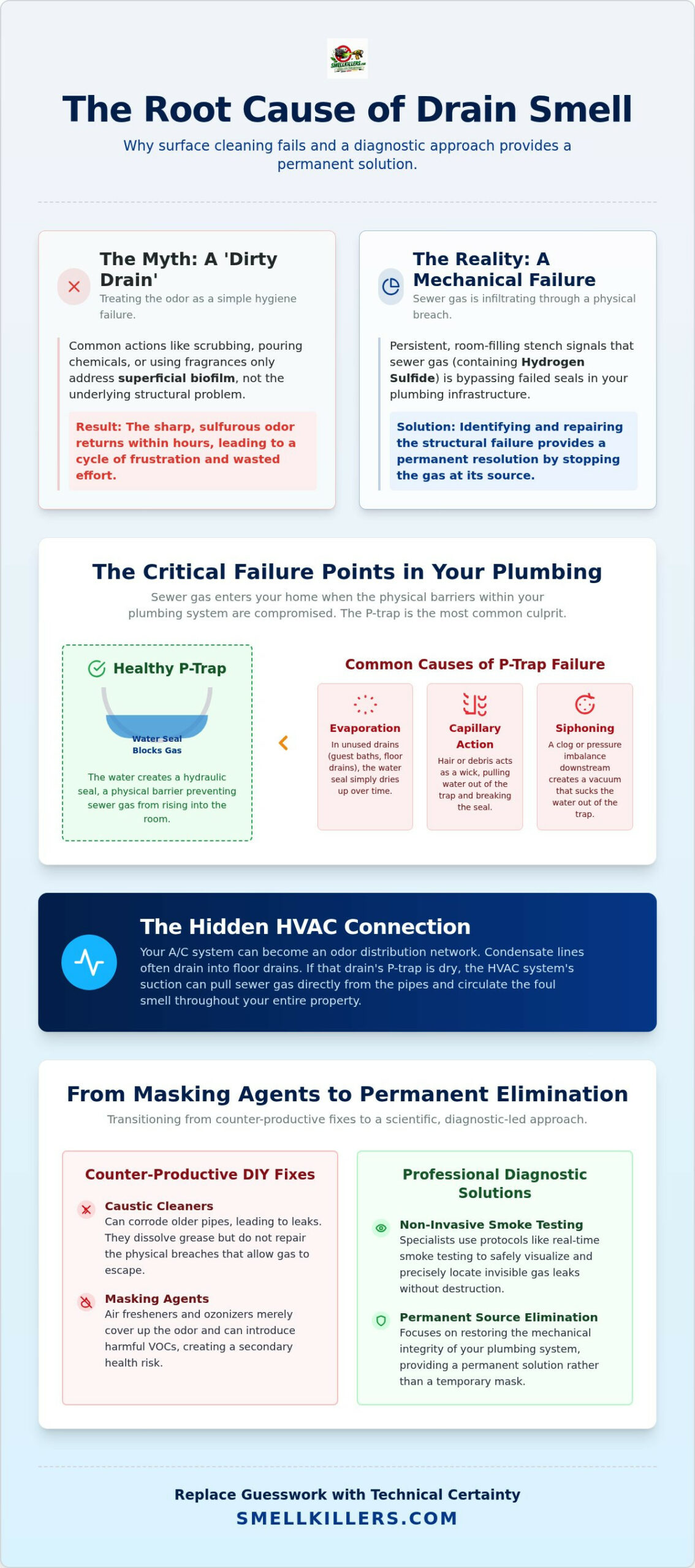
Many property owners treat a foul odor as a simple hygiene failure. This is the ‘Dirty Drain’ myth. You might scrub the drain grate or pour boiling water down the pipe, but the scent often returns within hours. This happens because the root cause of drain smell is frequently structural, not biological. Surface cleaning only addresses the visible symptoms. True resolution requires a diagnostic look at the plumbing architecture rather than another bottle of disinfectant.
Biological Biofilm vs. Sewer Gas Infiltration
Biofilm is a colony of bacteria and organic waste that forms in the first few inches of a drain pipe. It is a self-regenerating matrix; even if you kill the majority of the colony, the remaining bacteria repopulate the surface within hours. While biofilm produces a localized scent, it rarely accounts for a persistent, room-filling stench. That odor usually signals that Sewer gas is escaping through a failed seal or a compromised vent. This gas carries Hydrogen Sulfide, creating a recognizable rotten egg smell that permeates the air.
Sewer gas is a complex mixture of methane, carbon dioxide, and nitrogen.
Scrubbing the pipe removes the organic top layer but does nothing to stop the atmospheric pressure pushing gases from the municipal waste line into your living space.
The Danger of Chemical Over-Reliance
Caustic cleaners are often the first line of defense for frustrated homeowners. This over-reliance is technically flawed and physically dangerous. These chemicals are formulated to dissolve hair and grease, not to repair mechanical breaches in your plumbing. Using them repeatedly creates several risks:
- Infrastructure Corrosion: Harsh chemicals can degrade older plumbing infrastructure, especially cast iron pipes or thin-walled PVC, leading to pinhole leaks.
- Environmental Impact: Pouring industrial-strength disinfectants down the drain disrupts local water treatment processes and ecosystem health.
- Mechanical Ineffectiveness: ‘Natural’ hacks like vinegar and baking soda create a satisfying fizz but lack the pressure or chemical reach to address deep-seated structural gas leaks.
Masking odors with heavy fragrances or air fresheners is equally counter-productive. These products often contain volatile organic compounds that can trigger respiratory issues, adding a secondary health risk to the existing gas problem. Professional source identification replaces these temporary, superficial measures with scientific certainty. By focusing on diagnostic accuracy, we move beyond the “Dirty Drain” myth and target the physical origin of the infiltration. This transition from cleaning to detection ensures that the mechanical integrity of your home is restored, providing a permanent solution rather than a temporary mask.
Mechanical Failures: When the Plumbing Infrastructure Breaks Down
Surface cleaning is a cosmetic intervention. If the stench persists after scrubbing, you are likely dealing with a mechanical breach in your plumbing infrastructure. This physical failure allows sewer gas to bypass intended barriers and enter your living space. Identifying the root cause of drain smell requires moving beyond the bottle of bleach and analyzing the structural integrity of your waste system. When the hardware fails, the atmosphere of your home is compromised.
The Critical Role of the P-Trap
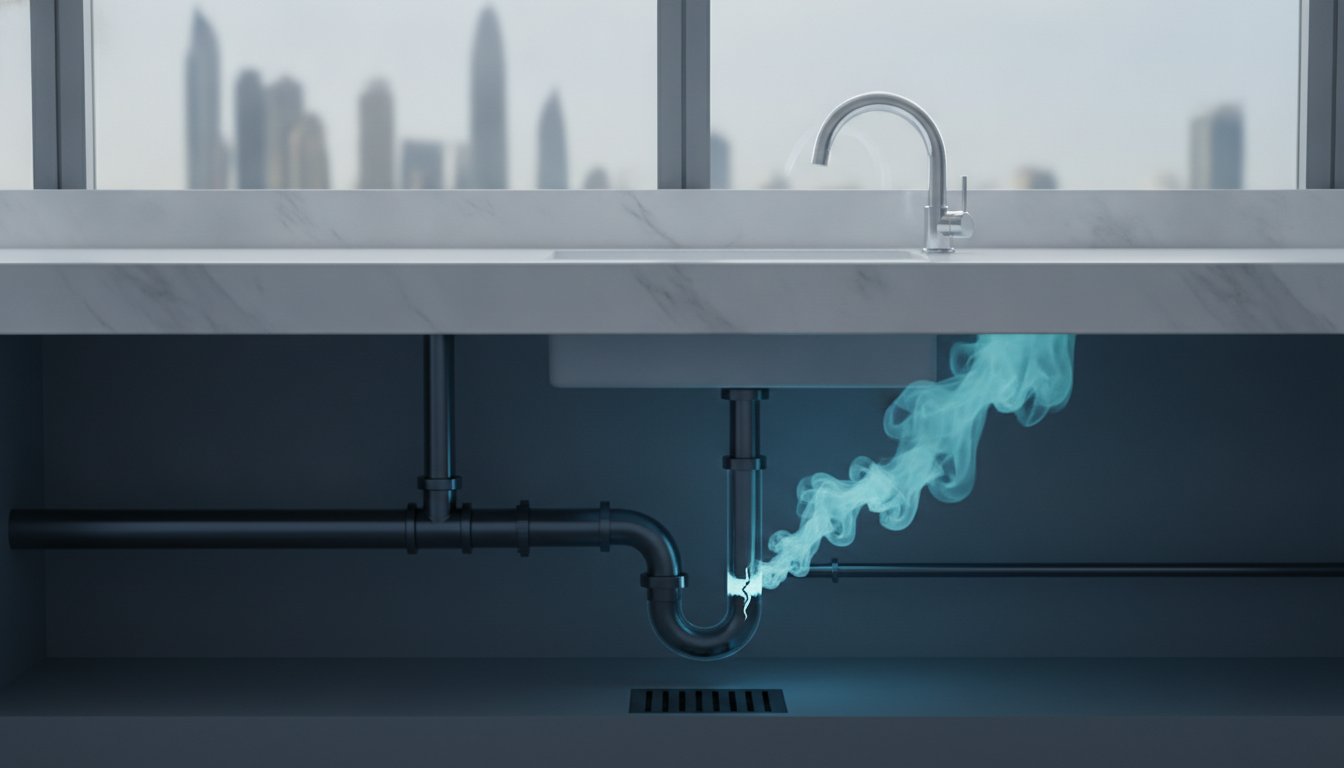
Every sink, shower, and floor drain utilizes a P-trap. This U-shaped pipe section functions as a hydraulic seal. It traps a specific volume of water that acts as a physical wall, preventing sewer gases from rising into the room. If this water barrier disappears, the seal is broken. Several mechanical factors cause trap failure:
- Evaporation: In guest bathrooms or unused floor drains, the water simply dries up over time.
- Capillary Action: A string or a clump of hair caught in the trap can act as a wick, slowly pulling water over the edge of the “U” and into the drain line.
- The Siphoning Effect: This occurs when a clog further down the line creates a vacuum. As waste moves past, it pulls the protective water out of the trap through sheer negative pressure.
A dry trap is a common entry point for odors. Simply running the tap might provide a temporary fix, but it does not address the underlying pressure imbalances that caused the siphoning in the first place. In the UAE’s extreme heat, P-trap evaporation is dramatically accelerated, making professional sewage smell diagnosis UAE specialists particularly valuable for identifying these climate-specific mechanical failures.
Vent Stack Blockages and Pressure Imbalances
Your plumbing system needs to breathe. The vent stack, typically located on your roof, equalizes air pressure within the pipes. When this stack becomes blocked by debris or bird nests, the system’s equilibrium is destroyed. You might notice gurgling sounds in the sink when you flush the toilet. This is the sound of the system gasping for air. Without proper venting, the plumbing creates ‘negative pressure’ that actively pulls sewer air through the traps and into your home. This is a foundational step in Diagnosing the Source of Drain Odor and requires professional intervention to clear the obstruction safely.
Mechanical failures aren’t always visible. A degraded wax ring beneath a toilet or a cracked pipe joint behind a wall can allow gas to leak into the building envelope before it even reaches the trap. These ‘invisible’ breaches require technical expertise to locate. In the UAE’s high ambient temperatures, accelerated microbial activity makes these failures even more acute, which is why sewage odour elimination UAE residents require must be approached as an engineering challenge, not a hygiene task. If you suspect your plumbing infrastructure has failed, a Property Odour Assessment is the most efficient way to identify the exact point of entry. We prioritize diagnostic accuracy over guesswork to ensure your home’s mechanical seals are fully restored.
The HVAC Connection: How A/C Systems Distribute Drain Odours
Most property owners search the floor for the source of a foul scent. They overlook the vents in the ceiling. In many modern buildings, your air conditioning unit acts as a motorized delivery system for sewage odors. The root cause of drain smell is frequently found at the intersection where the A/C condensate line meets the building’s waste pipes. If this connection is improperly sealed or plumbed, the cooling system becomes an open conduit for sewer gas. Scrubbing the floor drain won’t fix this. You’re fighting a distribution problem, not just a hygiene issue.
Condensate Drain Contamination
A/C units produce moisture as they dehumidify the air. This liquid must be drained, usually through a dedicated line that terminates in a floor drain or a sewage stack. Stagnant water in the A/C collection tray breeds specialized bacteria that create a scent often described as “wet dog.” However, the more severe technical failure is cross-contamination. If the P-trap in the A/C drain line dries out, the unit’s blower creates a ‘Pull Effect.’ It sucks sewer gas directly from the plumbing stack and forces it through the evaporator coil. This contaminates the entire air stream. Standard A/C cleaning fails here because it doesn’t address the mechanical breach in the drainage connection.
Pressure Differentials in Modern Apartments
Modern residential units are designed for maximum energy efficiency and airtightness. While this lowers cooling costs, it creates a volatile pressure environment. When you activate a kitchen exhaust fan or a bathroom vent, you create a vacuum within the living space. Air must enter from somewhere to replace what is being expelled. In an airtight apartment, the weakest point of resistance is often the drain trap. Odour remediation requires balancing the building’s internal pressure to prevent this atmospheric siphoning. Symptoms of HVAC-related drain smells include:
- Odours that intensify only when the A/C is running.
- Scent distribution that moves from room to room through the ductwork.
- Recurring smells that persist despite professional floor drain cleaning.
- Gurgling sounds coming from the A/C unit’s internal drainage tray.
Identifying these complex interactions requires a specialist who understands both HVAC and plumbing mechanics. For a deep dive into the technical remediation of these interconnected systems, consult our Aircon Odour Elimination: The Definitive Guide. Moving beyond superficial cleaning is the only way to achieve a permanent solution. Our approach focuses on diagnostic accuracy to ensure your indoor air quality is technically restored, not just masked.
Diagnostic Protocols: How Specialists Find the ‘Invisible’ Source
Technical experts don’t rely on human senses alone to identify building failures. Determining the root cause of drain smell requires a non-invasive, scientific approach that visualizes what is otherwise invisible. We replace subjective “smell tests” with calibrated instrumentation and logical deduction. This methodology ensures that the source is pinpointed without unnecessary demolition of walls or flooring. Our process follows a strict diagnostic sequence to move from symptom to resolution.
Smoke Testing and Thermal Imaging
Visualizing air movement is the most effective way to prove a structural breach. We utilize non-toxic, high-density smoke testing to pressurize the drainage and ventilation system. If a vent pipe is cracked behind a drywall or a joint has failed under the floor, the smoke escapes at the exact point of the leak. This provides immediate, undeniable proof of the failure. We complement this with thermal imaging. Infrared cameras detect moisture patterns and temperature variances within the building envelope. These patterns often indicate hidden sewage leaks or stagnant water pockets that are feeding biological growth. By mapping these thermal signatures, we identify the precise location of the mechanical compromise.
Electronic Gas Concentration Mapping
Precision requires data. We use electronic gas sensors to measure Hydrogen Sulfide (H2S) levels in parts per million (PPM). This is a critical safety protocol. High concentrations of sewer gas aren’t just unpleasant; they are toxic. Mapping these concentrations allows us to differentiate between methane-based sewer gas and localized biological odors. We follow a methodical grid pattern across the property to track gas plumes back to their origin. This data-driven detection is superior to traditional plumbing methods. It provides a clear chemical signature of the problem. For a deeper understanding of this process, consult the Property Odour Assessment, which serves as the professional gold standard for technical identification.
Identifying the origin is the first step toward permanent remediation. Once the diagnostic phase is complete, we provide a transparent breakdown of the findings and the necessary technical interventions. Don’t waste more resources on superficial fixes that ignore the data. Schedule a professional On-site Inspection to identify the structural failures in your property today. We prioritize diagnostic accuracy to ensure your environment is restored to a state of clinical purity.
Permanent Remediation: Moving from Masking to Elimination
Masking an odour is not a technical solution. It is a delay tactic that ignores the mechanical reality of your property’s infrastructure. Solving the root cause of drain smell requires a transition from superficial hygiene to structural remediation. Once a diagnostic protocol has identified the breach, the focus must shift to permanent elimination. We follow a strict four-stage process: Detect, Isolate, Remediate, and Verify. This methodical approach replaces the cycle of recurring smells with technical certainty.
The Failure of Traditional Odour Masking
Fragrance sprays, plug-in deodorizers, and industrial ozonizers are frequently used to hide foul scents. This practice is technically flawed and physically dangerous. Many commercial fragrance products contain Volatile Organic Compounds (VOCs) that degrade indoor air quality and can trigger respiratory distress. More importantly, masking allows sewer gas to reach toxic levels while remaining undetected by the inhabitants. When you hide a smell, you lose your primary warning system for a systemic failure. True psychological relief only comes from knowing the source has been physically removed, not just chemically hidden. Elimination is the only responsible path for property health.
Professional Remediation Protocols
Permanent resolution involves direct mechanical intervention. Depending on the diagnostic findings, remediation may include the mechanical sealing of failed pipe joints or the replacement of compromised P-traps. We don’t rely on temporary sealants; we restore the physical integrity of the hydraulic barrier. For issues originating in the ventilation system, we implement Professional German Style Aircon Cleaning. This is a clinical deep-clean of coils and ducts that removes secondary biological growth and neutralizes the “Pull Effect” mentioned in previous sections. Our protocols conclude with final verification testing. We use gas sensors to ensure zero infiltration, providing data-driven proof that the environment is restored.
Stop investing in temporary fixes that fail to address the structural origins of the problem. You need a systematic plan to reclaim your property’s air quality. Use our sewage smell removal checklist to begin the technical assessment of your home. This document provides the necessary steps for immediate action and long-term resolution. By following a structured remediation path, you move from a state of constant frustration to a state of permanent environmental safety. Our goal is the total transition from mystery to scientific resolution.
Restore Your Property’s Atmospheric Integrity
Persistent odors are not a cleaning failure; they are a mechanical warning. You’ve learned that siphoned traps, compromised vent stacks, and HVAC cross-contamination allow sewer gas to bypass surface scrubbing. These structural breaches require a shift from superficial maintenance to technical investigation. Identifying the root cause of drain smell is the only way to move from temporary masking to a permanent state of environmental health. Relying on chemicals only hides the symptom while the underlying infrastructure remains compromised.
We provide the diagnostic accuracy needed to resolve these failures permanently. Our specialized German-style diagnostic protocols utilize non-invasive detection technology to visualize gas leaks without damaging your property. Through an on-site inspection by odour experts, we replace guesswork with scientific certainty. It’s time to stop the cycle of recurring smells and restore your home’s air quality to a clinical standard. Book a Technical Property Odour Assessment Today to secure a clinically pure living environment. You deserve a home that is technically sound and permanently fresh.
Frequently Asked Questions
Is the smell coming from my drain dangerous to my health?
Sewer gas is hazardous and contains a mixture of hydrogen sulfide (H2S), methane, and carbon dioxide. Chronic exposure to these gases can cause persistent headaches, nausea, and dizziness. In high concentrations, H2S is toxic and poses a significant risk to the central nervous system. Identifying the source is a critical safety measure for your property.
Can a dry P-trap cause a sewage smell inside the house?
Yes, a dry P-trap is a common root cause of drain smell. The trap is designed to hold a specific volume of water that acts as a hydraulic seal against sewer gases. When this water evaporates due to lack of use or siphoning, the barrier fails. This allows gases from the municipal waste line to enter your living space unimpeded.
Why does the drain smell only happen when the A/C is running?
This occurs because the A/C blower creates negative pressure within the unit. If the A/C condensate line is improperly plumbed into the sewage system, the unit’s fan acts as a vacuum. It sucks sewer gas through the drainage connection and distributes it across the entire property through the ductwork. Standard cleaning will not resolve this mechanical distribution issue.
Will pouring bleach down the drain get rid of the smell permanently?
Bleach is a temporary disinfectant and will not provide a permanent solution. It kills surface-level biological biofilm but cannot repair mechanical breaches, restore dried P-traps, or fix pressure imbalances. Additionally, caustic chemicals can corrode older plumbing infrastructure. You must address the structural origin of the gas infiltration to stop the odor for good.
Why does the sewage smell come and go at different times of the day?
Gas infiltration fluctuates based on atmospheric pressure, wind direction, and building usage patterns. When neighbors in a multi-story building use their plumbing, it creates pressure surges in the main stack. These surges can push sewer gas through compromised seals or dry traps in your unit. Technical mapping is required to identify which environmental factors are triggering these periodic leaks.
How do I know if the smell is coming from the drain or the A/C unit?
Observe the distribution pattern of the scent. If the odor is localized to a single sink or shower, the drain is the likely source. However, if the smell permeates multiple rooms simultaneously or intensifies when the cooling system activates, the A/C system is likely pulling gas through its drainage connection. Professional sensors are the most accurate way to differentiate between these sources.
What is the most common root cause of drain smell in modern apartments?
Improperly plumbed A/C condensate lines and pressure imbalances are the primary root cause of drain smell in modern, energy-efficient apartments. These buildings are often designed to be airtight, which creates a vacuum effect when exhaust fans are used. This negative pressure forces sewer gas through the weakest mechanical seals in the plumbing and HVAC systems. For property owners in the region, understanding the specific environmental factors that intensify these failures is covered in detail in our guide to sewage odour elimination UAE properties require for permanent remediation.
Can a blocked roof vent cause my bathroom to smell like a sewer?
A blocked vent stack destroys the pressure equilibrium of your plumbing system. Without proper venting, the air needed to balance the flow of water is pulled from the fixture traps inside your home. This siphoning action empties the P-trap, breaking the hydraulic seal and allowing gases to rise into the bathroom. Gurgling sounds in the sink often accompany this specific failure.