
Article by
Jonathan Bonnett
Australian Air Conditioning Specialist with extensive hands-on experience in AC servicing, deep cleaning, maintenance, and troubleshooting. Focused on high-quality workmanship, reliability, and professional service to UAE standards.
The “fresh linen” scent pumped into your ventilation system isn’t a sign of a clean building; it’s a chemical signal that you’re ignoring a mechanical or biological failure. You’ve likely spent significant budget on sprays only for that persistent sewage or musty AC smell to return within hours. This cycle of masking vs eliminating odour doesn’t just waste money; it compromises the health of your occupants. Fragrance isn’t a solution. In fact, the American Lung Association updated its guidance in June 2026 to warn that these masking agents release volatile organic compounds (VOCs) that contribute to chronic respiratory issues.
Discover the scientific difference between hiding smells and permanent molecular elimination to ensure your property remains truly clean and safe. This guide explains why a clinical diagnosis of the source is the only way to achieve lasting results. You’ll learn how to identify the root cause of recurring smells and discover why modern standards, like the 2026 Federal Facilities Indoor Air Quality Assessment Act, are shifting the focus from “scented” air to verifiable, sensor-based purity.
Key Takeaways
- Understand the fundamental science of masking vs eliminating odour to transition from temporary fragrance coverage to permanent molecular destruction.
- Learn why “clean smells” can be deceptive, often hiding hazardous gases like hydrogen sulphide behind synthetic perfumes.
- Identify common odour vectors, such as dry floor drains and AC internal coils, through professional diagnostic protocols.
- Discover how German-style aircon cleaning provides the precision and depth required for clinical-grade remediation.
- Recognize the mechanism of olfactory fatigue and why your nose stops detecting the very smells that signal building maintenance failures.
The Science of Smell: Why Your Nose Isn’t Fooled by Fragrances
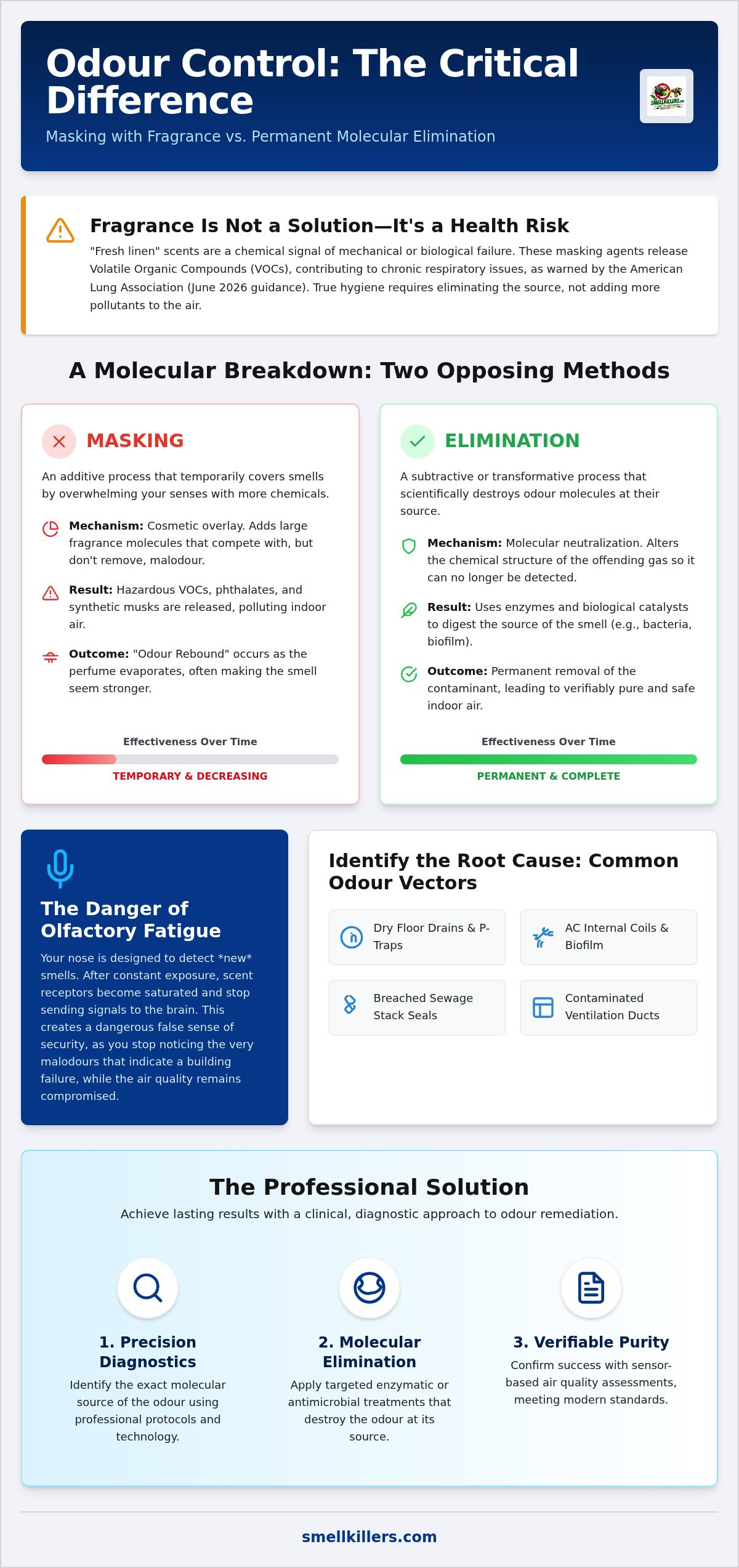
Odour is not a vague sensory perception. It is a physical presence of Volatile Organic Compounds (VOCs) or gases released by a specific source within a building’s infrastructure. Whether the origin is a biofilm in an AC drain tray or a breached seal in a sewage stack, these molecules are airborne contaminants. The technical distinction of masking vs eliminating odour is often misunderstood as a choice of preference; however, scientifically, it is a choice between concealment and correction. Masking is a cosmetic overlay that adds more chemicals to the air. Elimination is a targeted molecular intervention that removes the source entirely.
How the Human Nose Processes Odour
The biological mechanism behind The Science of Smell is highly sensitive to environmental changes. Scent receptors in the nasal cavity send immediate signals to the brain’s olfactory bulb, which prioritizes “new” or “threatening” smells for survival. When a maintenance team uses a fragrance spray, the brain initially registers the perfume. This leads to a state of “olfactory fatigue.” The receptors become saturated and stop sending signals about the fragrance, yet the underlying malodour molecules are still being inhaled. This creates a dangerous psychological trap. Property managers stop noticing the smell and assume the problem is gone, while the air quality remains compromised.
The Failure of Olfactory Interference
Most commercial air fresheners rely on olfactory interference. This process attempts to “block” the nose’s receptors by flooding them with heavy fragrance molecules. It does nothing to neutralize the actual source. Complex sewage gases or mold spores are often heavier and more persistent than the volatile oils used in perfumes. As the masking agent evaporates, the malodour “breaks through” the scent barrier. This phenomenon, known as odour rebound, is why smells seem to return even stronger after a room is sprayed. In high-heat or high-humidity environments, moisture acts as a carrier for VOCs, intensifying the underlying issue and rendering superficial scents completely ineffective. True hygiene requires the destruction of the molecule, not the temporary distraction of the senses. Understanding the necessity of masking vs eliminating odour ensures that property owners move beyond “clean smells” toward verifiable air purity.
Masking vs. Elimination: A Molecular Breakdown of Odour Control
The technical distinction between masking vs eliminating odour lies in the chemical interaction, or lack thereof, between the treatment and the contaminant. Masking is an additive process. It introduces large, volatile fragrance molecules into the air to overwhelm human scent receptors. These perfumes do not interact with the malodour molecules; they simply exist alongside them. Elimination is a subtractive or transformative process. It utilizes chemical bonding or biological digestion to physically destroy the offending substance at its source. For property managers, choosing a spray over a solution is the difference between hiding a symptom and curing a disease.
Many retail products marketed as air fresheners are technically indoor air pollutants. They don’t clean the air. Instead, they increase the total concentration of airborne chemicals. Research published via the National Institutes of Health has identified numerous hazardous chemicals in fragrances, including phthalates and synthetic musks that can trigger migraines and respiratory distress. True remediation requires the use of enzymes or antimicrobial agents. These biological catalysts digest the proteins and fats that feed odour-causing bacteria in drains and ventilation systems. Without physical source removal, chemical treatments are merely temporary delays.
Molecular Neutralization Explained
Professional-grade eliminators differ from retail deodorizers through reactive chemistry. Molecular neutralization is the chemical alteration of a gas into a non-volatile compound. While retail products often use “encapsulants” that trap smells in a temporary moisture bubble, professional treatments change the molecular structure of the gas itself. Once the molecule’s shape is altered, it can no longer bind to nasal receptors. If you are struggling with recurring smells, a professional property odour assessment can identify whether your facility requires this level of molecular intervention.
The Sustainability Factor
Relying on masking is both an environmental and financial liability. Aerosol propellants and synthetic musks linger in the building’s ecosystem and contribute to poor indoor air quality (IAQ) scores. Elimination is the only eco-friendly path. It resolves the issue once, preventing the need for the endless application of synthetic chemicals. This “one-and-done” approach is significantly more cost-efficient over a fiscal year. You stop paying for recurring masking services and start investing in a permanent state of air purity. Transitioning to elimination protocols ensures your maintenance budget is spent on results rather than temporary camouflage.
Myth-Busting: Why ‘Clean Smelling’ Doesn’t Mean ‘Clean Air’
A scent of lavender in a lobby does not indicate a sterile environment. It often signals a maintenance failure. The most pervasive myth in property management is the belief that if an odour is no longer detectable, the underlying gas or contaminant has been removed. This logic is flawed. Masking agents foster a dangerous sense of security by suppressing the olfactory warning signs of structural or mechanical decay. While you smell “lemon,” the air could still contain high concentrations of hazardous gases. The U.S. Environmental Protection Agency prioritizes source control for odor elimination as the most effective way to protect occupants, yet many facilities continue to rely on chemical camouflage.
Consider the “Lemon-Scented Mould” paradox often found in poorly maintained AC units. When internal coils develop a thick biofilm of mould and bacteria, they release microbial volatile organic compounds (mVOCs). Spraying a fragrance into the return air duct doesn’t kill the spores; it merely adds moisture and synthetic chemicals to the mix. This creates a “Sick Building Syndrome” environment where occupants suffer from headaches and fatigue without ever smelling the rot. The debate of masking vs eliminating odour is actually a debate about occupant safety. Masking hides the risk. Elimination removes it.
The Hidden Risks of Masking Sewage Smells
Ignoring a sewage smell by covering it with perfume is a significant liability. Sewer gas often contains hydrogen sulphide (H2S), which is toxic even at low levels, and methane, which is highly flammable. Masking these scents prevents the early detection of breached vent stacks or dried-out P-traps. A professional sewage odour elimination UAE protocol identifies these mechanical failures through technical diagnosis. This approach is far safer than retail solutions that leave the structural integrity of your plumbing systems in question while exposing residents to irritants.
VOCs and Indoor Air Quality
There is a technical irony in adding chemicals to “clean” the air. Plug-in diffusers and aerosol sprays contribute heavily to the total chemical load of a room. These products emit synthetic musks and phthalates that linger in carpets and upholstery. For children, pets, and individuals with pre-existing respiratory conditions, these masked environments are often more toxic than the original odour itself. Choosing elimination means you stop treating the air as a canvas for perfumes and start treating it as a vital resource that must be kept free of both malodours and synthetic VOCs.
Diagnostic Protocols: How to Identify the Root Cause of Building Odours
Effective remediation starts with a clinical investigation, not a cleaning bucket. Tracking a “scent trail” requires a methodical assessment of the building’s mechanical and plumbing vectors. Standard cleaning companies often fail because they address visible surfaces while ignoring the hidden internal infrastructure where bacteria thrive. To settle the debate of masking vs eliminating odour, one must first locate the origin. Without a precise diagnosis, any treatment is merely a guess. Professional on-site inspections utilize specialized technology to detect gases and microbial growth that the human eye cannot see. This diagnostic focus ensures that the transition from discomfort to resolution is based on scientific certainty rather than trial and error.
Most property managers treat smells as a janitorial issue. This is a mistake. Odours are symptoms of mechanical or environmental failures. A “dirty” smell in a hallway might actually be a pressure imbalance in the HVAC system pulling air from a sewage vent. Surface-level cleaning cannot reach these areas. By shifting the focus from “cleaning” to “clinical treatment,” you address the biological and chemical reality of the space. This investigative approach is the hallmark of professional building maintenance, prioritizing long-term air purity over the temporary relief of a scented spray. For a systematic walkthrough of how experts pinpoint the source of bad smell in building infrastructure, a technical diagnostic guide provides the precise inspection protocols used to locate hidden mechanical and biological failures.
AC and HVAC Odour Vectors
Air conditioning systems are primary vectors for recurring smells. Bacteria and thick biofilms frequently build up on cooling coils, where condensation provides a constant moisture source. Stagnant water in condensate trays creates a breeding ground for mould, which the fan then distributes throughout the property. This is a mechanical failure that requires technical intervention. For a detailed breakdown of these systems, consult our guide on aircon odour elimination to understand how deep-cleaning protocols differ from superficial sprays. Our German-style cleaning method focuses on these internal components to ensure total elimination.
Drain and Plumbing Infrastructure
Plumbing smells are rarely about “dirty” pipes. They are often the result of structural or pressure issues. In high-rise buildings, the “siphon effect” can pull water out of P-traps, allowing raw sewer gas to enter living spaces. Vent stack leaks or cracked sewage lines can also release inaudible gas leaks that bypass standard maintenance checks. Identifying these root causes is essential for long-term resolution. A comprehensive property odour assessment is the only reliable method to stop these smells from returning. If your facility suffers from persistent, mystery scents, schedule an on-site inspection today to receive a technical diagnosis and a permanent treatment plan.
Precision Remediation: The German-Style Approach to Permanent Odour Removal
Professional building maintenance requires a transition from janitorial “cleaning” to clinical “treatment.” German-style aircon cleaning is defined by its technical precision and depth. It does not rely on the superficial application of fragrances to hide symptoms. Instead, it utilizes specialized technology to reach the internal components where biological and chemical contaminants reside. This methodology settles the debate of masking vs eliminating odour by prioritizing the physical removal of the source. While standard services focus on what is visible, precision remediation addresses the microscopic reality of the building’s infrastructure.
SMELLKILLERS.COM prioritizes detection technology over chemical application. We don’t guess; we diagnose. Our technicians use sensor-based tools to map VOC concentrations and identify structural breaches. This investigative approach ensures that treatments are targeted and effective. Our 2026 protocol follows a strict, linear process to guarantee results:
- Inspection: A comprehensive survey of all potential vectors, including HVAC systems and plumbing lines.
- Diagnosis: Identifying the exact biological or mechanical origin of the malodour.
- Targeted Elimination: Utilizing clinical-grade protocols to destroy the source at a molecular level.
- Verification: Using sensors to confirm the air is free of contaminants before the site is cleared.
Clinical Cleaning Standards
Deep-coil treatment protocols are essential for eliminating biological sources like mould and bacteria that standard cleaning misses. These procedures reach into the fins of the cooling coils and the depths of the condensate lines. For sewage-related issues, we utilize non-invasive detection methods to find hidden leaks behind walls or under floors. This technical rigor is why a residential odour inspection UAE is considered the professional standard for property owners who demand permanent results over temporary fixes.
Your Path to a Permanent Solution
The 2026 protocol for UAE villas and apartments reflects a shift toward verifiable air quality. Property owners are increasingly rejecting the “fragrance loop” in favour of technical integrity. A one-time professional fix is significantly cheaper than a lifetime of sprays and recurring masking services. You stop managing the smell and start maintaining the asset. Don’t let a “clean smell” hide a structural risk. Take the first step toward a healthy, odour-free environment by booking a technical on-site inspection. We replace the mystery of recurring smells with scientific certainty and a permanent state of air purity.
Transition to Verifiable Air Purity
Stop treating air quality as a cosmetic preference. Persistent smells are physical signals of biological or mechanical failure within your building’s infrastructure. It’s dangerous to assume that a scented room is a clean one. Perfumes only saturate your receptors while leaving hazardous gases like hydrogen sulphide in place. True hygiene requires a clinical approach that destroys the source molecule. The fundamental choice between masking vs eliminating odour determines whether your facility is truly safe or merely scented.
Relying on temporary sprays creates a cycle of recurring costs and occupant health risks. Permanent resolution requires technical rigor. Our methodology utilizes specialized detection technology to locate hidden sewage leaks and AC biofilms that standard janitorial services miss. We replace superficial fixes with German-style precision cleaning and clinical root-cause remediation. Don’t settle for a mask when you can have a cure. Ensure your property meets the highest standards of safety and environmental responsibility.
Book Your Technical Odour Inspection Now
Your property deserves more than a temporary fragrance. Resolve the issue at its source and restore a healthy environment for your residents today.
Frequently Asked Questions
Why does my bathroom smell like sewage even after a deep clean?
Surface scrubbing fails because the source is likely internal to your plumbing infrastructure. Sewage odours usually indicate a mechanical failure, such as a dried-out P-trap, a breached vent stack, or a pressure imbalance in the drainage system. Deep cleaning only addresses visible surfaces, whereas raw sewer gas enters through these structural gaps. A technical inspection is required to identify the specific plumbing vector causing the leak.
Can air fresheners be harmful to my health if used daily?
Daily use of synthetic fragrances significantly increases the chemical load within your property. Most retail air fresheners release volatile organic compounds (VOCs) that can trigger migraines, skin allergies, and chronic respiratory distress. This highlights the health risks of masking vs eliminating odour. Instead of purifying the air, daily spraying adds hazardous chemicals like phthalates to your breathing zone, compromising long-term indoor air quality.
What is the difference between a standard AC cleaning and odour elimination?
Standard AC cleaning is a cosmetic service that focuses on filters and external panels. Clinical odour elimination is a technical intervention that targets the internal cooling coils and condensate trays. We utilize German-style precision cleaning to remove the deep-seated biofilm and microbial growth that standard methods miss. Elimination ensures the biological source is destroyed, whereas standard cleaning often leaves the root cause intact.
How long does professional odour elimination usually take?
The duration of a treatment depends on the complexity of the source identified during the diagnosis. Most professional remediation sessions are completed within 3 to 6 hours. This timeline includes the initial technical inspection, the targeted treatment of the vector, and a final verification phase. We prioritize efficiency to ensure your property returns to a state of resolution without prolonged downtime.
Is it possible to eliminate smells without using strong chemicals?
Yes, clinical-grade remediation often utilizes biological enzymes and antimicrobial agents rather than harsh synthetic chemicals. These enzymes digest the organic proteins and fats that feed odour-causing bacteria. This method is far more effective than masking because it physically removes the source of the smell. It provides a sustainable, eco-friendly solution that doesn’t leave behind toxic chemical residues or heavy perfumes.
Why does the bad smell in my AC only appear when I turn it on?
The smell appears because the fan pulls air directly across contaminated internal components. When the system is active, airflow picks up microbial volatile organic compounds from mouldy coils or stagnant water in the drain tray. This confirms the source is located within the unit’s infrastructure. Turning off the unit stops the distribution, but the biological source remains dormant and growing until it is clinically treated.
Will a property odour assessment find smells hidden inside walls or vents?
Technical assessments utilize specialized detection technology to track molecular trails behind building infrastructure. We identify gas leaks in sewage stacks and mould growth in wall cavities without resorting to invasive demolition. By mapping the concentration of specific gases, we can pinpoint the exact source of bad smell in building vents or structural voids, allowing for a targeted surgical fix.
How often should I have a professional odour inspection for my UAE villa?
Schedule a technical odour inspection annually as part of your preventative building maintenance. In the UAE’s high-humidity environment, AC systems and floor drains are prone to rapid biofilm buildup. If you detect a recurring musty or sewage scent that persists for more than 48 hours, book an inspection immediately. Early diagnosis prevents structural damage and protects your occupants from prolonged exposure to airborne contaminants.