

Article by
Jonathan Bonnett
Australian Air Conditioning Specialist with extensive hands-on experience in AC servicing, deep cleaning, maintenance, and troubleshooting. Focused on high-quality workmanship, reliability, and professional service to UAE standards.
That persistent, “rotten egg” odor in your villa isn’t a cleaning failure; it’s a structural breach. You’ve likely tried every heavy-duty detergent and scented diffuser available in the UAE, only for the stench to resurface within 48 hours. It’s exhausting to battle a problem that refuses to stay solved, especially when you fear the health impacts of hydrogen sulfide gas on your family.
Stop masking the symptoms and start diagnosing the source. Effective sewage smell removal requires a technical understanding of building physics rather than a mop and bucket. SMELLKILLERS.COM’s clinical 5-point diagnostic checklist identifies the exact mechanical origin of sewer gas, whether it’s a compromised P-trap or a faulty AC condensate connection. We replace guesswork with scientific certainty. This guide walks you through the precise steps to confirm the root cause, ensure compliance with relevant UAE building codes and health standards, and restore a neutral, safe environment to your home once and for all.
Key Takeaways
- Identify Hydrogen Sulfide (H2S) as the specific chemical source of “rotten egg” odors to understand the technical nature of the breach.
- Apply our 5-point clinical checklist for sewage smell removal Dubai to determine if the issue is a localized trap failure or a property-wide infrastructure problem.
- Discover why common DIY fixes like bleach only provide temporary masking and fail to address the underlying mechanical cause.
- Examine the critical link between AC condensate lines and sewer gas infiltration, a common technical oversight in UAE properties.
- Recognize the 48-hour threshold for persistent odors that signals the need for a professional on-site inspection and scientific source detection.
What is Sewer Gas and Why is it Inside Your House?
Sewer gas is a complex byproduct of decaying organic waste. It isn’t a single substance but a mixture of toxic and non-toxic gases including methane, carbon dioxide, and nitrogen. The most recognizable component is Hydrogen Sulfide (H2S). This is the chemical responsible for that distinct “rotten egg” odor that permeates many UAE villas and apartments. When this gas enters your home, it indicates that the specialized barriers designed to keep waste air out have failed.
When property owners seek sewage smell removal Dubai, they often mistake the odor for a surface cleanliness issue. Scrubbing floor tiles or pouring bleach down a drain won’t stop the gas. The odor is an airborne symptom of a mechanical failure within your plumbing or ventilation infrastructure. If you smell it, the gas has already bypassed your building’s physical barriers. Surface cleaning addresses bacteria on the tile, but it does nothing to stop the pressurized gas escaping from deep within the pipes.
The Chemistry of Sewage Odours
Methane and hydrogen sulfide act as the primary gases within residential drainage systems. These compounds form when anaerobic bacteria break down organic matter in stagnant water or dry pipes. While a “musty” smell often indicates a simple biofilm buildup on a drain cover, a “sharp” and pungent odor signifies a direct breach where sewer gas is escaping the main line. This distinction is critical for accurate diagnosis. Biofilm requires cleaning; gas escape requires a technical intervention.
Health and Safety Implications
Exposure to these gases is more than a nuisance; it’s a physiological risk. Prolonged inhalation can lead to specific symptoms:
- Persistent headaches and migraines.
- Nausea or sudden dizziness.
- Eye and throat irritation.
- Olfactory fatigue, where you eventually stop smelling the gas despite its presence.
Relying on air fresheners or scented candles is a dangerous strategy. Masking the scent hides the warning signs of a failing system. A persistent odor confirms that your plumbing seal, usually maintained by water in a P-trap, has been compromised. This allows untreated air from the municipal sewer to enter your living space. Scientific source detection is the only way to ensure long-term safety. For effective sewage smell removal Dubai, you must look beyond the scent and address the mechanical breach in the plumbing seal.
The 5-Point Sewage Smell Inside House Checklist
Effective sewage smell removal Dubai requires a systematic audit of your property’s infrastructure. Odors don’t appear without a mechanical or environmental cause. To resolve the issue permanently, you must transition from superficial cleaning to technical diagnosis. Use this clinical 5-point checklist to isolate the failure point in your plumbing or ventilation system.
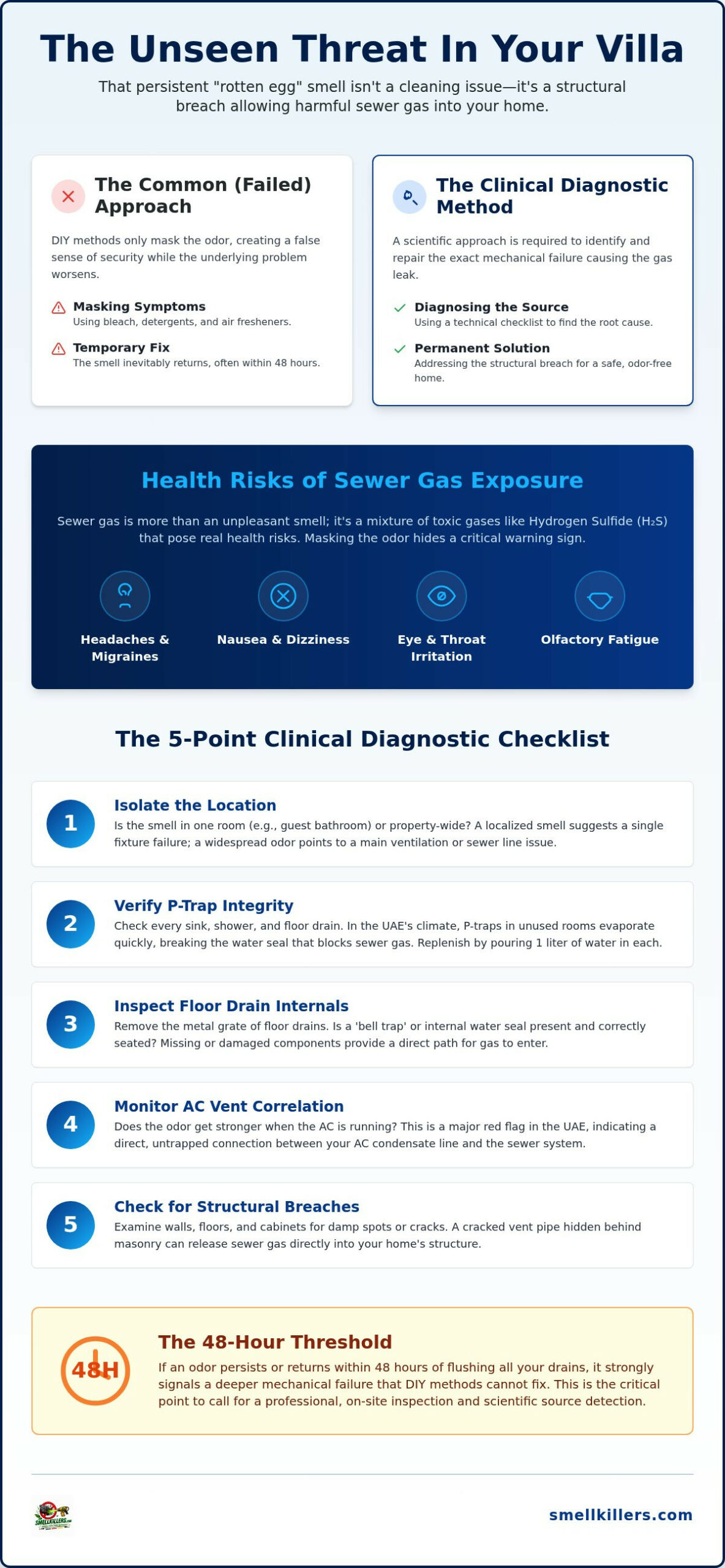
- Isolate the Location: Determine if the scent is localized to a single guest bathroom or if it’s property-wide. Localized smells suggest a specific fixture failure; property-wide odors indicate a main vent stack or sewer line issue.
- Verify P-Trap Integrity: Check every sink, shower, and floor drain. In the UAE’s arid climate, water seals in unused guest rooms evaporate rapidly, breaking the barrier against sewer gas.
- Inspect Floor Drain Internals: Remove the metal grate and verify the presence of a ‘bell trap’ or water seal. If these components are missing or improperly seated, gas flows freely into the room.
- Monitor AC Vent Correlation: Observe if the odor intensifies when the cooling system activates. This often points to a direct connection between the AC condensate line and the sewage system.
- Check for Structural Breaches: Examine walls and cabinets for damp spots. A cracked vent pipe hidden behind masonry can release gas directly into wall cavities.
Point 1-3: The Drainage System Audit
Start by restoring the physical barriers. Pour at least one liter of water into every drain, including floor traps and balcony outlets. This replenishes the P-trap seal. While doing this, listen for “gurgling” sounds coming from other drains. This noise suggests a venting issue where air pressure is pulling water out of your traps. Understanding the Health risks linked to sewer gas exposure is the first step in prioritizing these mechanical repairs. If the smell remains after flushing all traps, the internal mechanical seal of the floor drain may be damaged or incorrectly installed.
Point 4-5: Ventilation and Structural Breaches
In many Dubai villas, AC units create a “negative pressure” effect. When the air handler runs, it pulls air from the easiest available source. If the AC condensate line is connected to the sewer without a functional trap, the unit effectively sucks sewer gas into your ductwork. This distributes the odor throughout the entire property. High-rise buildings face unique challenges with “vent stack” pressure, where wind or blockages cause gas to bypass seals in lower-floor apartments. Check for dampness near vertical pipe runs, as even a hairline crack in a PVC stack can cause persistent odors. If these basic checks don’t reveal the source, a professional On-site Inspection is necessary to perform a scientific diagnostic sweep of the infrastructure.
Why Common DIY Methods Fail to Eliminate Odours
Stop treating a mechanical failure with liquid solutions. Most homeowners in the UAE respond to foul smells by pouring liters of bleach down their drains. This is the “Bleach Myth.” Bleach is a 24-hour placebo. It kills surface-level bacteria and provides a temporary chemical scent that masks the underlying issue. If the root cause is an evaporated P-trap or a cracked vent pipe, the gas will return as soon as the bleach odor dissipates. No amount of detergent can fix a structural breach in your plumbing infrastructure.
Most sewage odors originate in the “dry” sections of your drainage pipes. Gas rises; liquids fall. When you pour cleaners down a sink, the chemical only contacts the bottom half of the horizontal pipe. The anaerobic bacteria and pressurized gases residing in the upper half of the pipe and the vertical vent stacks remain untouched. For effective sewage smell removal Dubai, you must address the building’s physics rather than its surface cleanliness. Understanding the root cause of drain smell is essential before any remediation can succeed. Relying on superficial fixes often delays the necessary technical diagnosis.
The Problem with Chemical Drain Cleaners
Caustic drain cleaners are designed to dissolve organic blockages, not to neutralize airborne gases. These harsh chemicals can damage older PVC pipes and gaskets without ever reaching the source of the smell. This is why biofilm won’t go away after cleaning if the underlying plumbing logic is flawed. If your system has a faulty Air Admittance Valve (AAV) or a compromised seal, the gas will continue to bypass your efforts. Repeated chemical use is also an environmental burden that provides zero long-term resolution for gas infiltration.
Masking vs. Technical Remediation
Fragrance overload is a common symptom of “sick building syndrome.” Property owners often layer scented candles, diffusers, and air fresheners to hide the stench. This creates a dangerous environment where you experience “olfactory fatigue.” You eventually stop smelling the masking agent, but the dangers of hydrogen sulfide remain present in your indoor air. Toxic gases do not require a scent to be harmful.
Contrast these superficial attempts with odour expert UAE protocols. A professional intervention focuses on source detection and mechanical rectification. A “clean” home should be characterized by the total absence of any scent, not the presence of a heavy perfume. If you are currently using fragrances to survive your living room, you aren’t solving a problem; you’re hiding a hazard. Permanent sewage smell removal Dubai requires identifying the specific mechanical failure point and restoring the building’s airtight integrity.
AC Systems and Sewage Gas: The UAE Connection
In the UAE, your air conditioning system isn’t a closed loop. It’s often physically connected to your plumbing through condensate drain lines. These lines carry moisture away from the cooling coils and deposit it directly into the sewage system. This connection creates a direct bridge between your living room air and the municipal sewer. For effective sewage smell removal Dubai, you must treat your HVAC and plumbing as a single, integrated ecosystem. If you ignore the mechanical link between these two systems, the odor will return regardless of how often you clean your drains.
When the system is designed correctly, a P-trap prevents gas from traveling back up the line. However, the high ambient temperatures in Dubai cause these small water seals to evaporate rapidly. Once the seal is gone, the air handler’s suction pulls hydrogen sulfide directly into the ductwork. This is a common root cause of odors that seem to “come from the vents” rather than the floor. Professional aircon odour elimination requires identifying these compromised seals and restoring the mechanical barrier between your air and the waste lines.
The Condensate Line Trap
The small U-bend located in your AC closet or ceiling void is a frequent failure point. Because these traps are small, they hold very little water. During periods of low AC use or extreme heat, the water evaporates in days. This allows sewer gas to bypass the barrier. We recommend a monthly maintenance routine where you pour 500ml of water into the AC primary drain pan or the trap itself. This simple action maintains the hydraulic seal and prevents gas infiltration. If the trap is missing entirely, which happens in some older developments, a technical retrofit is the only permanent solution.
Cross-Contamination in Ventilation
High-rise buildings in Dubai often suffer from the “Venturi effect.” This occurs when wind passing over the roof vent stack creates pressure changes that pull gas into the apartments below. In a 40-story tower, these pressure differentials are significant. Additionally, powerful bathroom exhaust fans create negative pressure inside the home. If your drains aren’t perfectly sealed, the fan will literally suck sewer gas out of the pipes and into the room. This mechanical suction is often stronger than the gravity seal of a shallow trap.
You should also check for “crossover” at the roof level. Sometimes, fresh air intakes for the building are located too close to the sewer vent stacks. This causes the building’s own ventilation system to distribute sewer odors to every floor. If your odors persist despite fixing plumbing traps, the issue is likely a ventilation infrastructure failure. To resolve this, book a specialized A/C Odour Detection and Treatment to verify the integrity of your air distribution system and stop the cycle of contamination.
When to Call a Specialist for Sewage Odour Elimination
DIY interventions have a clear expiration date. If the foul scent persists for more than 48 hours after you’ve replenished every P-trap with water, the failure is structural. Intermittent smells are a specific red flag. These “phantom” odours often correlate with external pressure changes in the municipal sewer line or the building’s main vent stack. When the wind shifts or a neighbor flushes a high-volume fixture, gas is forced past your weakened seals. If the odour is accompanied by physical symptoms like headaches, nausea, or eye irritation, the concentration of hydrogen sulfide has reached a level that requires immediate technical intervention. Effective sewage smell removal Dubai depends on recognizing when a problem has surpassed the capabilities of a mop or a plunger.
A standard plumbing visit is often a wasted expense for gas infiltration. Plumbers are trained to find liquid leaks and clear physical blockages. They rarely possess the diagnostic tools to track invisible gas movement behind masonry or inside HVAC ducts. A specialized property odour assessment is fundamentally different. It’s a forensic investigation of your home’s air quality and infrastructure integrity. This process identifies the exact mechanical breach, whether it’s a cracked vent pipe, a faulty AAV, or a compromised AC condensate connection.
The SMELLKILLERS.COM Diagnostic Advantage
We operate with a German-style diagnostic protocol that prioritizes methodical accuracy over superficial speed. Our approach is clinical and tool-based. We don’t rely on “sniff tests.” We use specialized equipment to map gas concentrations and identify infrastructure failures. Our on-site inspections are strictly non-invasive. We don’t need to demolish walls or remove tiles to find the source of the problem. By pinpointing the root cause with scientific certainty, we ensure that you stop paying for recurring, temporary fixes. We provide a clear roadmap for permanent remediation, replacing mystery with technical data.
Booking Your Professional Inspection
The transition from constant frustration to a neutral, safe environment begins with a professional audit. For larger villas, penthouses, or corporate offices, the complexity of the plumbing and ventilation stacks increases. A commercial property smell inspection is designed to handle these multi-level systems. We audit the entire vertical infrastructure to ensure that a failure on one floor isn’t contaminating the floors above or below.
Don’t allow a structural breach to compromise your family’s health or your property’s value. Masking agents and fragrance diffusers only delay the inevitable. Professional sewage smell removal Dubai requires an investigator who looks beneath the surface. Secure your property’s air quality by identifying the origin of the infiltration. Stop the smell at the source today.
Restore Your Home’s Technical Integrity
Persistent odors are evidence of a structural breach within your property’s plumbing or ventilation network. You’ve learned that surface cleaning and chemical masking fail because they don’t address the evaporated seals or pressurized gas leaks hidden behind your walls. Resolving these issues requires a transition from guesswork to scientific source detection. By auditing your P-traps and AC condensate lines, you can identify the most common failure points unique to the UAE climate.
Operated by PANKOBAU Building Maintenance LLC, we utilize specialized German-style diagnostic protocols to isolate these infrastructure failures. We provide expert source detection for both residential and commercial properties, ensuring that you don’t have to keep paying for temporary fixes. If your checklist results are inconclusive, it’s time to Book a Professional On-Site Odour Inspection. Our methodical approach to sewage smell removal Dubai replaces uncertainty with clinical accuracy. You can reclaim a neutral, safe indoor environment today.
Frequently Asked Questions
Why does my house smell like sewage even after I clean the drains?
Cleaning only removes surface bacteria, not the pressurized gas escaping from a compromised mechanical seal. The odor is an airborne symptom of a breach in your building’s plumbing or ventilation infrastructure. Scrubbing tiles or using bleach cannot reach the “dry” part of the pipes where sewer gas resides. If the smell remains after cleaning, the gas is likely bypassing a dry P-trap or a cracked vent pipe.
Is breathing in sewage smell dangerous for my family?
Yes, prolonged exposure to sewer gas can cause headaches, nausea, and respiratory irritation. The primary concern is Hydrogen Sulfide (H2S), which is toxic even at low concentrations. Chronic inhalation can lead to olfactory fatigue. This is a dangerous state where your brain stops detecting the scent even though the toxic gas is still present in your indoor air.
Can a dirty AC unit cause a sewage smell inside the house?
A dirty AC unit usually produces a musty or “sock” smell, but a sharp sewage odor indicates a condensate line failure. If the AC drain line is connected directly to the sewer without a functional water trap, the air handler sucks gas into your ductwork. This technical oversight is common in many Dubai developments where HVAC and plumbing systems intersect improperly.
How do I fix a dry P-trap to stop sewer gas?
Pouring approximately one liter of water into the drain will restore the hydraulic seal immediately. This is the most effective first step for sewage smell removal Dubai. In the UAE’s high-heat environment, water in unused drains evaporates rapidly. You should repeat this process every two weeks for guest bathrooms, laundry floor drains, and balcony outlets to maintain the barrier.
Why is the sewage smell only coming from one bathroom?
Localized odors usually indicate a failure specific to that room’s fixtures, such as an evaporated floor trap or a compromised toilet seal. If the smell is isolated, check the least-used drain in that specific room first. Property-wide odors, by contrast, typically signal a main vent stack blockage or a significant pressure imbalance in the building’s central drainage core.
What is a professional property odour assessment?
A professional property odour assessment is a technical forensic investigation that uses specialized tools to track gas movement. Unlike a general plumbing visit, it maps the building’s infrastructure to find the exact mechanical origin of a leak. The process is non-invasive and identifies failures in plumbing, ventilation, and AC systems to ensure a permanent resolution rather than a temporary fix.
How long does it take to eliminate a sewage smell permanently?
Most technical odors are diagnosed during a single on-site inspection. Once the root cause is identified, permanent elimination often occurs immediately after the mechanical breach is sealed or the hydraulic seal is restored. Complex structural issues, such as cracked vent stacks located behind masonry, may require specific mechanical repairs following the initial diagnostic phase.
Will a plumber or an odour specialist fix the problem better?
An odour specialist is better equipped to handle gas infiltration and air quality issues. While plumbers focus on liquid leaks and clearing physical blockages, specialists use clinical diagnostic protocols for sewage smell removal Dubai to track airborne contaminants. Specialists understand the complex intersection of HVAC and plumbing, which is where most persistent UAE odors originate.