
Article by
Jonathan Bonnett
Australian Air Conditioning Specialist with extensive hands-on experience in AC servicing, deep cleaning, maintenance, and troubleshooting. Focused on high-quality workmanship, reliability, and professional service to UAE standards.
If your AC smells like sewage, you aren’t dealing with a simple cleaning issue; you’re witnessing a mechanical failure in your property’s pressure barriers. It’s a nauseating experience that standard maintenance companies often fail to resolve. You’ve likely tried superficial sprays and basic duct cleaning only to have the stench return within hours. The fear of breathing in toxic sewer gases is a valid concern for any resident in the UAE. This guide provides the technical clarity you need to move beyond temporary masking and superficial fixes.
We’ll show you how to identify the exact origin of the odour and implement a permanent resolution. We will examine the diagnostic steps required to isolate the source, explain the critical plumbing-ventilation connection, and provide the methodology to verify your indoor air is finally safe. Stop guessing and start diagnosing with a clinical approach to air quality. This 2026 guide replaces mystery with scientific certainty, ensuring your home environment is restored to a neutral, healthy state through precise technical intervention.
Key Takeaways
- Shift your perspective from cleaning to diagnostics; sewage odours signify a failed pressure barrier between your property’s plumbing and ventilation systems.
- Identify the mechanical culprits, such as dry P-traps and obstructed vent stacks, that allow hazardous hydrogen sulfide gas to infiltrate your indoor air.
- Understand why your AC smells like sewage despite regular maintenance, focusing on how sewer gases fuel secondary bacterial biofilm growth within the cooling unit.
- Execute precise diagnostic protocols to isolate the odour source, verifying floor drain integrity and water seal status across all connected infrastructure.
- Transition to permanent resolution using the SMELLKILLERS.COM methodology, combining technical on-site detection with clinical German-style aircon cleaning for total decontamination.
Understanding the “AC Smells Like Sewage” Phenomenon
When an AC smells like sewage, it indicates a specific breach in your property’s pressure containment. This scent is chemically distinct from the vinegary tang of acetic acid or the damp earthiness of common mold. A sewage odour is sharp, sulphurous, and resembles rotten eggs. It’s a technical symptom of gas infiltration rather than a simple hygiene issue. Understanding the origin requires looking beyond the filters and into the intersection of your ventilation and plumbing systems.
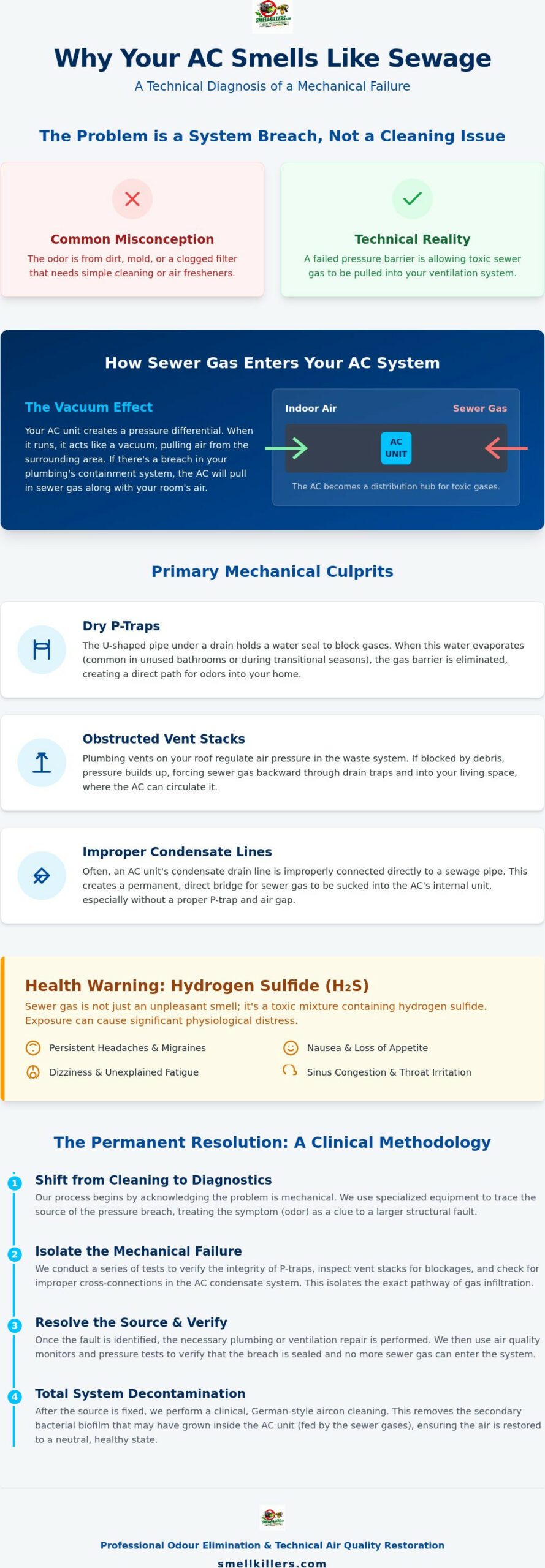
Your air conditioning system operates by creating a pressure differential. When the blower motor engages, the internal unit acts as a localized vacuum. If a compromise exists in the plumbing vent stacks or a drain trap has lost its water seal, the system pulls Sewer gas directly into the supply ducts. Instead of recirculating filtered air, the unit becomes a distribution hub for toxic bypass. This vacuum effect explains why the smell often intensifies the moment the cooling cycle begins.
The Difference Between Biological Growth and Sewage Infiltration
Distinguishing between “Dirty Sock Syndrome” and sewage infiltration is the first step in a professional diagnosis. Biological growth on evaporator coils produces a stale, musty odour caused by bacterial metabolic byproducts. In contrast, a sewage smell is chemically aggressive due to the presence of Hydrogen Sulfide (H2S). While standard coil cleaners might temporarily reduce biological odours, they have no effect on H2S. Masking agents and fragrance sprays are equally ineffective. They cannot neutralize the molecular structure of sewer gases; they only create a nauseating “perfumed sewage” scent that fails to address the root cause.
Immediate Symptoms and Property Impact
Exposure to these gases is not merely an olfactory nuisance. High concentrations of sewer gas in confined spaces lead to measurable physiological distress for UAE residents. You might notice symptoms that disappear when you leave the property but return shortly after the AC starts running.
- Persistent frontal headaches or migraines.
- Nausea and sudden loss of appetite.
- Sinus congestion and chronic throat irritation.
- Dizziness or unexplained fatigue during peak AC operation hours.
Hydrogen Sulfide is a toxic byproduct of organic decomposition in plumbing. Beyond the physical impact, the psychological toll on residents is significant. Living in an environment where the AC smells like sewage creates a sense of environmental insecurity. It transforms a place of rest into a source of anxiety, leading many to believe their home is fundamentally unsanitary. Resolving this requires a clinical approach that prioritizes source detection over superficial cleaning.
Technical Pathways: How Sewer Gas Infiltrates Ventilation Systems
Sewer gas infiltration isn’t a random occurrence. It’s a mechanical failure of the barriers designed to separate your living space from the municipal waste infrastructure. When your AC smells like sewage, the system is actively transporting volatile organic compounds from your pipes into your lungs. This happens through several specific technical pathways that standard cleaning services often overlook.
- Failed P-traps: These U-shaped pipes hold water to block gases. If the water evaporates or siphons out, the barrier vanishes.
- Obstructed Vent Stacks: Roof vents regulate plumbing pressure. If blocked, sewer gases are forced backward through your drains and into the AC intake.
- Cross-Connected Condensate Lines: In many UAE properties, AC drain lines are plumbed directly into sewage pipes without a proper air gap, creating a direct bridge for odours.
- Negative Building Pressure: Powerful exhaust fans in kitchens or bathrooms can create a vacuum, sucking gases through wall cavities and electrical conduits into the HVAC return.
Engineering flaws in the condensate system are particularly problematic. If the AC drain line connects to a soil pipe before the trap, the blower motor pulls air directly from the sewer. This isn’t a cleanliness issue; it’s a structural defect. Identifying these specific mechanical breaches requires a technical on-site inspection rather than a simple filter change.
Dry P-Traps and the Evaporation Problem
Transitional seasons in the UAE are peak times for these odours. During months when you use the AC less frequently, the water in floor drains and P-traps evaporates rapidly. Without this hydraulic seal, there’s nothing to stop Hydrogen Sulfide from entering the home. Simply pouring a cup of water down the drain is a common recommendation, but it’s often a temporary fix. If the trap dries out repeatedly, it indicates a venting imbalance or a slow leak in the plumbing infrastructure that requires professional diagnosis.
The “Venturi Effect” in High-Rise Buildings
In high-rise residential towers, wind speeds and the “stack effect” create significant pressure changes within the plumbing columns. When wind blows across the top of a vent stack, it can create a Venturi effect, pulling air out of the pipes. Conversely, high pressure can push gases through shared drainage lines. If your AC smells like sewage only during certain weather conditions or when neighbours use their plumbing, you’re likely dealing with a pressure-driven infiltration through shared infrastructure. These cases require precise source detection to isolate which structural interface has failed.
Beyond Surface Cleaning: Why Traditional HVAC Maintenance Fails
Standard HVAC maintenance is engineered to manage dust, debris, and mechanical wear. It is not an investigative tool for building infrastructure failures. When an AC smells like sewage, a routine filter replacement or a basic chemical coil wash will inevitably fail. Expert HVAC specialists like E.R.S. Heating & Cooling recognize that these methods address only the visible surface of the equipment while ignoring the environmental chemistry occurring within the system. Most general maintenance companies in the UAE provide a superficial service that lacks the diagnostic depth required for gas infiltration.
Hydrogen Sulfide (H2S) does more than just emit a foul odour. It serves as a primary nutrient source for sulfur-oxidizing bacteria. This leads to accelerated biofilm accumulation on the evaporator coils and within the condensate pan. Even if the initial gas leak is resolved, the established biological colony remains, continuing to emit secondary odours. You need a clinical decontamination of the entire air path, not a localized rinse of the filters. Standard cleaning treats the symptom, not the gas entry point.
Avoid service providers that rely on heavy fragrances or “perfumed” sanitizers. Fragrance-heavy cleaning is a significant diagnostic red flag. It indicates that the company lacks the technical expertise to locate the “Zero Point” of the odour. Masking a sewage smell with industrial perfumes is a temporary deception. It leaves the underlying gas infiltration active while adding synthetic chemicals to your breathing zone. True resolution requires removing the gas and the biological residue it leaves behind.
The Science of Porous Material Contamination
Modern AC units and ductwork often contain porous materials like internal insulation, foam gaskets, and fiberglass liners. These components act as chemical sponges. Once they are saturated with sewer gas compounds, they re-emit the odour even when the cooling system is inactive. Standard maintenance protocols don’t account for this “re-emission” effect. Identifying these contaminated zones is a critical part of a Property Odour Assessment. Without identifying which materials have been compromised, the smell will persist regardless of how many times the coils are sprayed. Properties dealing with concurrent biological growth alongside gas infiltration may also benefit from understanding AC mold smell removal UAE protocols, as sewer gas nutrients frequently accelerate microbial colonisation within the same porous components.
Source vs. Symptom: The Diagnostic Gap
General HVAC technicians focus on the machine’s internal mechanics. They look for refrigerant leaks, motor failures, or electrical faults. They are rarely trained to understand the hydraulic pressure dynamics of a building’s plumbing system or the integrity of floor drain seals. Consequently, they miss the specific odour vectors where the plumbing and ventilation systems intersect. SMELLKILLERS.COM closes this gap by prioritizing “Source Detection” as the mandatory first phase of treatment. We look beneath the surface to find the mechanical breach, ensuring the resolution is permanent rather than seasonal.
Diagnostic Protocols for Persistent Building Odours
Identifying why an AC smells like sewage requires a systematic approach that separates mechanical equipment failure from building infrastructure defects. Most property owners waste resources on repeated cleaning without first establishing a diagnostic baseline. Follow these sequential steps to isolate the root cause before committing to a treatment plan.
- Step 1: Isolate the Blower Activity. Determine if the odour is constant or intermittent. If the smell only appears when the blower motor engages, the AC is actively pulling gas from a breach. If the smell is persistent even when the system is off, the source is likely an open drain or a failed seal in the immediate vicinity.
- Step 2: Verify Water Seal Integrity. Inspect every floor drain and P-trap in the property. In the UAE climate, water seals in guest bathrooms or laundry rooms evaporate quickly. A dry trap is a direct gateway for sewer gas.
- Step 3: Locate the Condensate Termination. Trace the AC drain line to its final exit point. If it terminates directly into a sewage stack without a proper air gap or “tundish,” it creates a siphon effect that draws gases into the cooling unit.
- Step 4: Correlation with External Variables. Monitor the odour during high winds or heavy humidity. Pressure changes in the building’s main vent stack can force gases through weak points that otherwise remain dormant.
- Step 5: Execute Technical Gas Tracking. Utilize specialized equipment to detect Hydrogen Sulfide at the molecular level. This removes the subjectivity of human scent and provides a data-driven map of the infiltration path.
The Homeowner’s Preliminary Checklist
Before requesting professional intervention, perform a basic audit of your property’s plumbing interfaces. Start by pouring at least two litres of water into every floor drain, including those tucked under vanity units or in balcony corners. Check for “dry” smells in rooms that aren’t used daily. Another critical test involves your ventilation dynamics. Turn on all kitchen and bathroom exhaust fans simultaneously. If the sewage smell intensifies, your property is under heavy negative pressure, sucking gases out of the plumbing and into the AC return air path. If you are also noticing a smell coming from AC vent outlets specifically, this targeted diagnostic guide can help you map the exact infiltration pathway through your ductwork.
When to Call a Specialist
DIY diagnostics have clear limitations when dealing with complex building-wide issues. If you have filled all P-traps and the AC smells like sewage within 24 hours, the problem is likely an internal structural breach or a blocked roof vent stack. Odours that are strongest specifically at the return air vent indicate that the system is pulling gas from a wall cavity or a concealed plumbing chase. These scenarios require a professional on-site inspection from SMELLKILLERS.COM to prevent further exposure to toxic compounds. Precision tracking is the only way to ensure the resolution is permanent and the air is safe for habitation.
Professional Odour Elimination: The SMELLKILLERS Methodology
Resolving a situation where your AC smells like sewage requires more than a standard service checklist. It demands a forensic approach to building science. SMELLKILLERS.COM utilizes a clinical methodology that moves beyond the surface to eliminate the “Zero Point” of infiltration. We treat the property as a closed system where every plumbing and ventilation interface is a potential variable. Our process is designed specifically for property owners who’ve already exhausted traditional cleaning options without success.
Our on-site odour detection utilizes technical expertise to track gas movement through wall cavities, conduits, and ductwork. We don’t guess. We identify the exact mechanical failure that allows sewer gas to bypass your property’s hydraulic seals. Once the entry point is secured, we transition to decontamination. This ensures that the residual chemical markers of Hydrogen Sulfide are fully neutralized, preventing the “ghost smells” that often linger in porous materials after the initial leak is fixed.
The German-Style Cleaning Standard
German-style aircon cleaning is a rigorous, clinical protocol that differs fundamentally from standard UAE maintenance. We focus on the total removal of biological biofilms that thrive on sewer gas nutrients. These biofilms are often embedded deep within the evaporator fins and condensate channels. Our methodology uses eco-friendly, sustainable agents that break down organic matter without introducing harsh synthetic fragrances. This technical deep clean is essential to restore indoor air quality to a neutral, healthy state after a contamination event. It’s a high-tech solution that prioritizes long-term environmental responsibility over temporary masking. Properties where biological colonies have taken hold alongside gas infiltration require the same rigorous approach applied in AC mold smell removal UAE remediation, as the underlying microbial science and decontamination standards are directly comparable.
Property Odour Assessment and Resolution
A permanent resolution is only possible when every vector is addressed. Our Property Odour Assessment covers the entire infrastructure, from roof vent stacks to basement floor drains. We provide a methodical transition from a state of environmental discomfort to scientific certainty. By explaining the “how” and “why” of our interventions, we offer transparency that general contractors cannot match. The goal is a property that isn’t just “freshened” but technically verified as safe. Book your on-site odour inspection with SMELLKILLERS.COM to eliminate the root cause permanently.
The SMELLKILLERS.COM guarantee is built on diagnostic accuracy. We solve the problem by addressing the mechanical and biological root causes simultaneously. If your AC smells like sewage, stop relying on temporary masking agents that only delay the inevitable return of the stench. Choose a specialist who prioritizes source detection and clinical decontamination. Our German-style approach ensures that your indoor environment remains free of toxic gases and persistent odours long after the service is complete.
Restoring Technical Integrity to Your Indoor Air
Persistent odours are more than a nuisance; they are diagnostic indicators of structural failures in your property’s plumbing and ventilation interface. If your AC smells like sewage, the resolution requires moving beyond superficial sprays and standard filter changes. You must isolate the mechanical breach, restore the hydraulic seals in your P-traps, and eliminate the biological biofilms that thrive on hydrogen sulfide gas. Technical accuracy is the only path to a permanent fix in the UAE’s demanding climate.
SMELLKILLERS, operated by PANKOBAU Building Maintenance LLC, provides the specialized technical odour detection needed to find the exact origin of infiltration. By applying professional German-style aircon cleaning standards, we ensure every internal component is decontaminated and the air path is clinically restored. We replace the frustration of mystery smells with documented results and source identification. Don’t settle for temporary masking when scientific certainty and long-term resolution are available.
Eliminate your AC sewage smell permanently with SMELLKILLERS. Your home deserves a neutral, healthy environment where you can breathe with absolute confidence.
Frequently Asked Questions
Is it safe to breathe in sewer smells coming from my AC?
No, breathing in these odours is not safe for residents. The smell indicates the presence of Hydrogen Sulfide (H2S) and other volatile organic compounds found in sewer gas. Exposure often leads to physiological symptoms such as persistent headaches, nausea, dizziness, and respiratory irritation. Long-term exposure to these gases in a confined indoor environment poses significant health risks and requires immediate technical intervention.
Why does my AC smell like sewage only when it is turned on?
This occurs because the AC blower motor creates a localized vacuum effect within your property. When the system engages, it generates negative pressure that pulls air from any available opening. If there is a breach in your plumbing vents or a dry drain, the AC actively sucks sewer gas into the return air duct and distributes it throughout the rooms. It’s a mechanical transport issue rather than a simple cleanliness problem.
Can a dry P-trap cause my entire house to smell like a drain?
Yes, a single dry P-trap is sufficient to compromise the air quality of an entire property. The U-bend in your pipes is designed to hold a water seal that blocks gases from the municipal sewage system. In the UAE’s arid climate, water in unused guest bathrooms or laundry rooms evaporates quickly. Once this hydraulic seal vanishes, sewer gas has an unobstructed path into your living space, often resulting in an AC smells like sewage scenario. For those seeking expert assistance with these types of plumbing failures, Alberto Pro Plumbing offers the professional diagnostic and repair services needed to secure your property’s air quality.
What is the “Dirty Sock Syndrome” and how does it differ from sewage smells?
Dirty Sock Syndrome refers to the stale, musty odour caused by bacterial and fungal growth on the evaporator coils. It typically smells like damp gym clothes or old socks. In contrast, a sewage smell is chemically sharp and resembles rotten eggs or sulphur. While Dirty Sock Syndrome is a biological hygiene issue, a sewage smell is a diagnostic symptom of a failed pressure barrier between your plumbing and ventilation infrastructure.
Will standard AC duct cleaning get rid of sewage odours?
Standard duct cleaning is ineffective against sewage odours because it doesn’t address the source of the gas. While it might remove some surface dust, it cannot repair a failed P-trap, a blocked vent stack, or a cross-connected drain line. If the mechanical breach isn’t sealed, the smell will return within hours of the cleaning. You need a specialized approach that combines source detection with clinical decontamination of the affected components.
How much does a professional odour detection inspection cost in the UAE?
The cost of a professional inspection depends on several variables, including the property type, the number of AC units, and the complexity of the building’s plumbing layout. Apartment inspections differ in scope from large villa assessments. Because each case involves specific technical tracking and gas detection equipment, residents should request a tailored quote based on their property’s specific requirements and the severity of the odour issue.
Can a blocked vent stack on the roof cause smells inside my apartment?
Yes, a blocked vent stack is a common cause of internal odours in UAE high-rise buildings. These stacks regulate the pressure within the plumbing system. If they are obstructed by debris or structural issues, sewer gases have nowhere to go but back through your internal drains. This pressure imbalance can force gas through even functional P-traps, allowing the AC system to pull the stench into the ventilation ducts.
Why do fragrance sprays make the sewage smell worse?
Fragrance sprays don’t neutralize the molecular structure of Hydrogen Sulfide; they only attempt to overpower it. The result is a nauseating mixture of synthetic perfumes and toxic sewer gas. This “masking” approach is a diagnostic red flag because it ignores the underlying gas infiltration. Using heavy scents can actually increase respiratory irritation for residents while leaving the toxic root cause active and untreated.